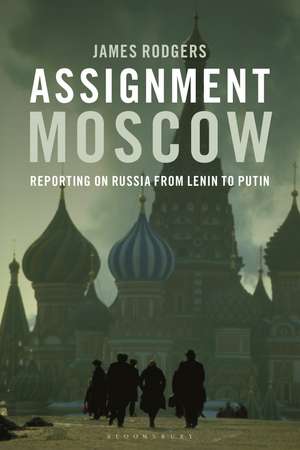
Assignment Moscow: Reporting on Russia from Lenin to Putin
Autor James Rodgersen Limba Engleză Paperback – 18 mai 2023
In Assignment Moscow, former foreign correspondent James Rodgers analyses the news coverage of Russia throughout history, from the coverage of the siege of the Winter Palace and a plot to kill Stalin, to the Chernobyl explosion and the Salisbury poison scandal.
| Toate formatele și edițiile | Preț | Express |
|---|---|---|
| Paperback (1) | 85.76 lei 22-36 zile | +78.34 lei 5-11 zile |
| Bloomsbury Publishing – 18 mai 2023 | 85.76 lei 22-36 zile | +78.34 lei 5-11 zile |
| Hardback (1) | 362.28 lei 22-36 zile | +32.49 lei 5-11 zile |
| Bloomsbury Publishing – 22 iul 2020 | 362.28 lei 22-36 zile | +32.49 lei 5-11 zile |
Preț: 85.76 lei
Preț vechi: 144.50 lei
-41%
Puncte Express: 129
Preț estimativ în valută:
15.18€ • 17.68$ • 13.19£
15.18€ • 17.68$ • 13.19£
Carte disponibilă
Livrare economică 02-16 februarie
Livrare express 16-22 ianuarie pentru 88.33 lei
Preluare comenzi: 021 569.72.76
Specificații
ISBN-13: 9781350356108
ISBN-10: 1350356107
Pagini: 280
Dimensiuni: 156 x 232 x 24 mm
Greutate: 0.44 kg
Editura: Bloomsbury Publishing
Colecția Bloomsbury Academic
Locul publicării:London, United Kingdom
ISBN-10: 1350356107
Pagini: 280
Dimensiuni: 156 x 232 x 24 mm
Greutate: 0.44 kg
Editura: Bloomsbury Publishing
Colecția Bloomsbury Academic
Locul publicării:London, United Kingdom
V-ar putea interesa
-
 Reporting ConflictJames RodgersPreț: 200.49 lei
 -
 -34%Preț: 524.99 lei791.50 lei
 -
 -17%Preț: 277.40 lei335.52 lei
 -
 Headlines from the Holy LandJames RodgersPreț: 241.76 lei
 -
 Preț: 187.79 lei
 -
 No Road HomeJames RodgersPreț: 139.79 lei
 -
 -34%Preț: 794.43 lei1203.92 lei
 -
 The Armenian Genocide: A Complete HistoryRaymond Kévorkian-32%Preț: 609.53 lei898.41 lei
 -
 Preț: 277.77 lei
 -
 Preț: 270.75 lei
 -
 Nazi Chic: Fashioning Women in the Third ReichProfessor Irene Guenther-21%Preț: 273.49 lei347.95 lei
 -
 Preț: 237.43 lei
 -
 -23%Preț: 237.06 lei307.09 lei
 -
 They Were Called Records, KidsJames RodgersPreț: 107.78 lei
 -
 Sisi und ihre GeschwisterErika BestenreinerPreț: 97.08 lei
Cuprins
Acknowledgements
List of illustrations
Foreword by Martin Sixsmith
Introduction
1.Sympathies in the Struggle: Reporting Russia in Revolution, 1917
2.'The press is lying, or does not know': Russia goes to war with itself
3.From 'A Wild And Barbarous Country' via Starvation to Stalinism
4.Believe Everything But The Facts
5.But What A Story Everything Tells Here: The Great Patriotic War
6.Secrets, Censorship, and Cocktails with the Central Committee
7.A Window On The Country: Reporting Reform and Ruin
8.'Free for all': the Yeltsin era
9.Becoming Strong Again?
10.Russia: My History
Bibliography
Index
List of illustrations
Foreword by Martin Sixsmith
Introduction
1.Sympathies in the Struggle: Reporting Russia in Revolution, 1917
2.'The press is lying, or does not know': Russia goes to war with itself
3.From 'A Wild And Barbarous Country' via Starvation to Stalinism
4.Believe Everything But The Facts
5.But What A Story Everything Tells Here: The Great Patriotic War
6.Secrets, Censorship, and Cocktails with the Central Committee
7.A Window On The Country: Reporting Reform and Ruin
8.'Free for all': the Yeltsin era
9.Becoming Strong Again?
10.Russia: My History
Bibliography
Index
Recenzii
Assignment Moscow exposes how the Moscow correspondent has had to adapt to multiple manifestations of censorship, or compete with state-run media, the severity of which has ebbed and flowed with changes in regime.
Rodgers's narrative rests on an enormous number of articles in Anglo-American media, books by and about journalists, and his own interviews with many Moscow correspondents.
Rodgers retains his focus on the correspondent's interactions with Russia and Russians, rather than being sidetracked into discussions of normative values or political controversy. This approach prepares the reader for the conclusion, which celebrates the openness and curiosity of the best Russia correspondents, reminding the reader that what they have just read is a history not of Russia but of how Western correspondents have told Russia's stories. Differentiating the two is an important and hitherto neglected task but one that James Rodgers has achieved masterfully.
Reporting from Russia has never been easy; Rodgers vividly captures the changing fortunes of Moscow correspondents over the past hundred years, as they penetrated the mysteries of life in Russia and brought them to our newspapers and screens. Some were duped, some were fellow-travellers or spies; most battled against censors and blank-faced politicians; all have helped to shape our understanding of the world's biggest country.
Writing about journalism in Russia since the revolution, James Rodgers rightly emphasises that to understand Russia you have to talk to people of all kinds. But he argues that even correspondents who knew the language and the history found it hard to report dispassionately because of official obstruction and their own emotional involvement.
A highly original, engrossing and accessible book, Assignment Moscow stands out among journalistic accounts of Russia for its subtlety, humility and historic scope. It tells the story of British and American journalists who aimed to throw light on Russia from Lenin to Putin, and in the process illuminated the West itself.
It is hard to believe that in the torrent of books published on Russia each year, that one could come along as original and valuable as Assignment Moscow. One comes to appreciate the service of our reporting men and women in Moscow. For all their fallibilities, without their dedication, we wouldn't have half the understanding of Russia that we have today, imperfect as it will always be. We therefore owe them - and especially Rodgers as journalist, teacher, analyst and cataloguer - a huge debt.
[Rodgers'] experience has been wisely distilled in this fair-minded, balanced and perceptive exploration of the problems reporters have faced in trying to report from Russia.
Reveals how journalists' experiences reporting from Russia for the past 100 years mirrors its changing attitude to the West.
Rodgers's narrative rests on an enormous number of articles in Anglo-American media, books by and about journalists, and his own interviews with many Moscow correspondents.
Rodgers retains his focus on the correspondent's interactions with Russia and Russians, rather than being sidetracked into discussions of normative values or political controversy. This approach prepares the reader for the conclusion, which celebrates the openness and curiosity of the best Russia correspondents, reminding the reader that what they have just read is a history not of Russia but of how Western correspondents have told Russia's stories. Differentiating the two is an important and hitherto neglected task but one that James Rodgers has achieved masterfully.
Reporting from Russia has never been easy; Rodgers vividly captures the changing fortunes of Moscow correspondents over the past hundred years, as they penetrated the mysteries of life in Russia and brought them to our newspapers and screens. Some were duped, some were fellow-travellers or spies; most battled against censors and blank-faced politicians; all have helped to shape our understanding of the world's biggest country.
Writing about journalism in Russia since the revolution, James Rodgers rightly emphasises that to understand Russia you have to talk to people of all kinds. But he argues that even correspondents who knew the language and the history found it hard to report dispassionately because of official obstruction and their own emotional involvement.
A highly original, engrossing and accessible book, Assignment Moscow stands out among journalistic accounts of Russia for its subtlety, humility and historic scope. It tells the story of British and American journalists who aimed to throw light on Russia from Lenin to Putin, and in the process illuminated the West itself.
It is hard to believe that in the torrent of books published on Russia each year, that one could come along as original and valuable as Assignment Moscow. One comes to appreciate the service of our reporting men and women in Moscow. For all their fallibilities, without their dedication, we wouldn't have half the understanding of Russia that we have today, imperfect as it will always be. We therefore owe them - and especially Rodgers as journalist, teacher, analyst and cataloguer - a huge debt.
[Rodgers'] experience has been wisely distilled in this fair-minded, balanced and perceptive exploration of the problems reporters have faced in trying to report from Russia.
Reveals how journalists' experiences reporting from Russia for the past 100 years mirrors its changing attitude to the West.
Caracteristici
Experienced BBC journalist who has also published three books reporting various international conflicts
Notă biografică
James Rodgers was a Foreign Correspondent in Moscow, Brussels and Gaza, working for BBC and Reuters. Since 2012, James has taught Journalism at City, University of London, where he lectures in the History of Journalism, and the Reporting of Armed Conflict.