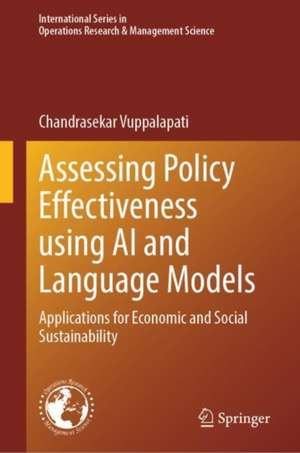
Assessing Policy Effectiveness using AI and Language Models
Autor Chandrasekar Vuppalapatien Limba Engleză Hardback – 31 mai 2024
Preț: 995.23 lei
Preț vechi: 1213.70 lei
-18%
Puncte Express: 1493
Carte tipărită la comandă
Livrare economică 09-23 decembrie
Livrare prin curier în România Termenul estimat este afișat lângă disponibilitate.
Transport gratuit pentru acest produs Plată online sau ramburs, în funcție de opțiunile comenzii.
Retur gratuit în 14 zile Comandă securizată și suport în română.
Specificații
ISBN-13: 9783031560965
ISBN-10: 3031560965
Pagini: 492
Ilustrații: XXI, 467 p. 245 illus.
Dimensiuni: 160 x 241 x 32 mm
Greutate: 0.85 kg
Ediția:2024
Editura: Springer
Locul publicării:Cham, Switzerland
ISBN-10: 3031560965
Pagini: 492
Ilustrații: XXI, 467 p. 245 illus.
Dimensiuni: 160 x 241 x 32 mm
Greutate: 0.85 kg
Ediția:2024
Editura: Springer
Locul publicării:Cham, Switzerland
Cuprins
Chapter 1: Introduction.- Chapter 2 : Natural Language Models.- Chapter 3: Large Language Models.- Chapter 4 : Macroeconomic Indicators, Aggregates, and Framework.- Chapter 5 : Economic Sustainability.- Chapter 6 : Social Sustainability.- Chapter 7: Conclusion.
Notă biografică
Chandrasekar Vuppalapati is a seasoned Software IT Executive with diverse experience in software technologies, enterprise software architectures, cloud computing, big data business analytics, internet of things (IoT), and software product and program management. He has held engineering and product leadership positions at Microsoft, GE Healthcare, Cisco Systems, St. Jude Medical, and Lucent Technologies. Chandrasekar has an MS in software engineering from San Jose State University (USA) and an MBA from Santa Clara
University (USA) and currently teaches software engineering, large-scale analytics, data science, mobile computing, cloud technologies, and web and data mining at San Jose State
University (USA).
University (USA) and currently teaches software engineering, large-scale analytics, data science, mobile computing, cloud technologies, and web and data mining at San Jose State
University (USA).
Textul de pe ultima copertă
This volume uses advanced machine learning techniques to analyze government communication to evaluate policy effectiveness. The book develops policy effectiveness foundation models by cohorting historical budget policies with statistical models which are built on well reputed data sources including economic events, macroeconomic trends, and ratings and commerce terms from international institutions. By signal mining policies to the economic outcome patterns, the book aims to create a rich source of successful policy insights in terms of their effectiveness in bringing development to the poor and underserved communities to ensure the spread of wealth, social wellbeing, and standard of living to the common denomination of society rather than a selected quotient. Enabling academics and practitioners across disciplines to develop applications for effective policy interventions, this volume will be of interest to a wide audience including software engineers, data scientists, social scientists, economists, and agriculture practitioners.
Caracteristici
Develops machine learning linkage models that offer policy recommendations Enables cross-disciplinary cooperation for developing applications to serve marginalized Uses machine learning techniques to analyze government speeches to evaluate policy effectiveness