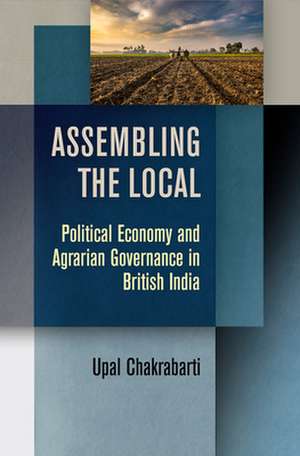
Assembling the Local
Autor Upal Chakrabartien Limba Engleză Hardback – 22 ian 2021
Through analyses of these three interrelated moments in British imperial history, Upal Chakrabarti's Assembling the Local engages with articulations of the local on multiple theoretical and empirical fronts, weaving them into a complex reflection on the problem of difference and a critical commentary on connections between political economy, agrarian property, and governance. Chakrabarti argues that the local should be reconceptualized as an abstract machine, central to the construction of the universal, namely, the establishment of political economy as a form of governance in nineteenth-century British India.
Preț: 542.40 lei
Preț vechi: 609.45 lei
-11%
Puncte Express: 814
Carte tipărită la comandă
Livrare economică 02-16 decembrie
Livrare prin curier în România Termenul estimat este afișat lângă disponibilitate.
Transport gratuit pentru acest produs Plată online sau ramburs, în funcție de opțiunile comenzii.
Retur gratuit în 14 zile Comandă securizată și suport în română.
Specificații
ISBN-13: 9780812252736
ISBN-10: 081225273X
Pagini: 288
Dimensiuni: 155 x 234 x 20 mm
Greutate: 0.48 kg
Editura: University of Pennsylvania Press
ISBN-10: 081225273X
Pagini: 288
Dimensiuni: 155 x 234 x 20 mm
Greutate: 0.48 kg
Editura: University of Pennsylvania Press
Cuprins
Introduction. Universality as Difference
Chapter 1. Science, Method, and Indigeneity: Political Economy
Chapter 2. The Trace of the Local: Rent
Chapter 3. Temporal Geographies of Power: Property
Chapter 4. Grounding Governance: Village
Chapter 5. Disputes in the Locality: Peasants
Conclusion. Rewriting Production
Notes
Bibliography
Index
Acknowledgments
Chapter 1. Science, Method, and Indigeneity: Political Economy
Chapter 2. The Trace of the Local: Rent
Chapter 3. Temporal Geographies of Power: Property
Chapter 4. Grounding Governance: Village
Chapter 5. Disputes in the Locality: Peasants
Conclusion. Rewriting Production
Notes
Bibliography
Index
Acknowledgments
Descriere
In Assembling the Local, Upal Chakrabarti argues that the "local" should be reconceptualized as an abstract machine, which was itself central to the construction of the universal, namely, the establishment of political economy as a form of governance in nineteenth-century British India.