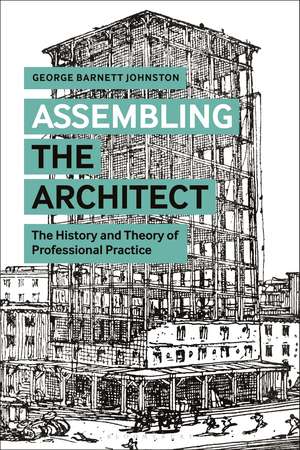
Assembling the Architect: The History and Theory of Professional Practice
Autor George Barnett Johnstonen Limba Engleză Paperback – 23 ian 2020
Focusing on the period 1870 to 1920 when the foundations were being laid for the U.S. architectural profession that we recognize today, this study traces the formation and standardization of the fundamental relationships among architects, owners, and builders, as codified in the American Institute of Architects' very first Handbook of Architectural Practice. It reveals how these archetypal roles have always been fluid, each successfully redefining their own agency with respect to the others in the constantly-shifting political economy of building.
Far from being a purely historical study, the book also sheds light on today's digitally-enabled profession. Contemporary architectural tools and disciplinary ideals continue to be shaped by the same fundamental tensions, and emergent modes of practice such as BIM (Building Information Modelling) and IPD (Integrated Project Delivery) represent the realization of programs and agendas that have been over a century in play.
Essential reading for professional practice courses as a contextual and historical companion to the Handbook, Assembling the Architect provides a critical perspective of the profession that is fundamental to understanding current architectural practice.
Preț: 207.49 lei
Preț vechi: 271.93 lei
-24%
Puncte Express: 311
Carte disponibilă
Livrare economică 31 octombrie-14 noiembrie
Livrare express 17-23 octombrie pentru 108.89 lei
Livrare prin curier în România Termenul estimat este afișat lângă disponibilitate.
Transport gratuit de la 400.00 lei Plată online sau ramburs, în funcție de opțiunile comenzii.
Retur gratuit în 14 zile Comandă securizată și suport în română.
Specificații
ISBN-13: 9781350126862
ISBN-10: 1350126861
Pagini: 320
Ilustrații: 74 bw illus
Dimensiuni: 166 x 234 x 16 mm
Greutate: 0.7 kg
Editura: Bloomsbury Publishing
Colecția Bloomsbury Visual Arts
Locul publicării:London, United Kingdom
ISBN-10: 1350126861
Pagini: 320
Ilustrații: 74 bw illus
Dimensiuni: 166 x 234 x 16 mm
Greutate: 0.7 kg
Editura: Bloomsbury Publishing
Colecția Bloomsbury Visual Arts
Locul publicării:London, United Kingdom
V-ar putea interesa
-
 Poetry, Property, and Place, 01Nina RappaportPreț: 209.12 lei
 -
 THE LIVING ELEMENTS OF HEALTHY BUILDING DESIGNJanus Welton Aia Bbei ArchitectPreț: 300.28 lei
 -
 Barrier-Free DesignJames Holmes-Seidle-51%Preț: 381.95 lei785.85 lei
 -
 Briefing Your ArchitectFrank Salisbury-42%Preț: 314.20 lei541.64 lei
 -
 Adult Coloring Books Mandala Vol.1Lori S. GonzalezPreț: 54.71 lei
 -
 Adult Coloring Books Mandala Vol.2Lori S. GonzalezPreț: 54.49 lei
 -
 Adult Coloring Books Mandala Vol.3Lori S. GonzalezPreț: 54.71 lei
 -
 Structural Systems - Second EditionMehdi Setareh-19%Preț: 478.14 lei590.30 lei
 -
 Informing DesignJoan I. Dickinson-26%Preț: 537.58 lei726.86 lei
 -
 Dirk Denison 10 HousesDirk DenisonPreț: 321.13 lei
 -
 Architect & DeveloperPetty Aia, JamesPreț: 108.66 lei
 -
 Built, Unbuilt and Imagined SydneyChatterjee, Dr AnuradhaPreț: 316.17 lei
Cuprins
List of Figures
Preface
Introduction
1. Seeing Double: Histories of Architectural of Practice
1. Owners and Builders, Their Umpires and Agents
a. Fifty Years Ago
b. The Uniform Contract
2. Mr. Day's Handbook
3. The Wisdom of Tom Thumtack
4. Another Kind of Architects' Handbook
2. The Architect's Office
1. Pictures at an Exhibition
2. Rockwell Kent
3. Squires & Wynkoop
4. Ewing & Chappell
5. The Architects' Building
3. Architect and Owner
1. A Collection of Practices
2. Various Forms of Architectural Service
3. The Selection of an Architect
a. By Direct Selection
b. By Competition
4. Fees, Contracts, and Consultants
a. "Fees - A Reductio Ad Absurdum"
b. Agreement Between Owner and Architect
c. Employment of Engineers and Other Consulting Specialists
5. The Architect-Owner Relationship
a. The Architect's Status
b. The Owner's Duties
4. Architects and Builders
1. Card Games and Boxing Matches
2. General Contractors
3. Architect as Owner's Agent
4. Builders Organize
a. William Sayward
b. A "Critical Analysis"
c. Arbitration versus Arbitrariness
5. A New Standard of Care
5. Tools, Technology, Practice
a. Drawings and Specs
b. Supervision and Superintendence
c. Shop Drawings
d. Change Orders
e. The Quantity System
2. New Tools of Practice
a. BIM and IPD
b. Architectural Practice, Artificial Intelligence
3. A Conversion
Bibliography
Index
Preface
Introduction
1. Seeing Double: Histories of Architectural of Practice
1. Owners and Builders, Their Umpires and Agents
a. Fifty Years Ago
b. The Uniform Contract
2. Mr. Day's Handbook
3. The Wisdom of Tom Thumtack
4. Another Kind of Architects' Handbook
2. The Architect's Office
1. Pictures at an Exhibition
2. Rockwell Kent
3. Squires & Wynkoop
4. Ewing & Chappell
5. The Architects' Building
3. Architect and Owner
1. A Collection of Practices
2. Various Forms of Architectural Service
3. The Selection of an Architect
a. By Direct Selection
b. By Competition
4. Fees, Contracts, and Consultants
a. "Fees - A Reductio Ad Absurdum"
b. Agreement Between Owner and Architect
c. Employment of Engineers and Other Consulting Specialists
5. The Architect-Owner Relationship
a. The Architect's Status
b. The Owner's Duties
4. Architects and Builders
1. Card Games and Boxing Matches
2. General Contractors
3. Architect as Owner's Agent
4. Builders Organize
a. William Sayward
b. A "Critical Analysis"
c. Arbitration versus Arbitrariness
5. A New Standard of Care
5. Tools, Technology, Practice
a. Drawings and Specs
b. Supervision and Superintendence
c. Shop Drawings
d. Change Orders
e. The Quantity System
2. New Tools of Practice
a. BIM and IPD
b. Architectural Practice, Artificial Intelligence
3. A Conversion
Bibliography
Index
Recenzii
Johnston's study of architectural practice stands apart from other histories of the profession because it emphasizes the
business of architecture as a determinant of the profession ... The strength of Johnston's study is in how it frames
architectural practice as a series of relationships that support and challenge one another.
Through a scholarly yet imaginative weaving of architectural practice's history inn the United States at a critical junction in time, Assembling the Architect sets original grounds for a broader theory of the profession, where socio-technical reflection becomes a true compass for informed action.
For all those who wish the profession of architecture was highly valued by and broadly accessible to a wide range of publics, Johnston reminds us that these goals are not new and have been poorly served by the well-meaning attempts to protect the integrity of the profession in the past. By tracing the evolution of the instruments of services, model law and ethical debates of the past, we see how architects have protected increasingly limited zones of influence. Seeking more equitable, integrated and data-enabled future practices, we would do well to heed the lessons of the past.
Johnston's detailed and colourful vignettes are a rigorous work of reconstruction ... The ease with which the text glides from one protagonist to another provides a rewarding reading experience ... His book provides a portal into the world of American architects a century ago.
business of architecture as a determinant of the profession ... The strength of Johnston's study is in how it frames
architectural practice as a series of relationships that support and challenge one another.
Through a scholarly yet imaginative weaving of architectural practice's history inn the United States at a critical junction in time, Assembling the Architect sets original grounds for a broader theory of the profession, where socio-technical reflection becomes a true compass for informed action.
For all those who wish the profession of architecture was highly valued by and broadly accessible to a wide range of publics, Johnston reminds us that these goals are not new and have been poorly served by the well-meaning attempts to protect the integrity of the profession in the past. By tracing the evolution of the instruments of services, model law and ethical debates of the past, we see how architects have protected increasingly limited zones of influence. Seeking more equitable, integrated and data-enabled future practices, we would do well to heed the lessons of the past.
Johnston's detailed and colourful vignettes are a rigorous work of reconstruction ... The ease with which the text glides from one protagonist to another provides a rewarding reading experience ... His book provides a portal into the world of American architects a century ago.