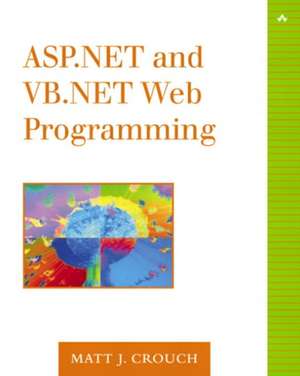
ASP.Net and VB.NET Web Programming: Addison-Wesley Microsoft Technology
Autor Matt J. Crouchen Limba Engleză Paperback – 30 apr 2002
Notăm cu interes structura progresivă a acestui volum tehnic, care facilitează tranziția către dezvoltarea web modernă prin parcurgerea etapizată a conceptelor, de la arhitectură la implementare. ASP.Net and VB.NET Web Programming debutează cu o analiză a modelului client-server și a limitărilor tehnologiilor anterioare, precum CGI, stabilind contextul necesar pentru înțelegerea avantajelor platformei .NET. Reținem că autorul, Matt J. Crouch, propune un parcurs de învățare care nu omite fundamentul limbajului; astfel, capitolul al doilea funcționează ca un curs intensiv de VB.NET, esențial pentru programatorii care migrează de la VB6 sau pentru cei aflați la început de drum.
Descoperim aici o explorare detaliată a modelului de programare ASP.NET. Analiza se extinde de la anatomia paginilor web și utilizarea controalelor de server, până la integrarea complexă cu librăria de clase a framework-ului .NET. Pe linia practică a lucrării Beginning ASP.Net in VB .Net de Matthew Macdonald, dar cu un focus specific pe serviciile de sistem și componentele gestionate (managed components), această carte din seria Addison-Wesley Microsoft Technology oferă instrumentele necesare pentru construirea unor aplicații web robuste.
Evoluția conținutului este logică: după stăpânirea interfeței și a logicii de business, cititorul este introdus în gestiunea datelor prin ADO.NET și în arhitectura serviciilor web. Un aspect tehnic important este capitolul dedicat securizării aplicațiilor, o componentă critică în mediul enterprise. Documentația este susținută de exemple de cod sursă care permit verificarea imediată a conceptelor teoretice în medii de testare.
Preț: 268.63 lei
Preț vechi: 335.79 lei
-20%
Carte în stoc
Livrare din stoc 16 octombrie
Specificații
ISBN-10: 0201734400
Pagini: 768
Dimensiuni: 190 x 234 x 42 mm
Greutate: 1.27 kg
Ediția:1
Editura: Addison-Wesley Professional
Seria Addison-Wesley Microsoft Technology
Locul publicării:Boston, United States
V-ar putea interesa
-
 VBScript in a NutshellPaul Lomax-20%Preț: 257.05 lei321.31 lei
 -
 Pro C# 2010 and the .Net 4 PlatformAndrew Troelsen-20%Preț: 545.30 lei681.63 lei
 -
 Pro C# 5.0 and the .Net 4.5 FrameworkAndrew Troelsen-20%Preț: 498.16 lei622.70 lei
 -
 Pro ASP.NET 4.5 in CAdam Freeman-20%Preț: 382.48 lei478.11 lei
 -
 -20%Preț: 226.43 lei283.04 lei
 -
 Pro ASP.NET Core 3Adam Freeman-20%Preț: 287.65 lei359.55 lei
 -
 -20%Preț: 302.24 lei377.80 lei
 -
 Moving to ASP.NETSteve Harris-20%Preț: 274.06 lei342.57 lei
 -
 Building Client/Server Applications with VB .NetJeff Levinson-20%Preț: 289.29 lei361.60 lei
 -
 Beginning Visual Web Programming in VB .NetChris Hart-20%Preț: 221.93 lei277.42 lei
 -
 Beginning ASP.Net 3.5 in C# 2008Matthew Macdonald-20%Preț: 284.91 lei356.14 lei
 -
 ASP.NET Core in ActionAndrew Lock-20%Preț: 316.93 lei396.16 lei
 -
 -27%Preț: 354.00 lei484.43 lei
 -
 -27%Preț: 352.39 lei483.24 lei
 -
 -28%Preț: 358.85 lei496.13 lei
 -
 Murachs ASP.NET 4.5 Web Programming with C# 2012Mary Delamater-29%Preț: 368.08 lei515.10 lei
 -
 Murachs ASP.NET 4.5 Web Programming with VB 2012Mary Delamater-27%Preț: 385.00 lei528.30 lei
 -
 .NET 10 RevealedKajetan Duszy¿ski-20%Preț: 240.60 lei300.75 lei
 -
 Mastering ASP.NET Core 10Mabrouk Mahdhi-20%Preț: 250.42 lei313.02 lei
 -
 Pro Microservices in .NET 10Sean Whitesell-20%Preț: 395.70 lei494.63 lei
De ce să citești această carte
Recomandăm acest ghid dezvoltatorilor care doresc să stăpânească ecosistemul Microsoft pentru web. Cititorul câștigă o înțelegere clară a modului în care ASP.NET interacționează cu VB.NET pentru a crea soluții scalabile. Este un instrument de lucru util în special pentru cei care au nevoie de o trecere rapidă la .NET, oferind atât baza teoretică a protocoalelor, cât și soluții aplicate pentru acces la baze de date și servicii web.
Despre autor
Matt J. Crouch este un specialist cu experiență vastă în tehnologii Microsoft, ocupând poziția de Senior Technologist la RealMed Corporation. Anterior, a activat ca dezvoltator software pentru Centillion Data Systems, unde s-a specializat în aplicații web și soluții de comerț electronic utilizând ASP și COM. Expertiza sa tehnică este reflectată în capacitatea de a sintetiza arhitecturi complexe în pași de implementare accesibili. Este, de asemenea, autorul volumului Web Programming with ASP and COM, publicat tot de Addison-Wesley Professional.
Cuprins
Preface.
1. The .NET Platform and the Web.
The Pathway to Web Applications.The Web Client/Server Model.Web Clients and Web Servers.Protocols for Web Client/Server Communication.Server-Side Processing with CGI Programs.Disadvantages of Using CGI.Components of ASP.NET and the .NET Framework.Overview of Internet Information Server.ISAPI Extensions.ISAPI Filters.Overview of ASP.NET.Web Forms.The .NET Common Language Runtime and Class Library.Managed Components in .NET.Web Services.Language Independence in the .NET Framework.COM+ Component Services and .NET.Direction and Plans for .NET.What's Ahead.
2. The VB.NET Crash Course.
What Is VB.NET?Hello World (Yet Again).Lab 2-1: Your First VB Application.Variables, Constants, and Operators.Variable Types.Declaring and Assigning Variables.Scope and Lifetime of Variables.Arrays.Converting Data Types.Using Constants.Arithmetic and Comparison Operators.Modularizing Your Code—Functions and Subroutines.Using Functions.Using Subroutines.Controlling Program Flow.Conditional Processing.Flow Control Statements.Loops.Handling Errors and Exceptions.Unstructured Error Handling.Structured Exception Handling.Object-Oriented Programming.Class Basics.Class Properties.Constructors and Destructors.Inheritance.Overridden Functions.Overloading.Polymorphism Overview.Interfaces.Implementing Polymorphism by Using Interfaces.Multithreaded Programming.Thread Synchronization.Events and Thread Synchronization.Summary.What's Ahead.
3. Working with ASP.NET.
The Features of ASP.NET.The Anatomy of ASP.NET Pages.The Code Structure of ASP.NET.Execution Stages and State Management.The Events Model for the Page Class.Introducing Web Forms.VS.NET Web Applications and Other IDE Basics.Separating Content and Code—the Code-Behind Feature.Application Configuration.Structure and Configuration of the Global.asax File.Using HTML Controls.The HTMLForm Control.The HTMLAnchor Control.The HTMLButton Control.The HTMLGenericControl Control.The HTMLImage Control.The HTMLInputButton Control.The HTMLInputCheckBox Control.The HTMLInputFile Control.The HTMLInputHidden Control.The HTMLInputImage Control.The HTMLInputRadioButton Control.The HTMLInputText Control.The HTMLSelect Control.The HTMLTable, HTMLTableCell, and HTMLTableRow Controls.The HTMLTextArea Control.Using Web Controls.Shared Web Control Properties.Web Controls for Displaying and Formatting Data.The Label Control.The Panel Control.The Table, TableRow, and TableCell Controls.Web Controls for Creating Buttons.The Button Control.The ImageButton Control.The LinkButton Control.Demonstration of Web Button Controls.Web Control for Inputting Text.The TextBox Control.Web Controls for Selecting Choices.The CheckBox Control.The RadioButton Control.The CheckBoxList and RadioButtonList Controls.Web Controls for Creating Lists.The ListBox Control.The DropDownList Control.Miscellaneous Basic Controls.The Hyperlink Control.The Image Control.Creating a Simple ASP.NET Application.Lab 3-1: Your First ASP.NET Project.ASP.NET Page Directives.The @ Page and @ Control Directives.The @ Import Directive.The @ Register Directive.The @ Assembly Directive.The @ OutputCache Directive.ASP.NET Rich Controls.The Calendar Control.The AdRotator Control.Validation Controls.The BaseValidator Control.The RequiredFieldValidator Control.The CompareValidator Control.The RangeValidator Control.The RegularExpressionValidator Control.The CustomValidator Control.Data List Controls.The Repeater Control.The DataGrid Control.The DataList Control.Building the XYZ Corporation Home Page.Lab 3-2: The XYZ Corporation Home Page.User Controls.Authoring a User Control.Saving State with the StateBag Object.ASP.NET Intrinsic Objects.The HttpRequest Object.The HttpResponse Object.The HttpServerUtility Object.The HttpApplicationState Object.The HttpSessionState Object.The ObjectContext Object.Summary.What's Ahead.
4. Using the .NET Framework Class Library.
Common Features of the .NET Framework Class Library.Using Data Collections (System.Collections).The ArrayList Class.The Stack Class.The Queue Class.The Hashtable Class.Handling File Input/Output and Directories (System.IO).Reading Text Files.Writing Text Files.Using Binary File I/O with the FileStream Object.Reading Binary Files.Writing Binary Files.Performing File Operations.Getting File Information.Copying, Moving, and Renaming Files.Deleting Files.Creating, Moving, and Renaming Directories.Creating and Getting Directory Information.Accessing Directory Contents.Watching the File System for Changes (System.IO.FileSystemWatcher).Using the Windows Event Log (System.Diagnostics).Working with Active Directory Services (System.DirectoryServices).Displaying Active Directory Services Contents.Searching Active Directory Services Contents.Modifying Active Directory Services Contents.Using Message Queues (System.Messaging).Creating a Queue.Sending a Message to a Queue.Dequeuing a Message.Communicating with Servers on the Internet (System.Web and System.Net).A Simple TCP Client Application.A Simple TCP Server Application.HTTP Communication.Manipulating XML Data (System.XML).Creating Tree-Based XML Documents.Loading and Searching Tree-Based XML Documents.Reading Stream-Based XML Data.Writing Stream-Based XML Data.Formatting XML Data for Display.Sending Internet E-mail (System.Web.Mail).Summary.What's Ahead.
5. Building .NET Managed Components for COM+.
The Concept of Managed Code Execution.The Common Language Runtime.The Common Type System.Just-in-Time Code Compilation.Code Assemblies.Application Domains.COM+ Component Services.Overview of COM.Overview of Transactions.Automatic Transactions.COM+ Applications.COM+ Security..NET Classes and COM+ Component Services.Using VB.NET to Develop Managed Components.Defining Namespaces.Using the Class Library.Using Component “ing”.Adding Initialization Code.Creating Methods.Creating Properties.Using the Class Library in an Application.Serviced Components.Building VB.NET Serviced Components.Lab 5-1: An Ordering and Inventory System Made with Serviced Components.Summary.What's Ahead.
6. Building Web Services.
The Need for Web Services.Standards-Based Functionality (XML and HTTP).Separation of Data from Presentation.Overview of Web Services.The .asmx File.Web Service Classes and Web Methods.Web Service Description Language.Web Service Wire Formats.Using HTTP GET.Using HTTP POST.Using the Simple Object Access Protocol (SOAP).Web Services Discovery.Static Discovery.Dynamic Discovery.Creating a Simple Web Service.Lab 6-1: The Palindrome Web Service.Calling Web Services with Proxy Classes.Creating a Client for a Web Service.Lab 6-2: A Console Application for the Palindrome Web Service.Managing State in Web Services.Using Transactions in Web Services.Making an Advanced Web Service.Lab 6-3: An Enhanced Ordering and Inventory System.Summary.What's Ahead.
7. Accessing Data with ADO.NET.
Overview of Data Access on the Web.Flat Files.Legacy or Mainframe Data.Proprietary Database APIs.Standard APIs.ADO.ADO.NET: The Next Generation of Data-Access Technology.ADO.NET Programming Objects and Architecture.The DataSet Class.The .NET Managed Data Provider.Displaying Database Data.The IDataReader Interface (System.Data.IDataReader).Working with Command Parameters.The DataGrid Control Revisited.Displaying Data in the DataGrid Control.Editing Data in the DataGrid Control.Programming with the DataList and DataGrid Controls.Lab 7-1: An Online Photo Gallery.Working with the DataSet and DataTable Objects.The DataSet Class Summary.The DataTable Class Summary.Creating DataSet and DataTable Objects.Adding Data to a DataTable Object.Displaying Data in a DataTable Object.Loading and Updating DataSet Objects with the IDataAdapter Interface.Filtering and Sorting Data with the DataView Class.Maintaining Data Integrity with the DataRelation Class.Using Manual Database Transactions.Working with Typed DataSet Objects.Lab 7-2: VS.NET and Typed DataSet Objects.Summary.What's Ahead.
8. Securing .NET Applications.
Windows Security 5File/Object System Security.User Rights, Groups, and Policies.IIS Authentication and Authorization Security.Anonymous Access.BASIC Authentication.Integrated Windows Authentication.Digest Authentication.Authentication by IP Address and Domain.A Crash Course in Cryptography.Symmetric Cryptography.Public Key Cryptography.Hashes and Digital Signatures.Digital Certificates.Implementing Data Encryption (System.Security.Cryptography).ASP.NET Authentication Security.The Forms-Based Authentication Provider.The Windows Authentication Provider.The Microsoft Passport Authentication Provider.Summary 6
Appendix A. .NET Framework Class Library Reference Tables.
Appendix B. ADO.NET Class Library Reference Tables.
Bibliography.
Index. 0201734400T05012002
Notă biografică
0201734400AB05012002
Textul de pe ultima copertă
ASP.NET and VB.NET Web Programming provides developers with the practical information and step-by-step guidance they need to become productive with .NET. This tutorial offers a comprehensive yet approachable introduction to the .NET Framework, ASP.NET programming, and XML Web Services development. Each chapter begins with an overview and then walks readers through one or more lab exercises that are well illustrated with screenshots and punctuated with tips and warnings. All examples are in Visual Basic.NET (VB.NET).
Key topics covered include:
- The .NET Framework and the Web
- Web Services
- Common Language Runtime (CLR)
- The .NET Framework class library
- ASP.NET
- VB.NET
- Internet Information Server (IIS)
- Managed components
- Web Forms
- ADO.NET
- Securing ASP.NET applications
0201734400B05012002
Descriere scurtă
- In-depth coverage of both Web applications and Web services.
- Includes detailed chapters on ADO.NET data access and securing .NET applications.
- Contains a "crash course" on Visual Basic .NET for both new VB developers and those upgrading from VB6!