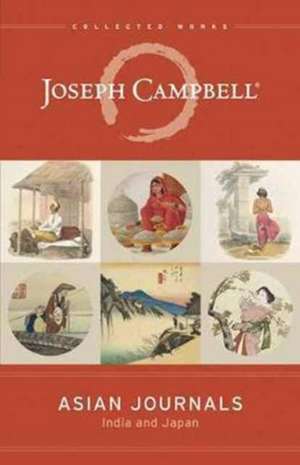
Asian Journals: Collected Works of Joseph Campbell
Autor Joseph Campbellen Limba Engleză Paperback – 31 aug 2017
Observăm în Asian Journals un moment de cotitură în biografia intelectuală a lui Joseph Campbell: trecerea de la studiul teoretic al textelor sacre la experiența directă, senzorială, a Orientului. Deși interesul său pentru filozofia budistă și hindusă a fost constant încă de la începutul carierei, abia în 1954, profitând de un an sabatic, autorul pornește într-o expediție de un an prin Asia. Această ediție, integrată în seria Collected Works of Joseph Campbell, are meritul de a reuni două volume anterior separate, oferind o perspectivă unitară asupra călătoriei sale din India până în Japonia.
Ne-a atras atenția modul în care Joseph Campbell alternează însemnările cotidiene despre oamenii întâlniți cu analize profunde despre mit și structură socială. Nu este doar un jurnal de călătorie, ci un laborator de idei unde se cristalizează conceptele ce vor fundamenta lucrările sale ulterioare. Stilul este direct, lucid și lipsit de artificii, reflectând curiozitatea unui savant care confruntă mitul cu realitatea politică și socială a deceniului șase.
Această lucrare reprezintă o alternativă biografică la Oriental Mythology (the Masks of God, Volume 2) pentru cursurile de istoria religiilor sau antropologie culturală, cu avantajul că oferă o privire „în spatele scenei”. Dacă în Oriental Mythology (the Masks of God, Volume 2) avem sinteza academică a sistemelor de credințe asiatice, în Asian Journals descoperim procesul de acumulare și reacțiile subiective ale autorului în fața acestor culturi. De asemenea, spre deosebire de abordarea psihanalitică din Psychology and the East de C. G. Jung, Campbell se concentrează pe manifestarea externă a simbolurilor în arhitectură, ritual și viața de zi cu zi.

Preț: 154.82 lei
Preț vechi: 202.33 lei
-23%
Carte disponibilă
Livrare economică 17-24 noiembrie
Specificații
ISBN-10: 1608685047
Pagini: 784
Dimensiuni: 140 x 216 x 43 mm
Greutate: 0.93 kg
Editura: NEW WORLD LIBRARY
Seria Collected Works of Joseph Campbell
V-ar putea interesa
-
 Myths to Live byJoseph Campbell-19%Preț: 98.20 lei121.56 lei
 -
 Phantom Hitchhikers and Other Urban LegendsAlbert JackPreț: 129.39 lei
 -
 Papers from the Eranos Yearbooks, Eranos 4Joseph Campbell-19%Preț: 597.22 lei737.32 lei
 -
 The Traveller's Tree: A Journey through the Caribbean IslandsPatrick Leigh Fermor-27%Preț: 72.85 lei99.49 lei
 -
 The Silk Road Journey With XuanzangSally WrigginsPreț: 212.55 lei
 -
 The Philosopher and the DruidsPhilip FreemanPreț: 107.26 lei
 -
 Pathways to BlissJoseph Campbell-25%Preț: 117.90 lei157.70 lei
 -
 Spirit WalkingEvelyn RysdykPreț: 127.94 lei
 -
 Awakening to the Spirit WorldHank WesselmanPreț: 135.83 lei
 -
 Myths of LightJoseph CampbellPreț: 90.21 lei
 -
 The Inner Reaches of Outer SpaceJoseph CampbellPreț: 94.11 lei
 -
 GoddessesJoseph Campbell-23%Preț: 148.44 lei192.27 lei
 -
 The Hero's JourneyJoseph CampbellPreț: 113.15 lei
 -
 Romance of the GrailJoseph Campbell-20%Preț: 125.52 lei157.73 lei
 -
 The Ecstasy of BeingJoseph Campbell-21%Preț: 125.09 lei157.45 lei
 -
 The Mythic DimensionJoseph CampbellPreț: 113.23 lei
 -
 The Flight of the Wild GanderJoseph CampbellPreț: 107.24 lei
 -
 Georgia through Earth, Fire, Air and WaterMichael P BermanPreț: 111.57 lei
 -
 Dogu Mitolojisi - Tanrinin Maskeleri 2Joseph CampbellPreț: 243.94 lei
De ce să citești această carte
Recomandăm această carte cititorilor care doresc să înțeleagă geneza ideilor lui Joseph Campbell. Dincolo de rigoarea academică a tratatelor sale, acest jurnal oferă acces la omul din spatele mitologului, surprins într-un moment de maximă receptivitate culturală. Este o resursă esențială pentru studenții de la antropologie și pentru oricine este fascinat de modul în care experiența personală modelează cercetarea științifică.
Descriere scurtă
Joseph Campbell was one of the foremost interpreters of myth in our time. Yet when he traveled to Asia for the first time he was nearly fifty and at the crossroads of his life and career. This edition of both of his Asian journals -- Baksheesh & Brahman, about his transformative six months in India and Sake and Satori, detailing his time in Japan and East Asia -- are as close as Campbell ever came to writing autobiography. Previously published in two cloth editions, they are now available in one paperback.
After ten years' intense study of Indian art and philosophy, Joseph Campbell embarked on this long postponed journey. Searching for the transcendent (Brahman) -- the exotic mystery of the India in his books -- he found instead stark realities: growing nationalism, cultural and religious rivalry, poverty, the impact of foreign aid, and a prevalent culture of what he called "baksheesh," or alms. His carefully kept journal chronicles the disillusionment and revelation that would change the course of his life and studies. It is at once a diary of his adventures, a forum in which he develops his revolutionary ideas and clarifies his future pursuits, and a record of his insightful discussions of art, philosophy, and transcendent realities with Indians from every level of society.
After nearly seven months in Indian, Campbell traveled through Ceylon, Thailand, Cambodia, Burma, Hong Kong, Taiwan, and finally coming to rest, for a full five months, in Japan. Sake & Satori is his journal of these travels and is a unique snapshot of Asia and its post-colonial struggles and Cold War tensions. The narrative is fueled by Campbell's knack for cultural and mythological comparison. Yet it also shows the fresh enthusiasm of a remarkably erudite teacher on his first trip to the Asia he has studied for most of his life. Campbell relates his experiences with a culturally intact Japan, where Noh drama, Kabuki theater, and Geisha houses are still common. He grapples with his self-discovered prejudices and opinions about how Asia is absorbing and resisting Western notions of gender, pluralism, and wealth. He relates revealing conversations with other travelers, as well as with Japanese from all walks of life, from geishas to scholars. Along the way, he allows passing asides to develop into wide-ranging philosophical explorations, augmented with his photos and drawings.
Campbell's life was at a turning point during his travels and many of the seeds of his transition from professor to cultural icon were planted during this Asian journey. These Asian journals impart unique and entertaining insights into both the man who wrote them and the cultures he described.