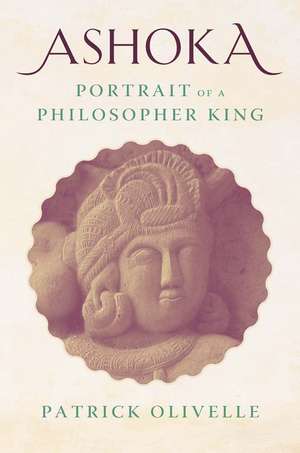
Ashoka: Portrait of a Philosopher King
Autor Patrick Olivelleen Limba Engleză Hardback – 9 ian 2024
“Mr. Olivelle has produced an outstanding monument of scholarship and sound judgment.”—Maxwell Carter, Wall Street Journal
A New Yorker “Best Book of 2024” Selection
There are few historical figures more integral to South Asian history than Emperor Ashoka, a third-century BCE king who ruled over a larger area of the Indian subcontinent than anyone else before British colonial rule. Ashoka sought not only to rule his territory but also to give it a unity of purpose and aspiration, to unify the people of his vastly heterogeneous empire not by a cult of personality but by the cult of an idea—“dharma”—which served as the linchpin of a new moral order. He aspired to forge a new moral philosophy that would be internalized not only by the people of his empire but also by rulers and subjects of other countries, and would form the foundation for his theory of international relations, in which practicing dharma would bring international conflicts to an end.
His fame spread far and wide both in India and in other parts of Asia, and it prompted diverse reimaginations of the king and his significance. In this deeply researched book, Patrick Olivelle draws on Ashoka’s inscriptions and on the art and architecture he pioneered to craft a detailed picture of Ashoka as a ruler, a Buddhist, a moral philosopher, and an ecumenist who governed a vast multiethnic, multilinguistic, and multireligious empire.
Preț: 196.80 lei
Puncte Express: 295
Carte disponibilă
Livrare economică 06-20 noiembrie
Livrare express 22-28 octombrie pentru 41.27 lei
Livrare prin curier în România Termenul estimat este afișat lângă disponibilitate.
Transport gratuit de la 400.00 lei Plată online sau ramburs, în funcție de opțiunile comenzii.
Retur gratuit în 14 zile Comandă securizată și suport în română.
Specificații
ISBN-13: 9780300270006
ISBN-10: 0300270003
Pagini: 408
Ilustrații: 19 color + 1 b-w illus.
Dimensiuni: 152 x 229 x 30 mm
Greutate: 0.72 kg
Editura: Yale University Press
Colecția Yale University Press
ISBN-10: 0300270003
Pagini: 408
Ilustrații: 19 color + 1 b-w illus.
Dimensiuni: 152 x 229 x 30 mm
Greutate: 0.72 kg
Editura: Yale University Press
Colecția Yale University Press
Recenzii
“In Ashoka: Portrait of a Philosopher King, Mr. Olivelle has produced an outstanding monument of scholarship and sound judgment.”—Maxwell Carter, Wall Street Journal
“This incisive biography aims to separate the historical Ashoka . . . from the one of legend.”—New Yorker, “Best Books of 2024”
“This biography presents a balanced and insightful picture of a unique figure in world history [and] fresh insights into Aśoka’s motives and methods. . . . Olivelle has succeeded in bridging the often wide gap between academic and popular writing.”—Richard Salomon, Journal of the American Oriental Society
“Olivelle invites rather than closes debate and offers more of a provocation than a definitive account. In this way, he mirrors Ashoka’s own strategy: to plant seeds rather than dictate doctrine.”—Patrick Horn, Reading Religion
“Relying on Ashoka’s own inscriptions, Olivelle draws a compelling portrait, and what we see is an extraordinary, exuberant personality, threatening to burst out of the pillars on which his words are engraved.”—Rohan Manoj, The Indian Express
“Olivelle has made a wonderful gift to the world: a brilliant, reliable, readable synthesis of what we know about one of history’s truly great emperors. This book should be in every learned person’s library.”—Richard W. Lariviere, president emeritus of the Field Museum, Chicago
“Ashoka is certainly one of the towering figures of world history. In this highly readable account, Patrick Olivelle has skillfully woven together more than a century of scholarship about this great king.”—Deven M. Patel, University of Pennsylvania
“Olivelle’s novel approach—to write a biography of Aśoka in Aśoka’s own words—that is, the words of his inscriptions—provides us with an entirely fresh and surprising portrait of the great Mauryan emperor, stripped of millennia of hagiography and religious piety and resituated in a conceptual landscape of Aśoka’s ‘civil religion.’”—Stephanie Jamison, University of California, Los Angeles
“In this wonderful book, subject and author are perfectly matched. Patrick Olivelle, arguably the greatest living scholar of ancient India, has given us a sensitive and authoritative biography of Ashoka, one of the most remarkable figures in world history and an emperor whose revolutionary moral philosophy has had an enduring legacy. With the rigour of its research, the subtlety of its judgments, and the elegance of its prose, Patrick Olivelle’s Ashoka sets new standards in biographical writing.”—Ramachandra Guha, author of Gandhi: The Years That Changed the World
“This incisive biography aims to separate the historical Ashoka . . . from the one of legend.”—New Yorker, “Best Books of 2024”
“This biography presents a balanced and insightful picture of a unique figure in world history [and] fresh insights into Aśoka’s motives and methods. . . . Olivelle has succeeded in bridging the often wide gap between academic and popular writing.”—Richard Salomon, Journal of the American Oriental Society
“Olivelle invites rather than closes debate and offers more of a provocation than a definitive account. In this way, he mirrors Ashoka’s own strategy: to plant seeds rather than dictate doctrine.”—Patrick Horn, Reading Religion
“Relying on Ashoka’s own inscriptions, Olivelle draws a compelling portrait, and what we see is an extraordinary, exuberant personality, threatening to burst out of the pillars on which his words are engraved.”—Rohan Manoj, The Indian Express
“Olivelle has made a wonderful gift to the world: a brilliant, reliable, readable synthesis of what we know about one of history’s truly great emperors. This book should be in every learned person’s library.”—Richard W. Lariviere, president emeritus of the Field Museum, Chicago
“Ashoka is certainly one of the towering figures of world history. In this highly readable account, Patrick Olivelle has skillfully woven together more than a century of scholarship about this great king.”—Deven M. Patel, University of Pennsylvania
“Olivelle’s novel approach—to write a biography of Aśoka in Aśoka’s own words—that is, the words of his inscriptions—provides us with an entirely fresh and surprising portrait of the great Mauryan emperor, stripped of millennia of hagiography and religious piety and resituated in a conceptual landscape of Aśoka’s ‘civil religion.’”—Stephanie Jamison, University of California, Los Angeles
“In this wonderful book, subject and author are perfectly matched. Patrick Olivelle, arguably the greatest living scholar of ancient India, has given us a sensitive and authoritative biography of Ashoka, one of the most remarkable figures in world history and an emperor whose revolutionary moral philosophy has had an enduring legacy. With the rigour of its research, the subtlety of its judgments, and the elegance of its prose, Patrick Olivelle’s Ashoka sets new standards in biographical writing.”—Ramachandra Guha, author of Gandhi: The Years That Changed the World
Notă biografică
Patrick Olivelle is professor emeritus in the Department of Asian Studies at the University of Texas. His recent publications include Yājñavalkya: A Treatise on Dharma and Hindu Law: A New History of Dharmaśāstra. He lives in Austin, TX.
Descriere
An illuminating biography reconstructing the life and legacy of a unique king in world history and the most famous emperor in South Asian history