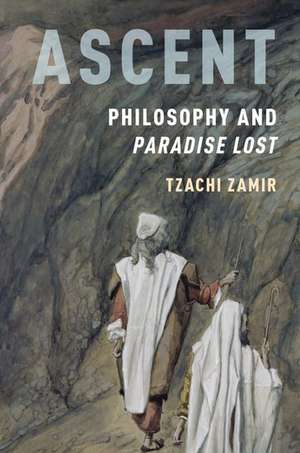
Ascent: Philosophy and Paradise Lost
Autor Tzachi Zamiren Limba Engleză Hardback – 4 ian 2018
Preț: 416.95 lei
Preț vechi: 583.67 lei
-29%
Puncte Express: 625
Carte tipărită la comandă
Livrare economică 26 noiembrie-02 decembrie
Livrare prin curier în România Termenul estimat este afișat lângă disponibilitate.
Transport gratuit pentru acest produs Plată online sau ramburs, în funcție de opțiunile comenzii.
Retur gratuit în 14 zile Comandă securizată și suport în română.
Specificații
ISBN-13: 9780190695088
ISBN-10: 0190695080
Pagini: 216
Dimensiuni: 211 x 142 x 23 mm
Greutate: 0.34 kg
Editura: Oxford University Press
Colecția OUP USA
Locul publicării:New York, United States
ISBN-10: 0190695080
Pagini: 216
Dimensiuni: 211 x 142 x 23 mm
Greutate: 0.34 kg
Editura: Oxford University Press
Colecția OUP USA
Locul publicării:New York, United States
Recenzii
There is much else we may be stimulated to find by thinking through this fine addition to Milton scholarship.
Zamir's analysis proves that philosophical approaches to the gift can enliven and deepen readings of Paradise Lost.
fine addition to Milton scholarship.
This year's group of Milton books undoubtedly peaks, however, with Tzachi Zamir's marvellous and mindexpanding Ascent: Philosophy and Paradise Lost
the book invites active readership and thoughtful response. Because it does so, it should interest not only scholars of seventeenth-century literature and philosophers, but also any readers interested in the religious imagination and its critiques.
Frank, honest, and stimulating
There is no doubt that Zamir has succeeded eminently and entirely in capturing the scope and structure of Milton's ambition, and, in doing so, in making modes of enhanced, better articulated self-consciousness available, for Milton scholars, Christian theologians, and Philosophers alike.
Over and above the specific achievements of his account of his account, I found particularly refreshing Zamir's foregrounding of the question: what does it mean to relate to something that one stands absolutely outside?
Zamir's subtle, nuanced interpretation of Paradise Lost provides rich insight into the nature and characterization of the Father, the Son, Adam, Eve, and Satan. ... The book will reward any reader with an interest in Paradise Lost, Milton's theodicy, or the intersection of religion, philosophy, and literature. Zamir's writing is marvellously clear and will be accessible to students at all levels. ... Highly recommended.
In Double Vision: Moral Philosophy and Shakespearean Drama, Tzachi Zamir demonstrated what can be done when an acute philosopher and subtle literary critic turns his attention to a great writer. Now he has done the same with Milton in Ascent: Philosophy and 'Paradise Lost'. In a book essential for anyone interested in the intersections of literature, philosophy, and religion, Zamir offers a generous and empathetic reading of claims for religious poetry that his own philosophical commitments in part preclude. In deeply illuminating chapters on gratitude in Paradise Lost, Zamir demonstrates that Milton's poem contains a gift theory more nuanced even than Jacques Derrida's or Jean-Luc Marion's.
A refreshing departure from the usual concerns of Miltonic studies, this book offers a searching meditation on the ethics of Paradise Lost. Zamir finds in Milton's epic an implicit critique of the limitations of philosophy, indeed an exemplary signposting of those moments at which literary modes of understanding transcend the merely philosophical.
This book brings to bear on its topic the learning and insights both of philosophy and of literary criticism. It is a sensitive and thoughtful exploration of Milton's poetry and philosophical theology. Both those who are interested in understanding the power of Milton's poetry and those who share with Milton an interest in philosophical theology will find this book helpful.
Zamir's analysis proves that philosophical approaches to the gift can enliven and deepen readings of Paradise Lost.
fine addition to Milton scholarship.
This year's group of Milton books undoubtedly peaks, however, with Tzachi Zamir's marvellous and mindexpanding Ascent: Philosophy and Paradise Lost
the book invites active readership and thoughtful response. Because it does so, it should interest not only scholars of seventeenth-century literature and philosophers, but also any readers interested in the religious imagination and its critiques.
Frank, honest, and stimulating
There is no doubt that Zamir has succeeded eminently and entirely in capturing the scope and structure of Milton's ambition, and, in doing so, in making modes of enhanced, better articulated self-consciousness available, for Milton scholars, Christian theologians, and Philosophers alike.
Over and above the specific achievements of his account of his account, I found particularly refreshing Zamir's foregrounding of the question: what does it mean to relate to something that one stands absolutely outside?
Zamir's subtle, nuanced interpretation of Paradise Lost provides rich insight into the nature and characterization of the Father, the Son, Adam, Eve, and Satan. ... The book will reward any reader with an interest in Paradise Lost, Milton's theodicy, or the intersection of religion, philosophy, and literature. Zamir's writing is marvellously clear and will be accessible to students at all levels. ... Highly recommended.
In Double Vision: Moral Philosophy and Shakespearean Drama, Tzachi Zamir demonstrated what can be done when an acute philosopher and subtle literary critic turns his attention to a great writer. Now he has done the same with Milton in Ascent: Philosophy and 'Paradise Lost'. In a book essential for anyone interested in the intersections of literature, philosophy, and religion, Zamir offers a generous and empathetic reading of claims for religious poetry that his own philosophical commitments in part preclude. In deeply illuminating chapters on gratitude in Paradise Lost, Zamir demonstrates that Milton's poem contains a gift theory more nuanced even than Jacques Derrida's or Jean-Luc Marion's.
A refreshing departure from the usual concerns of Miltonic studies, this book offers a searching meditation on the ethics of Paradise Lost. Zamir finds in Milton's epic an implicit critique of the limitations of philosophy, indeed an exemplary signposting of those moments at which literary modes of understanding transcend the merely philosophical.
This book brings to bear on its topic the learning and insights both of philosophy and of literary criticism. It is a sensitive and thoughtful exploration of Milton's poetry and philosophical theology. Both those who are interested in understanding the power of Milton's poetry and those who share with Milton an interest in philosophical theology will find this book helpful.
Notă biografică
Tzachi Zamir is Associate Professor of English and Comparative Literature at the Hebrew University of Jerusalem. Zamir is the author of Double Vision: Moral Philosophy and Shakespearean Drama (Princeton, 2006), Ethics and the Beast (Princeton, 2007), and Acts: Theater, Philosophy and the Performing Self (The University of Michigan Press, 2014). He is the editor of a forthcoming collection of articles on Hamlet and philosophy for Oxford University Press.