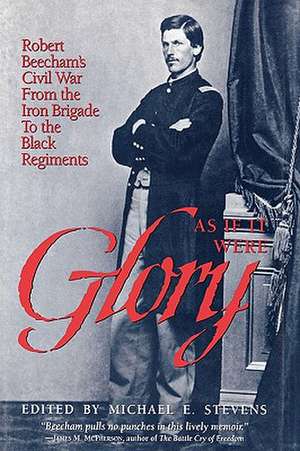
As If It Were Glory
Editat de Michael E Stevensen Limba Engleză Hardback – iun 1998
Beecham's war was a long one-he served from May 1861 through the completion of the war in the spring of 1865. With the Iron Brigade he saw action at such momentous battles as Chancellorsville and then at Gettysburg, where he was taken prisoner. Returned to service in a prison exchange, Beecham was promoted to first lieutenant of the 23rd United States Colored Troops whom he lead in fierce fighting at the Battle of the Crater. At the Crater, Beecham was wounded, again captured, and, after eight months in a Confederate prison, escaped to find his way to Annapolis just before the conclusion of the war.
In his narrative, Beecham celebrates the ingenuity of the enlisted man at the expense of officers who are often arrogant or incompetent. He also chides the altered recollections of fellow veterans who remember only triumphs and forgot defeats. In one of the most powerful parts of his memoir, Beecham pays tribute to the valor of the African Americans who fought under his command and insists that they were "the bravest and best soldiers that ever lived."
Preț: 353.70 lei
Preț vechi: 432.76 lei
-18%
Puncte Express: 531
Preț estimativ în valută:
62.55€ • 73.40$ • 54.25£
62.55€ • 73.40$ • 54.25£
Carte tipărită la comandă
Livrare economică 09-23 martie
Specificații
ISBN-13: 9780945612551
ISBN-10: 0945612559
Pagini: 264
Dimensiuni: 157 x 235 x 20 mm
Greutate: 0.59 kg
Editura: Bloomsbury Publishing
Locul publicării:New York, United States
ISBN-10: 0945612559
Pagini: 264
Dimensiuni: 157 x 235 x 20 mm
Greutate: 0.59 kg
Editura: Bloomsbury Publishing
Locul publicării:New York, United States
Cuprins
Foreword
Introduction
Chapter 1: "As if it were glory and not years of bitter war": Bull Run and a Winter of Idleness: May 1861-April 1862
Chapter 2: "I was pretty sick": Surviving the Military Hospitals: April 1862-December 1862
Chapter 3: "A campaign of adventure": From the Mud March to Chancellorsville: January 1863-June 1863
Chapter 4: "We were all boys then": The First Day at Gettysburg: July 1, 1863
Chapter 5: "The living prepared for the morrow": The Second Day at Gettysburg: July 2, 1863
Chapter 6: "Into the fiercest hell of battle": The Third Day at Gettysburg: July 3, 1863
Chapter 7: "The scenes I witnessed there": Life in a Southern Prison Camp: July-August 1863
Chapter 8: "My first promotion": Becoming an Officer with the U.S. Colored Troops: August-December 1863
Chapter 9: "Soldiers till the last man falls": With the Twenty-third U.S. Colored Troops: January-June 1864
Chapter 10: "We'll show the world today that colored troops are soldiers": The Battle of the Crater: June-July 1864
Chapter 11: "We were a sorry-looking set": Prisoner of War Again: July 1864-March 1865
Chapter 12: "The paths and the vocations of peace": March-June 1865
Introduction
Chapter 1: "As if it were glory and not years of bitter war": Bull Run and a Winter of Idleness: May 1861-April 1862
Chapter 2: "I was pretty sick": Surviving the Military Hospitals: April 1862-December 1862
Chapter 3: "A campaign of adventure": From the Mud March to Chancellorsville: January 1863-June 1863
Chapter 4: "We were all boys then": The First Day at Gettysburg: July 1, 1863
Chapter 5: "The living prepared for the morrow": The Second Day at Gettysburg: July 2, 1863
Chapter 6: "Into the fiercest hell of battle": The Third Day at Gettysburg: July 3, 1863
Chapter 7: "The scenes I witnessed there": Life in a Southern Prison Camp: July-August 1863
Chapter 8: "My first promotion": Becoming an Officer with the U.S. Colored Troops: August-December 1863
Chapter 9: "Soldiers till the last man falls": With the Twenty-third U.S. Colored Troops: January-June 1864
Chapter 10: "We'll show the world today that colored troops are soldiers": The Battle of the Crater: June-July 1864
Chapter 11: "We were a sorry-looking set": Prisoner of War Again: July 1864-March 1865
Chapter 12: "The paths and the vocations of peace": March-June 1865
Recenzii
An exceptional memoir by an unusually idealistic and sophisticated Iron Brigade soldier who fought from Bull Run to Gettysburg and who finished the war as an officer in a Black regiment. Beecham understood the war in terms of freedom and rejected the racist and counterfactual postwar myth of the Lost Cause. Highly recommended.
Robert Beecham's outstanding memoir is marked by insight and humor. He never forgot that he was marching to history's drum whether with the Iron Brigade at Gettysburg or on the drill field with his black regiment. This is a front-rank look at the American Civil War.
This bold and refreshing memoir tears away at the growing shroud of myths during the postwar era of reconciliation. . . . For Beecham, like Abraham Lincoln before him, African-Americans made as good soldiers as any, and in Beecham's eyes, sometimes better.
Beecham pulls no punches in this lively memoir of his service as a soldier in the famed Iron Brigade and as an officer of African-American troops. Unlike most Civil War memoirs, this one does not romanticize the war nor does it make any concessions to the Confederacy, which Beecham in 1902 considered to have been as wrong and baneful as he had four decades earlier when he gave four years of his life fighting for Union and freedom.
Robert Beecham's outstanding memoir is marked by insight and humor. He never forgot that he was marching to history's drum whether with the Iron Brigade at Gettysburg or on the drill field with his black regiment. This is a front-rank look at the American Civil War.
This bold and refreshing memoir tears away at the growing shroud of myths during the postwar era of reconciliation. . . . For Beecham, like Abraham Lincoln before him, African-Americans made as good soldiers as any, and in Beecham's eyes, sometimes better.
Beecham pulls no punches in this lively memoir of his service as a soldier in the famed Iron Brigade and as an officer of African-American troops. Unlike most Civil War memoirs, this one does not romanticize the war nor does it make any concessions to the Confederacy, which Beecham in 1902 considered to have been as wrong and baneful as he had four decades earlier when he gave four years of his life fighting for Union and freedom.