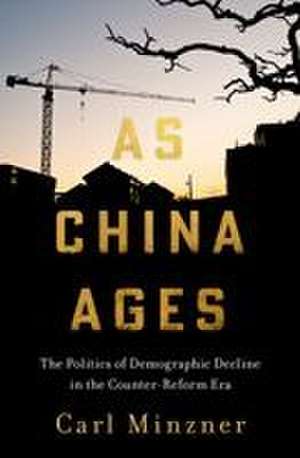
As China Ages: The Politics of Demographic Decline in the Counter-Reform Era
Autor Carl Minzneren Limba Engleză Hardback – 5 apr 2027
Preț: 171.31 lei
Preț vechi: 201.55 lei
-15% Precomandă
Puncte Express: 257
Carte nepublicată încă
Livrare prin curier în România Precomanda se expediază când titlul devine disponibil.
Transport gratuit de la 400.00 lei Plată online sau ramburs, în funcție de opțiunile comenzii.
Retur gratuit în 14 zile Comandă securizată și suport în română.
Doresc să fiu notificat când acest titlu va fi disponibil:
Se trimite...
Specificații
ISBN-13: 9780197678596
ISBN-10: 0197678599
Pagini: 296
Dimensiuni: 156 x 235 mm
Editura: Oxford University Press
Colecția OUP USA
Locul publicării:New York, United States
ISBN-10: 0197678599
Pagini: 296
Dimensiuni: 156 x 235 mm
Editura: Oxford University Press
Colecția OUP USA
Locul publicării:New York, United States
Recenzii
Much of the public conversation focuses on China's rise, but Carl Minzner authoritatively argues there is nothing inexorable about it. To the contrary, he depicts a country facing a future defined by a shrinking, aging population, repressive politics, and mounting social tensions, a polity led by what Minzner describes as a 'brittle and sclerotic one-party state...whose choices are undermining China's long-term future.' The result is a provocative book that teaches as it challenges conventional wisdom.
As China Ages is a highly-engaging, authoritative, and trenchant analysis of China's demographic crisis. Minzner's deep dive into the causes and consequences of China's aging and shrinking population, set within the context of other East Asian countries' experiences, makes a major contribution to understanding a transformative challenge facing one of the world's leading powers.
Carl Minzner has emerged as one of the West's most perceptive public intellectuals on China. His previous book accurately predicted the end of China's reform era, and this one now takes us into the future, to a time when China will be powerful and influential but also old and more fragile. It is a story of demographic decline magnified by political ossification-a worrying combination that will underlie what is likely to be a tumultuous mid-21st century.
Few in the China field could have pulled together so many strands to tell a holistic story about one of the most daunting policy challenges facing China: a rapidly aging population. Minzner has made a convincing case that a dramatic reorientation of policy and fiscal priorities is needed to improve the daunting future facing hundreds of millions in the coming years, particularly in China's fast-greying countryside. It is a vital read.
The onset of population decline in China has unleashed an avalanche of demographic alarmism. Not Carl Minzner's As China Ages. Insightful, powerful, and elegantly crafted, Minzner offers a compelling account of how the twin forces of demographic decline and political retrenchment will shape the drama of twenty-first-century China. A timely sequel to his prescient End of an Era, As China Ages illuminates how authoritarian retrenchment, marked by neo-traditionalism, ethnocentrism, and growing political sclerosis, is likely to deepen China's demographic woes and render China's path forward far more uncertain and perilous.
As China Ages is a fascinating and highly readable account of how China is following Japan, Taiwan, and Korea's developmental states in coping with the social and economic problems created by declining marriage and birth rates. The Chinese pattern, Minzner persuasively argues, is both similar and different. The CCP government is limited by its enthnonationalism from opening to inbound migration; its pension, health care, and educational systems lag behind because of its opposition to welfarism and fear of social unrest; and it has abandoned the feminism that characterized its revolutionary and Maoist period. The future for aging China is bleaker than that of its neighbors.
As China Ages is a highly-engaging, authoritative, and trenchant analysis of China's demographic crisis. Minzner's deep dive into the causes and consequences of China's aging and shrinking population, set within the context of other East Asian countries' experiences, makes a major contribution to understanding a transformative challenge facing one of the world's leading powers.
Carl Minzner has emerged as one of the West's most perceptive public intellectuals on China. His previous book accurately predicted the end of China's reform era, and this one now takes us into the future, to a time when China will be powerful and influential but also old and more fragile. It is a story of demographic decline magnified by political ossification-a worrying combination that will underlie what is likely to be a tumultuous mid-21st century.
Few in the China field could have pulled together so many strands to tell a holistic story about one of the most daunting policy challenges facing China: a rapidly aging population. Minzner has made a convincing case that a dramatic reorientation of policy and fiscal priorities is needed to improve the daunting future facing hundreds of millions in the coming years, particularly in China's fast-greying countryside. It is a vital read.
The onset of population decline in China has unleashed an avalanche of demographic alarmism. Not Carl Minzner's As China Ages. Insightful, powerful, and elegantly crafted, Minzner offers a compelling account of how the twin forces of demographic decline and political retrenchment will shape the drama of twenty-first-century China. A timely sequel to his prescient End of an Era, As China Ages illuminates how authoritarian retrenchment, marked by neo-traditionalism, ethnocentrism, and growing political sclerosis, is likely to deepen China's demographic woes and render China's path forward far more uncertain and perilous.
As China Ages is a fascinating and highly readable account of how China is following Japan, Taiwan, and Korea's developmental states in coping with the social and economic problems created by declining marriage and birth rates. The Chinese pattern, Minzner persuasively argues, is both similar and different. The CCP government is limited by its enthnonationalism from opening to inbound migration; its pension, health care, and educational systems lag behind because of its opposition to welfarism and fear of social unrest; and it has abandoned the feminism that characterized its revolutionary and Maoist period. The future for aging China is bleaker than that of its neighbors.
Notă biografică
Carl Minzner is a senior fellow for China studies at the Council on Foreign Relations (CFR) and a professor at Fordham Law School. He is an expert in Chinese law and governance and has written extensively on these topics in both academic journals and the popular press. He is the author of End of an Era (Oxford, 2018).