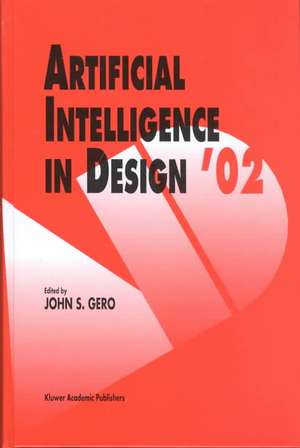
Artificial Intelligence in Design '02
Editat de Asko Riitahuhtaen Limba Engleză Hardback – 31 iul 2002
Preț: 1337.36 lei
Preț vechi: 1671.70 lei
-20%
Puncte Express: 2006
Carte tipărită la comandă
Livrare economică 02-16 decembrie
Livrare prin curier în România Termenul estimat este afișat lângă disponibilitate.
Transport gratuit pentru acest produs Plată online sau ramburs, în funcție de opțiunile comenzii.
Retur gratuit în 14 zile Comandă securizată și suport în română.
Specificații
ISBN-13: 9781402007163
ISBN-10: 1402007167
Pagini: 656
Ilustrații: X, 642 p.
Dimensiuni: 160 x 241 x 40 mm
Greutate: 1.09 kg
Ediția:2002
Editura: SPRINGER NETHERLANDS
Locul publicării:Dordrecht, Netherlands
ISBN-10: 1402007167
Pagini: 656
Ilustrații: X, 642 p.
Dimensiuni: 160 x 241 x 40 mm
Greutate: 1.09 kg
Ediția:2002
Editura: SPRINGER NETHERLANDS
Locul publicării:Dordrecht, Netherlands
V-ar putea interesa
-
 -19%Preț: 92.16 lei114.22 lei
 -
 Computer VisionSimon J. D. Prince-20%Preț: 582.72 lei728.39 lei
 -
 Machine LearningPeter Flach-20%Preț: 386.84 lei483.55 lei
 -
 Multi-Agent Machine LearningSchwartz-20%Preț: 675.81 lei844.77 lei
 -
 Wavelet Neural NetworksAntonis K Alexandridis-20%Preț: 634.18 lei792.72 lei
 -
 Practical Introduction to CompDawson-Howe-20%Preț: 518.21 lei647.76 lei
 -
 Machine Learning: An Algorithmic Perspective, Second EditionStephen Marsland-20%Preț: 625.22 lei781.53 lei
 -
 -9%Preț: 987.33 lei1084.98 lei
 -
 Hybrid MetaheuristicsFrancisco Almeida-20%Preț: 317.47 lei396.84 lei
 -
 -20%Preț: 1321.32 lei1651.65 lei
 -
 The Design of Intelligent AgentsJörg Müller-20%Preț: 319.70 lei399.63 lei
 -
 Agent-Oriented ProgrammingMatthew M. Huntbach-20%Preț: 327.69 lei409.62 lei
 -
 Unconventional ComputationSelim G. Akl-20%Preț: 332.70 lei415.87 lei
 -
 -20%Preț: 328.93 lei411.16 lei
 -
 Automated Deduction - CADE-21Frank Pfenning-20%Preț: 334.25 lei417.82 lei
 -
 Believable BotsPhilip Hingston-20%Preț: 676.70 lei845.88 lei
 -
 Design for ConfigurationAsko RiitahuhtaPreț: 375.49 lei
 -
 Artificial Intelligence in Design '94John S. Gero-20%Preț: 363.31 lei454.15 lei
 -
 Artificial Intelligence in Design '92John S. GeroPreț: 506.95 lei
 -
 Artificial Intelligence in Design '98John S. Gero-20%Preț: 357.93 lei447.41 lei
 -
 Artificial Intelligence in Design '96John S. Gero-20%Preț: 364.01 lei455.01 lei
 -
 -18%Preț: 965.69 lei1177.67 lei
 -
 Paradigms of Artificial IntelligenceAchim G Hoffmann-20%Preț: 335.03 lei418.79 lei
Public țintă
ResearchCuprins
Design Synthesis.- Synthesis in designing.- A graphical notation for mixed-initiative dialogue with generative design systems.- Web-based configuration of virtual private networks with multiple suppliers.- Frameworks for Design.- Constructing design worlds.- The situated function—behaviour—structure framework.- Representational flexibility for design.- Spatial Synthesis and Analysis.- Analysis of architectural space composition using inductive logic programming.- Towards an architectural design system based on generic representations.- Digital sandbox.- Conceptual Knowledge in Design.- MMforTED: A cognitive tool fostering the acquisition of conceptual knowledge about design products.- From concept to embodiment: challenge and strategy.- Artificial intelligence for the design and grading of precious stones.- Learning from Human Designers.- Using protocol analysis to investigate collective learning in design.- 5. 8 analogies per hour.- Towards computational tools for supporting the reflective team.- Evolutionary Approaches in Design.- An evolutionary approach to the inverse problem in rule-based design representations.- Evolving three-dimensional architecture form.- Strategic shape design.- An evolutionary framework for enhancing design.- Knowledge Support for Design.- Knowledge support for customer-based design for mass customization.- Elucidating the design requirement for conventional and automated conceptual design.- Case-based design facilitated by the design exemplar.- Systemic Support.- Connectivity as a key to supporting design.- Automated (re-)design of software agents.- Automated toolset selection for feature manufacturing.- Components in Design and Design Models.- Requirements specification and automated evaluation of dynamic properties of a component-baseddesign.- Identifying component modules.- Perspectors.- Product data exchange using ontologies.- Author Index.- Contact Authors’ Email Addresses.