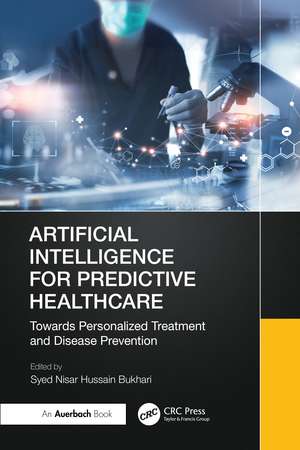
Artificial Intelligence for Predictive Healthcare: Towards Personalized Treatment and Disease Prevention
Editat de Syed Nisar Hussain Bukharien Limba Engleză Hardback – 6 mai 2026
Artificial Intelligence for Predictive Healthcare: Towards Personalized Treatment and Disease Prevention delves into the algorithms, technologies, and applications that are driving this transformation of healthcare. Highlights include:
- Optimizing diagnosis and treatment plans with AI
- Machine learning and generative AI for cancer diagnosis and treatment
- The evolving role of healthcare professionals in smart healthcare
- Hybrid machine learning algorithms for early prediction of diabetes
Preț: 922.69 lei
Preț vechi: 971.25 lei
-5%
Puncte Express: 1384
Carte tipărită la comandă
Livrare economică 07-21 decembrie
Livrare prin curier în România Termenul estimat este afișat lângă disponibilitate.
Transport gratuit pentru acest produs Plată online sau ramburs, în funcție de opțiunile comenzii.
Retur gratuit în 14 zile Comandă securizată și suport în română.
Specificații
ISBN-13: 9781041137559
ISBN-10: 1041137559
Pagini: 323
Ilustrații: 122
Dimensiuni: 156 x 234 mm
Greutate: 0.63 kg
Ediția:1
Editura: CRC Press
Colecția Auerbach Publications
ISBN-10: 1041137559
Pagini: 323
Ilustrații: 122
Dimensiuni: 156 x 234 mm
Greutate: 0.63 kg
Ediția:1
Editura: CRC Press
Colecția Auerbach Publications
Public țintă
AcademicCuprins
1. Introduction to AI in Healthcare. 2. AI Technologies Uses for Diagnostic Modalities in Drug Resistant Tuberculosis Diagnosis. 3. From Preprocessing to Prediction: An Analytical Study on Diabetes Data. 4. Integrating AI-Powered Multi-Modal Data for Early Cardiovascular Disease Detection and Personalized Predictive Healthcare. 5. Role of AI Technology in the Diagnosis of Urinary Tract Infection. 6. Evolving Role of Healthcare Professionals in Smart Healthcare. 7. Deep Learning-Based Stratification of Iron Overload in Thalassemia Patients. 8. Comparative Analysis of Automated Malaria Cell Classification: EfficientNet-B0 Transfer Learning Versus Traditional Machine Learning. 9. Deep CNN Optimization Method for MRI Image-Based Brain Tumor Identifications. 10. Tech-Enabled Transformations in Gender-Inclusive Healthcare: A Critical Interpretive Synthesis of Artificial Intelligence in India. 11. Healthcare AI Optimizing Diagnosis and Treatment Plans: AI Driven Precision Medicine and Personalized Healthcare. 12. A Comparative Analysis of Supervised and Semi-Supervised Deep Learning Models for Monkeypox Blisters Classification. 13. Hybrid Machine Learning Algorithms for Early Prediction of Diabetes. 14. Nature-Inspired Algorithms of Machine Learning and Generative AI for Cancer Diagnosis and Treatment. 15. Future Trends in AI and Healthcare.
Notă biografică
Dr. Syed Nisar Hussain Bukhari is an accomplished academician and researcher, currently serving as Scientist-D at the National Institute of Electronics and Information Technology (NIELIT), Srinagar-an institute under the Ministry of Electronics and Information Technology (MeitY), Government of India. He brings over 12 years of experience in teaching, research, and institutional leadership, with a specialized focus on artificial intelligence, machine learning, deep learning, and their interdisciplinary applications.
Dr. Bukhari completed his bachelor’s and master’s degrees in computer applications from the University of Kashmir and earned his PhD in machine learning from the University Institute of Computing, Chandigarh University, in 2022. His research contributions have been published in several high-impact journals, including IEEE Transactions, Nature, Springer, MDPI, and so on. In addition to journal publications, his work has been widely cited in international conferences and book chapters.
He has received multiple Best Paper Awards at various international forums and holds patents for his research innovations. His editorial engagements include authoring and editing books published by CRC Press, Taylor & Francis Group. He is a reviewer for leading journals such as Scientific Reports (Nature), Computers in Biology and Medicine (Elsevier), and Briefings in Bioinformatics (Oxford University Press) and regularly serves as a session chair at Scopus-indexed international conferences. He serves as an academic editor for PLOS One—a prestigious, high-impact factor journal—where he contributes to the peer review and curation of highquality interdisciplinary research. Additionally, he served as a guest editor for two thematic collections of the Journal of Visualized Experiments (JoVE) titled “Recent Advancements in Computational Biology and Bioinformatics” and “Next-Gen Computational Techniques in Medical Imaging and Signal Processing,” highlighting his engagement with emerging research trends and editorial leadership in the field.
As a faculty member, Dr. Bukhari has taught a wide range of technical subjects, including machine learning, Python, web technologies, and data structures, to postgraduate students. He has also led training initiatives in artificial intelligence and emerging technologies for engineering students, professionals, and government stakeholders. Dr. Bukhari led the Department of Information Technology at NIELIT Srinagar, where he played a key role in strengthening undergraduate and postgraduate academic programs. He is currently serving as academic head at NIELIT Srinagar and head, Department of Computer Science and Applications, at NIELIT Deemed to be University, Srinagar Campus.
Known for his collaborative spirit, Dr. Bukhari maintains active research partnerships with institutions across India and abroad. He is a member of the Institution of Electronics and Telecommunication Engineers (IETE) and the International Association of Engineers (IAENG). His professional journey reflects a sustained commitment to research excellence, academic mentorship, and the development of impactful, technology-driven solutions.
Dr. Bukhari completed his bachelor’s and master’s degrees in computer applications from the University of Kashmir and earned his PhD in machine learning from the University Institute of Computing, Chandigarh University, in 2022. His research contributions have been published in several high-impact journals, including IEEE Transactions, Nature, Springer, MDPI, and so on. In addition to journal publications, his work has been widely cited in international conferences and book chapters.
He has received multiple Best Paper Awards at various international forums and holds patents for his research innovations. His editorial engagements include authoring and editing books published by CRC Press, Taylor & Francis Group. He is a reviewer for leading journals such as Scientific Reports (Nature), Computers in Biology and Medicine (Elsevier), and Briefings in Bioinformatics (Oxford University Press) and regularly serves as a session chair at Scopus-indexed international conferences. He serves as an academic editor for PLOS One—a prestigious, high-impact factor journal—where he contributes to the peer review and curation of highquality interdisciplinary research. Additionally, he served as a guest editor for two thematic collections of the Journal of Visualized Experiments (JoVE) titled “Recent Advancements in Computational Biology and Bioinformatics” and “Next-Gen Computational Techniques in Medical Imaging and Signal Processing,” highlighting his engagement with emerging research trends and editorial leadership in the field.
As a faculty member, Dr. Bukhari has taught a wide range of technical subjects, including machine learning, Python, web technologies, and data structures, to postgraduate students. He has also led training initiatives in artificial intelligence and emerging technologies for engineering students, professionals, and government stakeholders. Dr. Bukhari led the Department of Information Technology at NIELIT Srinagar, where he played a key role in strengthening undergraduate and postgraduate academic programs. He is currently serving as academic head at NIELIT Srinagar and head, Department of Computer Science and Applications, at NIELIT Deemed to be University, Srinagar Campus.
Known for his collaborative spirit, Dr. Bukhari maintains active research partnerships with institutions across India and abroad. He is a member of the Institution of Electronics and Telecommunication Engineers (IETE) and the International Association of Engineers (IAENG). His professional journey reflects a sustained commitment to research excellence, academic mentorship, and the development of impactful, technology-driven solutions.
Descriere
The book explores of how Artificial Intelligence—including Machine Learning, Deep Learning, and Generative AI—is being applied to healthcare. With real-world examples and case studies, it offers a roadmap to understanding AI's potential to predict, personalize, and prevent health conditions.