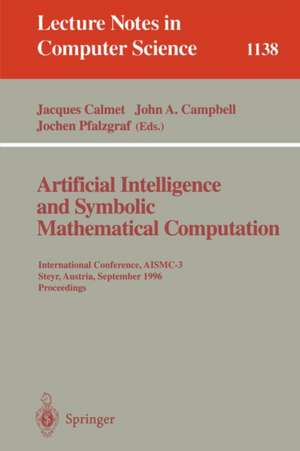
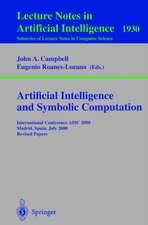
Artificial Intelligence and Symbolic Mathematical Computation
Editat de Jaques Calmet, John A. Campbell, Jochen Pfalzgrafen Limba Engleză Paperback – 11 sep 1996
The 19 revised full papers presented in the book were carefully selected by the program committee; also included are four invited survey and state-of-the-art contributions by Scott, Dillmann and Friedrich, Cohn, and Wang. Among the topics addressed are theorem proving, rewriting systems, symbolic computation, spatial reasoning, computational geometry, and automated deduction.
Preț: 327.07 lei
Preț vechi: 408.84 lei
-20%
Puncte Express: 491
Carte tipărită la comandă
Livrare economică 05-19 decembrie
Livrare prin curier în România Termenul estimat este afișat lângă disponibilitate.
Transport gratuit de la 400.00 lei Plată online sau ramburs, în funcție de opțiunile comenzii.
Retur gratuit în 14 zile Comandă securizată și suport în română.
Specificații
ISBN-13: 9783540617327
ISBN-10: 3540617329
Pagini: 396
Ilustrații: VIII, 384 p.
Dimensiuni: 155 x 235 x 22 mm
Greutate: 0.6 kg
Ediția:1996
Editura: Springer
Locul publicării:Berlin, Heidelberg, Germany
ISBN-10: 3540617329
Pagini: 396
Ilustrații: VIII, 384 p.
Dimensiuni: 155 x 235 x 22 mm
Greutate: 0.6 kg
Ediția:1996
Editura: Springer
Locul publicării:Berlin, Heidelberg, Germany
V-ar putea interesa
-
 -19%Preț: 92.35 lei114.22 lei
 -
 Computer VisionSimon J. D. Prince-20%Preț: 582.72 lei728.39 lei
 -
 Machine LearningPeter Flach-20%Preț: 386.84 lei483.55 lei
 -
 Multi-Agent Machine LearningH M Schwartz-20%Preț: 675.81 lei844.77 lei
 -
 Wavelet Neural NetworksAntonios K Alexandridis-20%Preț: 634.18 lei792.72 lei
 -
 Practical Introduction to CompDawson-Howe-20%Preț: 518.21 lei647.76 lei
 -
 Machine Learning: An Algorithmic Perspective, Second EditionStephen Marsland-20%Preț: 625.22 lei781.53 lei
 -
 Natural Language Processing and Computational LinguisticsMohamed Zakaria Kurdi-9%Preț: 1021.06 lei1122.04 lei
 -
 2nd International Workshop on Evidence-based Technology Enhanced LearningPierpaolo Vittorini-48%Preț: 756.98 lei1448.51 lei
 -
 -20%Preț: 683.75 lei854.69 lei
 -
 -20%Preț: 1025.84 lei1282.31 lei
 -
 -20%Preț: 1029.17 lei1286.46 lei
 -
 Algebraic Algorithms and Error-Correcting CodesJaques CalmetPreț: 384.12 lei
 -
 Artificial Intelligence and Symbolic ComputationJaques Calmet-20%Preț: 334.40 lei418.00 lei
 -
 Artificial Intelligence and Symbolic ComputationJohn A. Campbell-20%Preț: 320.50 lei400.63 lei
 -
 Artificial Intelligence and Symbolic Mathematical ComputingJacques Calmet-20%Preț: 336.31 lei420.38 lei
 -
 -20%Preț: 321.74 lei402.18 lei
 -
 Believable BotsPhilip Hingston-20%Preț: 676.70 lei845.88 lei
 -
 Artificial Intelligence in MedicineNiels Peek-20%Preț: 336.96 lei421.20 lei
 -
 Transactions on Computational Collective Intelligence XNgoc-Thanh Nguyen-20%Preț: 330.76 lei413.45 lei
 -
 Hybrid MetaheuristicsMaria J. Blesa-20%Preț: 302.43 lei378.04 lei
 -
 Automated Deduction -- CADE-24Maria Paola Bonacina-20%Preț: 331.59 lei414.49 lei
Public țintă
ResearchCuprins
Symbolic computation and teaching.- Analytica — An experiment in combining theorem proving and symbolic computation.- Document recognition, semantics, and symbolic reasoning in reverse engineering of software.- Compromised updates in labelled databases.- An inference engine for propositional two-valued logic based on the radical membership problem.- Programming by demonstration: A machine learning approach to support skill acquision for robots.- Knowledge-based information processing in manufacturing cells — The present and the future.- Calculi for qualitative spatial reasoning.- Combining local consistency, symbolic rewriting and interval methods.- Proof transformation for non-compatible rewriting.- PATCH Graphs: An efficient data structure for completion of finitely presented groups.- Measuring the likely effectiveness of strategies.- A new approach on solving 3-satisfiability.- Geometry machines: From AI to SMC.- Interactive Theorem Proving and finite projective planes.- Towards modelling the topology of homogeneous manifolds by means of symbolic computation.- Solving geometrical constraint systems using CLP based on linear constraint solver.- Towards a sheaf semantics for cooperating agents scenarios.- Data types in subdefinite models.- On theorem-proving in Horn theories with built-in algebras.- Backward reasoning in systems with cut.- Soundness and completeness versus lifting property.- Reasoning with preorders and dynamic sorts using free variable tableaux.