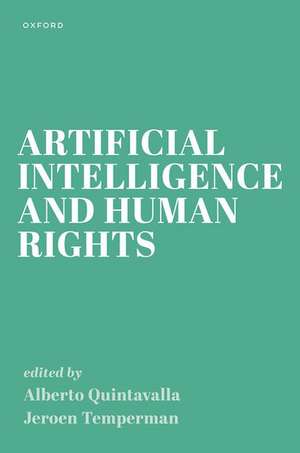
Artificial Intelligence and Human Rights
Alberto Quintavalla, Jeroen Tempermanen Limba Engleză Hardback – 6 sep 2023
Preț: 1127.07 lei
Preț vechi: 1621.59 lei
-30%
Puncte Express: 1691
Carte tipărită la comandă
Livrare economică 04-15 decembrie
Livrare prin curier în România Termenul estimat este afișat lângă disponibilitate.
Transport gratuit pentru acest produs Plată online sau ramburs, în funcție de opțiunile comenzii.
Retur gratuit în 14 zile Comandă securizată și suport în română.
Specificații
ISBN-13: 9780192882486
ISBN-10: 0192882481
Pagini: 688
Dimensiuni: 165 x 240 x 44 mm
Greutate: 1.16 kg
Editura: OUP OXFORD
Colecția OUP Oxford
Locul publicării:Oxford, United Kingdom
ISBN-10: 0192882481
Pagini: 688
Dimensiuni: 165 x 240 x 44 mm
Greutate: 1.16 kg
Editura: OUP OXFORD
Colecția OUP Oxford
Locul publicării:Oxford, United Kingdom
Recenzii
This book is a welcome attempt to consider some of the serious, even alarming, implications for human rights. It comprises more than 30 essays by a wide range of contributors, covering subjects such as civil and political rights, privacy, asylum, non-discrimination and legal procedure. The scale of the endeavour is [vast] ... [T]his book is an important contribution to what can only be the beginning of a revolution.
The book fills a gap in the literature by extensively covering the interplay between AI and HR, comprising first-, second- and third-generation rights...Another significant contribution of the book is providing an answer to whether the HR framework is the right one to address AI-related issues, risks, and opportunities...The book represents a strong foundation and invites conversation between academics and legal professionals altogether as we are figuring out how to incorporate technological developments further while trying to answer what we call Q 0: how we would like the world of tomorrow to look like.
[A]n essential reference to academics, policy practitioners, and legal experts concerned with responsible human-centered AI governance frameworks in their development. The book's structure is meticulously organized, with each part focusing on specific intersections between AI and various human rights concerns ... [A]n essential addition to discourses in AI and human rights on regulation and policy reforms that must be undertaken if AI technology is ever to respect, rather than undermine, human rights.
The book fills a gap in the literature by extensively covering the interplay between AI and HR, comprising first-, second- and third-generation rights...Another significant contribution of the book is providing an answer to whether the HR framework is the right one to address AI-related issues, risks, and opportunities...The book represents a strong foundation and invites conversation between academics and legal professionals altogether as we are figuring out how to incorporate technological developments further while trying to answer what we call Q 0: how we would like the world of tomorrow to look like.
[A]n essential reference to academics, policy practitioners, and legal experts concerned with responsible human-centered AI governance frameworks in their development. The book's structure is meticulously organized, with each part focusing on specific intersections between AI and various human rights concerns ... [A]n essential addition to discourses in AI and human rights on regulation and policy reforms that must be undertaken if AI technology is ever to respect, rather than undermine, human rights.
Notă biografică
Dr. Alberto Quintavalla is Assistant Professor at the Department of Law & Markets of the Erasmus University Rotterdam and Associated Fellow of the Jean Monnet Centre of Excellence on Digital Governance. He has been a visiting researcher at the Hebrew University of Jerusalem (recipient of the Guidetti Prize) and the European University Institute. He has been awarded the prize for the best 'new voice' published in the European Journal of Legal Studies (2020/2021). He is admitted to the Italian Bar. His research interests are at the intersection of environmental governance, human rights, and digital technologies.Jeroen Temperman is Professor of International Law at Erasmus School of Law at Erasmus University Rotterdam. He specialises in international human rights law. He is the Editor-in-Chief of Religion & Human Rights: An International Journal. He served as member of the Organization for Security and Cooperation in Europe's Panel of Experts on Freedom of Religion or Belief from 2016-2022. He has authored, among other books, Religious Hatred and International Law and State-Religion Relationships and Human Rights Law, and edited Blasphemy and Freedom of Expression and The Lautsi Papers.
Cuprins
- Table of International Law
- Table of Domestic Law
- Table of International Cases
- Table of Domestic Cases
- Acknowledgements
- About the Contributors
- Part I: AI-Based Human Rights Violations: A Technical Perspective
- 1: Alberto Quintavalla and Jeroen Temperman: Introduction
- 2: Martina %Smuclerová, Lubo Král, and Jan Drchal: AI Life Cycle and Human Rights: Risks and Remedies
- Part II: Artificial Intelligence and Assorted First Generation Civil and Political Rights
- 3: Valentina Golunova: Artificial Intelligence and the Right to Liberty and Security
- 4: Jeroen Temperman: Artificial Intelligence and Religious Freedom
- 5: Giovanni De Gregorio and Pietro Dunn: Artificial Intelligence and Freedom of Expression
- 6: Margaret Warthon: Artificial Intelligence and Freedom of Assembly
- 7: Letizia Tomada and Raphaële Xenidis: Artificial Intelligence and the Right to Property: The Human Rights Dimension of Intellectual Property
- Part III: Artificial Intelligence and Privacy
- 8: Alessia Zornetta and Ignacio Cofone: Artificial Intelligence and the Right to Privacy
- 9: Natalia Menéndez González: The Rights to Privacy and Data Protection and Facial Recognition Technology in the Global North
- 10: Malcolm Katrak and Ishita Chakrabarty: Privacy, Political Participation and Dissent: Facial Recognition Technologies and the Risk of Digital Authoritarianism in the Global South
- 11: Bart van der Sloot: The Production of and Control Over Data in the AI-Era: The Two Failing Approaches to Privacy Protection
- 12: Andrea Pin: Artificial Intelligence, the Public Space, and the Right to Be Ignored
- Part IV: Artificial Intelligence and Non-Discrimination
- 13: Louis Koen and Kgomotso Mufamadi: Artificial Intelligence and Racial Discrimination
- 14: Fabian Lütz: Artificial Intelligence and Gender-Based Discrimination
- 15: Masuma Shahid: Artificial Intelligence and LGBTQ+ Rights
- 16: Marília Papaléo Gagliardi: Artificial Intelligence and Women's Rights: Deepfake Technology
- 17: Antonella Zarra, Silvia Favalli, and Matilde Ceron: Artificial Intelligence and Disability Rights
- Part V: Artificial Intelligence and Fair Procedure
- 18: Helga Molbæk-Steensig and Alexandre Quemy: Artificial Intelligence and Fair Trial Rights
- 19: Migle Laukyte: Artificial Intelligence and Data Analytics: A Recipe for Human Rights Violations
- 20: Sarah de Heer: Artificial Intelligence and the Right to an Effective Remedy
- Part VI: Artificial Intelligence and Asylum
- 21: Raimy Reyes: Artificial Intelligence Technologies and the Right to Seek and Enjoy Asylum
- 22: Dhruv Somayajula: Artificial Intelligence Screening and the Right of Asylum
- Part VII: Artificial Intelligence and Second Generation Rights
- 23: Adekemi Omotubora: Artificial Intelligence and the Right to Food
- 24: Caroline Compton and Jessie Hohmann: Artificial Intelligence and the Right to Housing
- 25: Joe Atkinson and Philippa Collins: Artificial Intelligence and Human Rights at Work
- 26: Enrique Santamaría Echeverría: Artificial Intelligence and the Right to Health
- Part VIII: Artificial Intelligence and Third Generation Rights
- 27: Shu Li, Béatrice Schütte, and Lotta Majewski: Artificial Intelligence and Consumer Protection Rights
- 28: Alberto Quintavalla: Artificial Intelligence and the Right to a Healthy Environment
- Part IX: Artificial Intelligence and Human Rights: Reflections
- 29: Kostina Prifti, Alberto Quintavalla, and Jeroen Temperman: Artificial Intelligence and Human Rights: Understanding and Governing Common Risks and Benefits
- 30: Klaus Heine: Human Rights, Legal Personality and Artificial Intelligence: What Can Epistemology and Moral Philosophy Teach Law?
- 31: David Gunkel: Robot Rights / Human Responsibility
- 32: Florian Gamper: The Limits of AI Decision-Making: Are There Decisions Artificial Intelligence Should Not Make?
- 33: Sofia Ranchordás: Smart Cities, Artificial Intelligence and Public Law: An Unchained Melody
- 34: Isabel Ebert and Lisa Hsin: Putting Private Sector Responsibility in the Mix: A Business and Human Rights Approach to Artificial Intelligence
- 35: Alessandro Ortalda and Paul De Hert: Artificial Intelligence Human Rights Impact Assessment
- 36: Elizaveta Gromova and Evert Stamhuis: Real Life Experimentation with Artificial Intelligence
- Part X: Conclusion
- 37: Alberto Quintavalla and Jeroen Temperman: Conclusion
- Bibliography
- Index