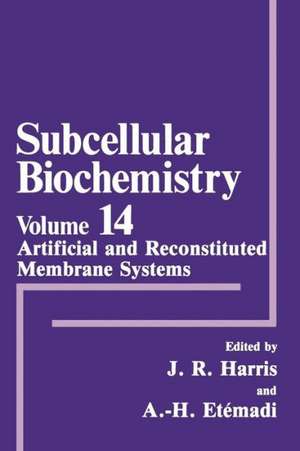
Artificial and Reconstituted Membrane Systems
Editat de J. Robin Harris, Abol-Hassan Etémadien Limba Engleză Paperback – 14 dec 2011
Preț: 388.47 lei
Puncte Express: 583
Carte tipărită la comandă
Livrare economică 27 noiembrie-11 decembrie
Livrare prin curier în România Termenul estimat este afișat lângă disponibilitate.
Transport gratuit de la 400.00 lei Plată online sau ramburs, în funcție de opțiunile comenzii.
Retur gratuit în 14 zile Comandă securizată și suport în română.
Specificații
ISBN-13: 9781461393641
ISBN-10: 1461393647
Pagini: 524
Ilustrații: XVIII, 501 p. 20 illus.
Dimensiuni: 152 x 229 x 29 mm
Greutate: 0.75 kg
Ediția:Softcover reprint of the original 1st ed. 1989
Editura: Springer
Locul publicării:New York, NY, United States
ISBN-10: 1461393647
Pagini: 524
Ilustrații: XVIII, 501 p. 20 illus.
Dimensiuni: 152 x 229 x 29 mm
Greutate: 0.75 kg
Ediția:Softcover reprint of the original 1st ed. 1989
Editura: Springer
Locul publicării:New York, NY, United States
V-ar putea interesa
-
 Clinical BiochemistryNessar Ahmed-27%Preț: 799.90 lei1095.76 lei
 -
 LipidsDenis J. Murphy-19%Preț: 474.69 lei586.04 lei
 -
 Bioelectrochemistry of Biomembranes and Biomimetic MembranesRolando Guidelli-9%Preț: 1126.78 lei1238.23 lei
 -
 -27%Preț: 1633.90 lei2227.70 lei
 -
 Cellulose & Cellulose Derivatives: Synthesis, Modification & ApplicationsMd Ibrahim H Mondal-27%Preț: 2298.80 lei3130.63 lei
 -
 -27%Preț: 2299.54 lei3131.11 lei
 -
 Phase TransformationsMichel Soustelle-9%Preț: 1018.34 lei1119.05 lei
 -
 Chemical EcologyAnne-Genevi?ve Bagn?res-9%Preț: 1017.78 lei1118.44 lei
Public țintă
ResearchCuprins
1 The Role of Detergents in Membrane Reconstruction.- 1. Introduction.- 2. The Membrane Environment.- 3. Detergents.- 4. Reconstitution.- 5. Some Concluding Comments.- 6. References.- 2 Membrane Lipid Phase Behavior and Lipid-Protein Interactions.- 1. Introduction.- 2. Polymorphism of Membrane Polar Lipids.- 3. Phase Bèhavior of Mixed Lipid Systems.- 4. Protein-Lipid Interactions.- 5. Conclusions.- 6. References.- 3 Reconstitution of Membrane Molecular Mechanisms in Bilayer Lipid Membranes and Patch-Clamp Bilayers.- 1. Introduction.- 2. Techniques for Formation and Characterization of Reconstituted Bilayers.- 3. Reconstitution of Membrane Molecular Mechanisms Related to Ion Transport and Excitability.- 4. Reconstitution of Synaptic Events.- 5. Reconstitution of Sensory Mechanisms.- 6. Physiological Processes in Nonexcitable Membranes.- 7. Concluding Remarks and Perspective.- 8. References.- 4 Fluorescence Studies of Membrane Dynamics and Heterogeneity.- 1. Introduction.- 2. Do Domains Exist?.- 3. What Are the Relaxation Times for Lipid Domains?.- 4. Future Trends.- 5. References.- 5 Membrane Fusion: Fusogenic Agents and Osmotic Forces.- 1. Introduction.- 2. Fusogenic Lipids.- 3. Fusion Induced by Polyethylene Glycol.- 4. Electrically Induced Cell Fusion.- 5. Molecular Models for Membrane Fusion.- 6. Virally Induced Membrane Fusion i.- 7. Exocytosis.- 8. References.- 6 Lectin-Carbohydrate Interactions in Model and Biological Membrane Systems.- 1. Introduction.- 2. Lectins: Abundance and Properties.- 3. Glycolipids and Glycoproteins: Biological Receptors for Lectins.- 4. Lectin-Carbohydrate Interactions in Model Systems.- 5. Lectin-Carbohydrate Interactions in Biological Systems.- 6. References.- 7 Energy-Transducing Complexes in Bacterial Respiratory Chains.- 1.Introduction.- 2. Electron Transfer Chain and Energy Coupling.- 3. Reconstitution into Liposomes.- 4. Cytochrome Oxidase.- 5. Cytochrome bc1 Complexes.- 6. NADH Dehydrogenases and Complex I.- 7. Energy-Transducing Components Other Than Complexes I-IV.- 8. Concluding Remarks and Outstanding Problems.- 9. References.- 8 Reconstitution of the High-Affinity Receptor for Immunoglobulin E.- 1. Introduction.- 2. Purification of the Receptor.- 3. Mechanisms of Action of the Receptor: Possible Functions to Reconstitute.- 4. Reconstitution Studies.- 5. Conclusions.- 6. References.- 9 Reconstitution of Acetylcholine Receptors into Planar Lipid Bilayers.- 1. Introduction.- 2. Technical Aspects of Acetylcholine-Receptor Reconstitution.- 3. Properties of Reconstituted Acetylcholine-Receptor Channels.- 4. Gating Models and Theoretical Aspects.- 5. Data from Other Experiments.- 6. Principal Requirements for a Functional Aeetylcholine-Receptor Channel.- 7. Summary and Conclusion.- 8. References.- 10 Liposomes as Carriers of Drugs: Observations on Vesicle Fate after Injection and Its Control.- 1. Introduction.- 2. Retention of Drugs by Liposomes in Contact with Blood.- 3. Circulation of Liposomes in the Blood.- 4. Distribution of Liposomes in Tissues.- 5. Conclusions.- 6. References.- 11 Reconstitution and Physiological Protein Translocation Processes.- 1. Introduction.- 2. Membrane Proteins and Protein Translocation Processes.- 3. Energy Dependence of Protein Translocation Processes.- 4. Translocation and Membrane-Anchoring Signals.- 5. Post-Translational Protein Translocation.- 6. Protein Translocation through or Insertion into Lipid Aggregates.- 7. General and Concluding Remarks.- 8. References.