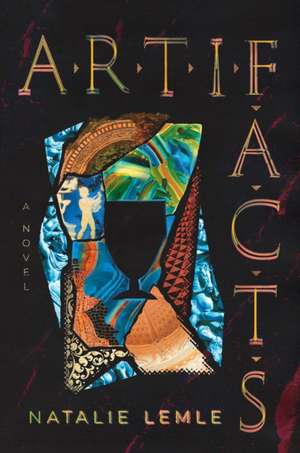
Artifacts
Autor Natalie Lemleen Limba Engleză Hardback – 2 iul 2026
Successful trusts and estates attorney Lena Connolly is asked by a colleague to assist on a case: the Italian government claims an artifact was looted and sold to a museum illegally and is seeking repatriation. The object in question is a cup made of dichroic glass, which would have been rare even in Ancient Rome, let alone thousands of years later.
Lena has done everything she can to put the study abroad summer she spent on an archaeological dig in the Italian Alps behind her. Her dreams of being an archaeologist shattered when her mentor Cyrille disappeared and her enigmatic boyfriend Giamma went dark, but with this new case, the past comes roaring back.
Told in alternating timelines, Artifacts follows young Lena as she falls in love with both archaeology and Giamma on the streets of Torino while her adult self pieces together what truly happened on the dig, now a fully restored Roman villa with World Heritage status. The dichroic cup, Lena discovers, may have been taken from the very site she helped unearth.
Powerful and exuberant, Natalie Lemle’s Artifacts brings readers behind the museum glass and asks questions about cultural heritage and the historical preservation of our shared sense of humanity.
Preț: 113.61 lei
Preț vechi: 137.51 lei
-17%
Puncte Express: 170
Carte disponibilă
Livrare economică 20 noiembrie-02 decembrie
Livrare express 31 octombrie-06 noiembrie pentru 54.49 lei
Livrare prin curier în România Termenul estimat este afișat lângă disponibilitate.
Transport gratuit de la 400.00 lei Plată online sau ramburs, în funcție de opțiunile comenzii.
Retur gratuit în 14 zile Comandă securizată și suport în română.
Specificații
ISBN-13: 9781668068342
ISBN-10: 1668068346
Pagini: 352
Dimensiuni: 152 x 229 x 30 mm
Greutate: 0.44 kg
Editura: Simon&Schuster
Colecția Simon & Schuster
ISBN-10: 1668068346
Pagini: 352
Dimensiuni: 152 x 229 x 30 mm
Greutate: 0.44 kg
Editura: Simon&Schuster
Colecția Simon & Schuster
Notă biografică
Natalie Lemle is the author of Artifacts. She studied classics and art history at Tufts University and earned an MFA in creative writing from Emerson College. She is the founder of art_works, an art advisory connecting visual artists with global companies, and serves on the boards of the Institute of Contemporary Art/Boston and the Associates of the Boston Public Library. She lives in Boston.
Extras
Chapter I I.
MARCH 7, 2022
NEW YORK CITY
People with bad blood like us shouldn’t procreate. Jinny said that to me once when we were little, and I never forgot it.
She did, though. Which is to say, Jinny’s pregnant—by choice. Arrangement was the exact word she used last night as she was shoving clothes into her backpack, avoiding my wide-eyed stare. I imagine her now on her flight back to LA, taking a pause from grading her students’ midterms to gaze out the window at flat clouds like in the O’Keeffe skyscape at the Art Institute, the one I loved as a kid because she did.
My thoughts are interrupted by an unfamiliar, genderless voice: “It’s a shakedown.”
I’m in the client-facing kitchen on the fifteenth floor, the only one in the firm with an espresso machine—and I’m startled, not because I can map any significance onto these words, but because it’s seven thirty on a Monday and the labyrinth of cubicles I walked through to get here was deserted as of five minutes ago. I open a drawer and tune in as I dig for dark roast.
“They want everything back,” the voice says, quieter now. “Tutto. Si, tutto.”
I peer around the corner, momentarily locking eyes with a bright-eyed older woman pressing a cell phone to her ear. I’m pretty sure I’ve never seen her before, but she turns away before I can get a good look at her face. As she makes her way down the corridor, I take in her tweed jacket, the seam in her pantyhose, and the way she’s ever so slightly favoring her left leg.
Americano in hand, I head to the elevator bank, clocking the unoccupied reception desk. I feel an impulse to turn back and ask the woman who she is and how she got up here, but then I remember about Jinny and catch the elevator.
BACK AT MY DESK, I sip coffee and stare out my window at the steel-gray Hudson, ruminating on last night’s sequence of events. Jinny across the table from me at dinner, drinking water instead of Sancerre; Jinny explaining after she vomited back at my apartment that morning sickness is a misnomer for the constant nausea of early pregnancy; Jinny insisting she was doing this on her own when I asked who the father was.
I’m refreshing my inbox for the tenth time when there’s a knock at my office door. “Yeah?” I call, glancing at the time in the upper right corner of my laptop. It’s 7:46. I got in early so I could proof and revise the second draft of a complicated estate plan, but I haven’t even opened the document. I should have gone to the gym, which is where I go when I really need to get something done. Nothing makes me more productive than the threat of exercising.
Emmanuel Reyes, the chair of the firm’s litigation practice, sticks his head in. “Got a minute, Lena?”
“Sure,” I say, getting to my feet when he signals for me to follow him. “I just need to—”
He cuts me off. “I’ll be brief.”
Emmanuel, who is not my boss—but whose advocacy would go a long way with the other equity partners at my annual review—is a good guy, deep down. I’ve heard him talk about his childhood in Rhode Island after a few drinks at work functions, the one-bedroom Section 8 apartment that housed him and his mother and his two brothers. When he clears his throat, I put the estate plan out of my mind and follow him.
Emmanuel’s office window is at least five times the size of mine, and as he gathers up a stack of papers at his desk, I take a seat at the round table in the corner and look out into the building next door, where a man on a headset is pacing around a conference room.
“Am I remembering correctly from that recruiting event way back that you speak Italian? You studied abroad or something?”
I straighten my spine and nod. “It’s rusty, I’m sure,” I say. “But yes.” I look up at the white grid of his dropped ceiling and calculate: eighteen. I was in Italy eighteen years ago. Incidentally, there are six rows of three large squares in the ceiling—I’m no numerologist, but this synchronicity feels somehow meaningful. I smooth my bangs as I try to picture myself back then: center-parted ash-brown hair down to the middle of my back, wide eyes, slack jaw.
“My granddaughter picked it out this morning,” he says, catching me eyeing his graffiti-print tie as he pulls out the chair next to me. “She spent the night.”
“How old is she?” I ask, out of politeness rather than genuine interest.
Emmanuel smiles and shakes his head. “Four. We gave up and put a sleeping bag on the floor of our room.”
I nod, thinking of how I slept on Jinny’s bedroom floor throughout our childhood, and then commandeered the whole room when she went to college. Other than my Romeo and Juliet movie poster, which I taped to the back of her closet door so I could doze off to the sight of Claire Danes kissing Leonardo DiCaprio, the room remained a shrine to my sister. My sister, who is now ten weeks pregnant.
He opens a manila folder. “Italy is accusing Fordham University’s museum of housing looted art. The report that came out of NYPD’s investigation is pretty brutal.”
I open my mouth to ask what this has to do with trusts and estates, but I change my mind and nod.
“We’ve been retained to represent Fordham in the case.”
This is a single-office corporate law firm; we’re less hierarchical than most big firms, which means that while it takes longer to make partner, it’s also easy to keep up with cases outside my practice area. But I’ve never heard of litigation working on a cultural heritage case, or any art law case. “They don’t have their own general counsel?”
“They do, but she doesn’t want to touch this.”
“Why?”
“She’s a higher ed attorney. She doesn’t know anything about looted antiquities—”
“Sorry,” I interrupt. What does Emmanuel know about looted antiquities? “Since when do we do cultural heritage law?”
“My team won a case a few years ago,” he says impatiently, “brought against an art dealer who was implicated in selling Nazi-looted paintings to some oil family in the fifties. I obtained a complete dismissal of all claims against the client.”
“He didn’t do it? The art dealer?”
“The case fell under government enforcement and compliance. The court was determined not to have jurisdiction,” Emmanuel says. “The claims were dismissed.”
So Emmanuel has practiced art law here. And now my skepticism is replaced with the energizing realization that this conversation must be about bringing me on to his new case—it’s not unheard of, after all, for litigation to pull in support from trusts and estates, especially during discovery.
“The museum only collects ancient art,” he continues. “Everything Italy wants back is fifth century or earlier. They don’t have great evidence for all of it. Most of it, actually. But this one, this cup—this is the smoking gun.”
He slides a photograph of a bas-relief glass cylinder layered into an ornate metal casing toward me. It looks like a cup made from stained glass with its green glow. I spot a winged figure holding up a bow and arrow. “It’s Cupid,” I say.
“Yeah,” he says. “Amor and Psyche, that’s how they have it catalogued. There’s something, some kind of metal—silver maybe?—mixed in with the glass, which makes it green.” He shuffles around his papers and pulls out another photograph. “If the light shows through the other way, it turns red. Dichroic glass, I guess it’s called.”
“Why is it the smoking gun?” I ask, noticing another vignette on the cup, in which a woman with butterfly wings—Psyche—holds up a torch to sleeping Cupid’s face.
“The Italians have Polaroids of it from a Swiss warehouse raid in the nineties. The dealer, this Italian guy, Valerio something, was arrested for illicit antiquities trading. Most of what he was dealing in was looted.”
My throat spasms, and I start coughing as Emmanuel opens his laptop and pulls up a document that shows a series of scanned blown-out Polaroids of the cup at different angles.
3–4 sec vetro—? is written in Sharpie on the central photo’s bottom white border.
“You okay, kid?”
I clear my throat and nod. “So this guy was just keeping Polaroids of all the things he sold?”
“Apparently it was part of an inventory system. The text down here is—”
“The origin date, right? Their guess. And material.”
Emmanuel grins. “See? I knew you could help.”
My cheeks warm at this validation, and I try to sound as nonchalant as possible when I ask, “Where in Switzerland was the warehouse?”
“Chiasso. Right over the border from Italy, in the Alps. Near Lugano.”
A warehouse near Lugano. Giamma. My eye twitches, and suddenly I’m in a wind tunnel with Giamma on one end and Cyrille on the other. I can practically feel Cyrille telling me—what is he telling me? He’s moving his mouth, he’s saying something, but I can’t hear it, and I can’t read his lips.
Emmanuel regards me impatiently. “What’s wrong?”
“Nothing,” I say with as much confidence as I can muster.
Thankfully, Emmanuel forges ahead. “The Italians haven’t shared all their evidence. But in advance of that, I need you to go through the paperwork. I know it’s not your wheelhouse, but this is too complicated to assign to someone who doesn’t understand international tax law. And a lot of it is not in English. Hence my question about whether you speak Italian.”
A sudden calmness comes over me. Some part of myself, I understand, is being unearthed. An old drive, an old yearning, and for a moment I can imagine a world in which I’m not locked away in my office drawing up estate plans and red-lining paperwork and editorializing wills according to my clients’ verbal tics. A world in which I am an active participant, doing work that matters.
“You’d be doing me a huge favor,” he adds. “And I checked, trusts and estates leadership is good with it.”
“Right,” I say, returning my gaze to the window. The man in the headset, the one I saw in the building next door when I first sat down, has disappeared. Cyrille was there too—up at the dig site in Orbagne that dark August morning—and then he was gone.
I take a deep breath, cringing at the sour smell of my now-cold coffee. I cover my cup with my hand and refocus. “So I’ll start with the policy docs?”
Emmanuel relaxes into his chair. “There’s a lot to wade through. State, national, international—there’s UNESCO’s charter, and then there are all the Italian policies. I’ll give you access to the folder on the drive.”
“Okay,” I say. “Next steps?”
He looks at his watch, then gathers up his papers. “Actually, the curator from Fordham will be here in about an hour for deposition prep. You wanna sit in?”
“Sure,” I say, putting the will I came in early to revise out of my mind.
BACK IN MY OFFICE, I call Lakshmi. She picks up on the first ring. “I have five minutes,” she says.
“You want to call me back later?”
“No, now is good.” She’s breathing audibly; I can tell she’s on foot.
“Are you on your way to a meeting?”
“I took my morning call from home so I could do Ovid’s walk. Iñigo left for a board meeting in San Francisco at the crack of dawn.”
A visual of the husky mix they rescued a month ago, which I’ve only seen in photos, comes to mind. For as long as I’ve known Iñigo, I have a harder time picturing him; he’s always traveling for work lately. “Maybe he crossed paths with Jinny at security.”
“How did it go with her this weekend?”
I decide to wait until Lakshmi has more than five minutes to get into it. “I’ll tell you later.”
“Tell me now!”
Outside my office, two first-year associates erupt into unselfconscious laughter. I watch them for a moment, telegraphing my disapproval, then I get up and close my door. It’s better to keep work relationships professional. Also, your twenties are not for socializing—they’re for building your career. I spent those years billing ten-hour days, then eating takeout at my desk while I caught up on non-billable to-dos. I always had Lakshmi, but we only ever saw each other on the weekends when we were finished with the work we’d brought home with us.
“She’s pregnant,” I say.
“Oh, babe.”
Hearing the empathy in her voice, I feel a wave of affection for Lakshmi, because it is such a relief not to have to explain. That with the little information she has absorbed about Jinny and me over the years, she can fill in the blanks and issue an appropriate response.
“Listen,” she says. “I’m just getting to work. Come over tomorrow. You can finally see the new place.”
In general I prefer to self-soothe with reality television and peanut butter and jelly on weeknights, but I should go. I should be with my friend, meet the dog, see her new place in the West Village, furnished by Iñigo’s IPO windfall and Lakshmi’s recent promotion to partner. “Yeah, fine. Thai?”
“I’ll make us something.”
Lakshmi never cooks. “Will I like it?”
She laughs. “Just come over at eight. Okay?”
“Wait,” I say. “Remember our professor Cyrille? From that archeology seminar sophomore year?”
There’s a long silence. And then, “Why are you thinking about him?”
Despite the wariness in her tone, I press forward. “The head of litigation just pulled me into this case against Fordham’s ancient art museum. Apparently they have all this stuff that Italy wants back. And I just—we never—” I hesitate, recalibrating. Then I decide to go ahead and come out with it. “Remember how Cyrille’s dig was looted?”
“Lena,” she says slowly, “the last time we talked about this, it did not end well.”
She’s right; the last time we talked about Cyrille, it led to the first and only fight of our nearly twenty-year friendship. We got past it, but I’ll never forget the betrayal I felt when Lakshmi said to me, eyes pleading in exasperation, only you can get over whatever you think happened. I didn’t talk to her for almost six months after that.
“You’re right,” I say. “Never mind. I’ll see you tomorrow.”
When we hang up, I open a new tab in my browser and search for Cyrille DuPuy, which I haven’t done in a decade. Nothing comes up except an old academic profile on the Université de Lyon website. Next, I google archeologia Orbagne.
My mouth floats open as I click into a press release announcing that the Roman villa I spent a summer excavating—my Orphean summer, as I’ve come to think of it, because at a certain point I started to get the sense that looking back on that brief period meant relinquishing something important about the life I’d managed to create for myself—has been granted UNESCO world heritage status.
I scan the photos of La villa del frutteto, which is now a fully excavated, multibuilding stone compound. There are images of elaborate interior floor mosaics: some are abstract geometric patterns, and then there are figurative ones that illustrate the workings of a farm—an apple orchard, a wine harvest, a field of roses—and finally, the mountains, with their ancient roads snaking up and around them. I breathe in audibly.
After I look at the images, I read the accompanying text. Cyrille’s name is nowhere to be found, and the site’s discovery is fully attributed to Dr. Pietro Botti. Which probably means what I think it means: Cyrille never came back.
I was once someone who believed that unearthing something from the ground, holding it, turning it over in my hands, would somehow teach me something about my place in the world. Maybe I am still that person. Because in this moment, I want nothing more than to run my hands over the rough surface of this alpine mosaic, to understand in a practical sense how thousands of tesserae came together to form an accurate image of the magical mountains rising around it. Something tells me that if I could do that, I might finally fill in the lacunae of my summer in the Alps. I might even start to understand the person I have since become: a risk-averse, paper-pushing attorney who keeps her office door closed.
Italy wants Fordham to return antiquities that belong to them. But cultural heritage is, in a way, a myth: a story conceived in retrospect to explain what to do with the things we have inherited. After my summer in Orbagne, I came to understand that ancient objects belong only to the past, which will always try to reclaim you. And to fixate on the past, I remind myself, is to sabotage the present.
AT NINE O’CLOCK I GRAB my laptop and make my way to the small conference room next to Emmanuel’s office. The daisy room, we call it, because of the framed print on the wall adjacent to the floor-length window. Whoever picked out the firm’s art back in the nineties, before we moved from Midtown to Hudson Yards, must have been inspired by a hospital waiting room. Or maybe just the culture here. If we had decorative pillows, they would be embroidered with phrases like Let’s take a surgical approach and We need to stop the bleeding.
“Lena,” Emmanuel says when I walk in, “this is Dr. Boswell.”
I recognize Dr. Boswell immediately, but she looks different here than she did in the context of the kitchen downstairs. More grandmotherly, maybe—I notice now the oversized flower brooch on the lapel of her tweed jacket and the pink tone of her dyed blond hair.
“Caroline,” she says, studying my face.
Emmanuel pours Caroline a glass of water from the carafe on the center of the table. After a few minutes of small talk, he opens his folder.
“Let’s start from the beginning,” he says. “The cup was a donation from a company called—” He looks down at the museum’s provenance report. “Creon, one of your vendors. Can you walk us through the accession process?”
“Yeah, so this was part of a group donation,” Caroline says with a flippancy that counters her buttoned-up appearance. “From Creon, as you say. They manufacture the glass display cases we use throughout the museum—”
“And to clarify”—Emmanuel interjects—“this was a donation, not an exchange of some sort? Was there a conflict-of-interest clause in your vendor agreement with them?”
Caroline clears her throat. “Most of our vendors make generous annual cash donations,” she says. “The president of the company made a gift of art in lieu of a monetary donation. This was a one-off in 2007.”
Emmanuel looks up from his papers. His silver eyebrows are knitted together. “Sidebar,” he says. “And this is not an accusation. I get that it’s standard in your world. But it sounds like pay to play. Obviously this is not a government case, but it’s a political one, and it’s higher ed. So we need to be careful with the verbiage you use to describe your relationship.”
Caroline narrows her eyes and nods. I open my laptop as inconspicuously as I can and google Creon museum cases. The website is in English. They have sophisticated branding and high-res photos of artifacts in glass cases on their home page. I navigate to the About section. None of the leadership team’s bios are accompanied by headshots.
“Let’s keep going,” Emmanuel continues. “How did Creon’s president determine what to give the museum? Were you involved in that decision?”
Caroline breathes in deeply, and I get the feeling she’s told this story a hundred times. “Creon holds and displays an important collection of imperial Roman objects,” she says. “In their Turin office.”
“Wait,” I say, glancing up from my laptop. Emmanuel shoots me a look. “I’m sorry to interrupt, but Creon’s website has them based in Rome. With offices in Los Angeles and Seoul.”
Caroline regards me quizzically. “Their unofficial headquarters are in Turin. And the gallery is open by appointment.”
I type Creon gallery into my notes document and nod at her. “Got it, okay.”
“The gallery is small, and it doubles as a showroom for their products—their display cases. And I knew—I’d always known—that Filippo has a ton of stuff in storage at the office.”
At this I straighten up. “Filippo Dalmasso. Creon’s president?”
Caroline nods. “We’re talking rare sculptures, sarcophagi, papyrus fragments—incredible stuff. Anyway, in 2006, we were on a museum patron trip, this was with Oliver—”
“Oliver?” Emmanuel asks.
“Oliver Clive, Fordham’s director of planned giving.”
I tilt my head to the side as an image of a solicitous, well-groomed man flashes in my mind’s eye. “I know Oliver,” I say to Emmanuel, who nods back at me. To Caroline, I clarify, “I’ve worked with him on a few estates I represent.”
She looks surprised. “Really?”
“For the university, not the museum. Fordham alums love giving back to Fordham.”
Emmanuel shuffles through his papers. “I don’t see him on any of these witness lists.”
Caroline shrugs, and Emmanuel nods at me. I type Oliver Clive in the to-dos section of my notes.
“So anyway,” Caroline says, “one night we’re at dinner and Oliver starts telling him about the tax breaks if he donates through the American office. When the works were last appraised, all that, and whether they’re promised to any other institutions.
“And then the Greek and Roman galleries reopened at the Met a few months later,” Caroline continues after a brief pause. “Filippo came in for the opening. This was when the Rothschilds’ collection was getting a ton of press. And that’s when he committed to making the donation. I was thrilled, obviously.”
“But the donation was anonymous?” Emmanuel asks.
“Correct,” Caroline says. “Very common for a gift of that magnitude. They don’t want the other museums they work with coming after them with requests.”
“Did you have a role in selecting the objects he was donating?” Emmanuel asks again.
Now Caroline leans forward. “Look. I’m a papyrologist by training. I wanted the fragments. The cup, it’s special and everything, but we’re small. We’re not super focused on late Roman stuff. We’ve got one in-house conservator for the collection, which encompasses the entire ancient world, and she doesn’t do glass. I actually had to outsource conservation for a lot of what he donated. Though I will not deny that the cup raised the museum’s profile. There are only two complete figurative dichroic glass cups in the world. The other one is in the British Museum.”
“Okay, so you outsourced conservation,” Emmanuel says. “Who did the cataloguing?”
I raise my eyebrows, impressed with Emmanuel’s museum-speak. Caroline hesitates.
“I guess what I’m asking,” Emmanuel adds, “is who verified the provenance? Was that you?”
“Provenance is a judgment call,” she says. “And this was a group donation. And it was before all the drama of Marianne’s indictment. The aftermath of it, I mean.”
“Marianne?” I ask.
She pauses. I examine her face. She looks either exasperated or indignant, or both. “Marianne Flynn,” she says.
I look over at Emmanuel, who gives me a minute shake of his head.
“The point is,” Caroline continues, “it was a different time. It’s not like now, when there’s a microscope on everything we do.”
Emmanuel clears his throat. He’s losing his patience, I can tell.
“What you have to understand,” Caroline says, “is that most of these so-called ‘looted antiquities’ are being repatriated on a moral basis.” She looks at Emmanuel and me expectantly. “It’s good PR.”
“And so this document—” Emmanuel holds up a scan of the provenance from the original accession file. “Who composed this document?”
“I did,” Caroline says with a trace of resentment. “Based on the information that Filippo provided, which I took at face value. And the collections committee ratified it.”
“Who sits on the collections committee?” I ask. Emmanuel shakes his head at me again, this time vigorously. “Sorry,” I say. “Not relevant.”
“It might be relevant,” Emmanuel says. “But let’s stay on track.”
“Look, there’s nothing nefarious going on here,” Caroline says. “I’m not an idiot. I’ve been in the field for decades. I’ve seen sketchy deals, and trust me, this was not sketchy. There was no reason to think anything from Italy was unearthed after 1939. This cup, for example—it’s glass. The condition is too good for it to have been looted. There’s a fragment at the Met with the same dichroic properties—go look at that. That was probably looted.”
Caroline delivers these words with such force that for a second I’m utterly convinced there’s no reason for us to be sitting here, questioning her. But then her eyes glaze over, as if she’s making a calculation of some sort. “Why?” I hear myself ask.
Caroline and Emmanuel exchange a glance. “What do you mean, why?” she asks.
I close my eyes hard, picturing the dark mountains surrounding Giamma’s car on the road from Orbagne to Saint-Marcel. Italians would never dig holes like that, his friend said from the back seat when I asked them about the looting at Cyrille’s dig that winter. Even looters in Italy care about the art, was the implication.
When I open my eyes, Caroline is searching my face. I can’t tell if she’s challenging me or reconsidering me. But I decide to disengage; I don’t want to give either one of them a reason to take away my seat at this table. “Forget it.”
Emmanuel gives me a quizzical look, then asks Caroline more questions about her current relationship with Filippo Dalmasso, which she tells us is ongoing and good; Creon just provided six new cases for their Etruscan gallery renovation. I stay quiet, silently berating myself. I haven’t lost my composure like this in a client-facing meeting since I was an associate.
“Last thing,” Emmanuel says. “What have Creon’s people said about all this?”
For the first time in our conversation, Caroline deflates slightly. “We haven’t been in contact.”
She’s lying. I feel it in my bones. Caroline was speaking in Italian this morning. She must have been on the phone with Filippo Dalmasso.
“So your relationship is ‘ongoing and good,’ but you haven’t discussed the charges?” Emmanuel presses.
“I’m not sure he knows about them at all,” she says. “Though every time Italy makes one of these requests it seems to end up in the press over there. But I have not brought it up, no.”
Emmanuel watches Caroline for a long moment, then puts his pen down. “All right. Let’s leave it there.”
On our way out of the conference room, Caroline hesitates, then reaches into her bag and pulls out a postcard. “The cup will be on view for the next few weeks for an exhibition—” She pauses, registering Emmanuel’s alarmed expression. “I know, I know,” she says. “But the show has been in the works for years, long before any of this. The Many Faces of Aphrodite. There’s a VIP opening tonight, just for our top-tier patrons. You’re welcome to stop by.”
“I’ll be there,” I blurt, as Emmanuel simultaneously says with feigned regret, “I wish we could make it.”
Caroline looks amused and takes her leave. I walk Emmanuel back to his office.
“Were you just trying to be respectful of my time, or do you not want me to go to the opening?” I ask.
“Go if you want to. But bill the hours and take notes. She’s slippery. I can’t put my finger on it, but something feels off about the sequence of events. We should talk to this Oliver guy. And maybe the conservator she mentioned. Can’t make it up, huh?”
Now would be the moment to tell Emmanuel about the phone call I overheard this morning, but I decide not to. It’s as if I want to preserve the curiosity I’m feeling in this moment, to keep it for myself. “Do you think Filippo Dalmasso knows it was looted?” I ask.
Emmanuel shrugs. “I don’t see what changes if he does.”
When he closes the door to his office, I stand there in the hallway, examining the Cupid and Psyche cup on Caroline’s postcard, trying to call up as many details as I can about the myth, which I knew well at one point in my life. Venus sending Cupid to mess with the mortal princess Psyche, whose beauty rivaled hers; Cupid falling in love with her instead; Psyche disobeying when he told her never to look at him, holding up a torch to his beautiful sleeping face in the middle of the night after she realized she was pregnant. Psyche atoning for this betrayal and then marrying Cupid in an apotheosis blessed by the gods, just in time to give birth to their daughter.
Mainly I recall the solitude of navigating noun declensions, conjugating verbs, grasping for English equivalents to the Latin. Words can only take you so far, I remember thinking. Maybe they can get you out of your own head, but they can’t bring you into the past. Not like artifacts can.
MARCH 7, 2022
NEW YORK CITY
People with bad blood like us shouldn’t procreate. Jinny said that to me once when we were little, and I never forgot it.
She did, though. Which is to say, Jinny’s pregnant—by choice. Arrangement was the exact word she used last night as she was shoving clothes into her backpack, avoiding my wide-eyed stare. I imagine her now on her flight back to LA, taking a pause from grading her students’ midterms to gaze out the window at flat clouds like in the O’Keeffe skyscape at the Art Institute, the one I loved as a kid because she did.
My thoughts are interrupted by an unfamiliar, genderless voice: “It’s a shakedown.”
I’m in the client-facing kitchen on the fifteenth floor, the only one in the firm with an espresso machine—and I’m startled, not because I can map any significance onto these words, but because it’s seven thirty on a Monday and the labyrinth of cubicles I walked through to get here was deserted as of five minutes ago. I open a drawer and tune in as I dig for dark roast.
“They want everything back,” the voice says, quieter now. “Tutto. Si, tutto.”
I peer around the corner, momentarily locking eyes with a bright-eyed older woman pressing a cell phone to her ear. I’m pretty sure I’ve never seen her before, but she turns away before I can get a good look at her face. As she makes her way down the corridor, I take in her tweed jacket, the seam in her pantyhose, and the way she’s ever so slightly favoring her left leg.
Americano in hand, I head to the elevator bank, clocking the unoccupied reception desk. I feel an impulse to turn back and ask the woman who she is and how she got up here, but then I remember about Jinny and catch the elevator.
BACK AT MY DESK, I sip coffee and stare out my window at the steel-gray Hudson, ruminating on last night’s sequence of events. Jinny across the table from me at dinner, drinking water instead of Sancerre; Jinny explaining after she vomited back at my apartment that morning sickness is a misnomer for the constant nausea of early pregnancy; Jinny insisting she was doing this on her own when I asked who the father was.
I’m refreshing my inbox for the tenth time when there’s a knock at my office door. “Yeah?” I call, glancing at the time in the upper right corner of my laptop. It’s 7:46. I got in early so I could proof and revise the second draft of a complicated estate plan, but I haven’t even opened the document. I should have gone to the gym, which is where I go when I really need to get something done. Nothing makes me more productive than the threat of exercising.
Emmanuel Reyes, the chair of the firm’s litigation practice, sticks his head in. “Got a minute, Lena?”
“Sure,” I say, getting to my feet when he signals for me to follow him. “I just need to—”
He cuts me off. “I’ll be brief.”
Emmanuel, who is not my boss—but whose advocacy would go a long way with the other equity partners at my annual review—is a good guy, deep down. I’ve heard him talk about his childhood in Rhode Island after a few drinks at work functions, the one-bedroom Section 8 apartment that housed him and his mother and his two brothers. When he clears his throat, I put the estate plan out of my mind and follow him.
Emmanuel’s office window is at least five times the size of mine, and as he gathers up a stack of papers at his desk, I take a seat at the round table in the corner and look out into the building next door, where a man on a headset is pacing around a conference room.
“Am I remembering correctly from that recruiting event way back that you speak Italian? You studied abroad or something?”
I straighten my spine and nod. “It’s rusty, I’m sure,” I say. “But yes.” I look up at the white grid of his dropped ceiling and calculate: eighteen. I was in Italy eighteen years ago. Incidentally, there are six rows of three large squares in the ceiling—I’m no numerologist, but this synchronicity feels somehow meaningful. I smooth my bangs as I try to picture myself back then: center-parted ash-brown hair down to the middle of my back, wide eyes, slack jaw.
“My granddaughter picked it out this morning,” he says, catching me eyeing his graffiti-print tie as he pulls out the chair next to me. “She spent the night.”
“How old is she?” I ask, out of politeness rather than genuine interest.
Emmanuel smiles and shakes his head. “Four. We gave up and put a sleeping bag on the floor of our room.”
I nod, thinking of how I slept on Jinny’s bedroom floor throughout our childhood, and then commandeered the whole room when she went to college. Other than my Romeo and Juliet movie poster, which I taped to the back of her closet door so I could doze off to the sight of Claire Danes kissing Leonardo DiCaprio, the room remained a shrine to my sister. My sister, who is now ten weeks pregnant.
He opens a manila folder. “Italy is accusing Fordham University’s museum of housing looted art. The report that came out of NYPD’s investigation is pretty brutal.”
I open my mouth to ask what this has to do with trusts and estates, but I change my mind and nod.
“We’ve been retained to represent Fordham in the case.”
This is a single-office corporate law firm; we’re less hierarchical than most big firms, which means that while it takes longer to make partner, it’s also easy to keep up with cases outside my practice area. But I’ve never heard of litigation working on a cultural heritage case, or any art law case. “They don’t have their own general counsel?”
“They do, but she doesn’t want to touch this.”
“Why?”
“She’s a higher ed attorney. She doesn’t know anything about looted antiquities—”
“Sorry,” I interrupt. What does Emmanuel know about looted antiquities? “Since when do we do cultural heritage law?”
“My team won a case a few years ago,” he says impatiently, “brought against an art dealer who was implicated in selling Nazi-looted paintings to some oil family in the fifties. I obtained a complete dismissal of all claims against the client.”
“He didn’t do it? The art dealer?”
“The case fell under government enforcement and compliance. The court was determined not to have jurisdiction,” Emmanuel says. “The claims were dismissed.”
So Emmanuel has practiced art law here. And now my skepticism is replaced with the energizing realization that this conversation must be about bringing me on to his new case—it’s not unheard of, after all, for litigation to pull in support from trusts and estates, especially during discovery.
“The museum only collects ancient art,” he continues. “Everything Italy wants back is fifth century or earlier. They don’t have great evidence for all of it. Most of it, actually. But this one, this cup—this is the smoking gun.”
He slides a photograph of a bas-relief glass cylinder layered into an ornate metal casing toward me. It looks like a cup made from stained glass with its green glow. I spot a winged figure holding up a bow and arrow. “It’s Cupid,” I say.
“Yeah,” he says. “Amor and Psyche, that’s how they have it catalogued. There’s something, some kind of metal—silver maybe?—mixed in with the glass, which makes it green.” He shuffles around his papers and pulls out another photograph. “If the light shows through the other way, it turns red. Dichroic glass, I guess it’s called.”
“Why is it the smoking gun?” I ask, noticing another vignette on the cup, in which a woman with butterfly wings—Psyche—holds up a torch to sleeping Cupid’s face.
“The Italians have Polaroids of it from a Swiss warehouse raid in the nineties. The dealer, this Italian guy, Valerio something, was arrested for illicit antiquities trading. Most of what he was dealing in was looted.”
My throat spasms, and I start coughing as Emmanuel opens his laptop and pulls up a document that shows a series of scanned blown-out Polaroids of the cup at different angles.
3–4 sec vetro—? is written in Sharpie on the central photo’s bottom white border.
“You okay, kid?”
I clear my throat and nod. “So this guy was just keeping Polaroids of all the things he sold?”
“Apparently it was part of an inventory system. The text down here is—”
“The origin date, right? Their guess. And material.”
Emmanuel grins. “See? I knew you could help.”
My cheeks warm at this validation, and I try to sound as nonchalant as possible when I ask, “Where in Switzerland was the warehouse?”
“Chiasso. Right over the border from Italy, in the Alps. Near Lugano.”
A warehouse near Lugano. Giamma. My eye twitches, and suddenly I’m in a wind tunnel with Giamma on one end and Cyrille on the other. I can practically feel Cyrille telling me—what is he telling me? He’s moving his mouth, he’s saying something, but I can’t hear it, and I can’t read his lips.
Emmanuel regards me impatiently. “What’s wrong?”
“Nothing,” I say with as much confidence as I can muster.
Thankfully, Emmanuel forges ahead. “The Italians haven’t shared all their evidence. But in advance of that, I need you to go through the paperwork. I know it’s not your wheelhouse, but this is too complicated to assign to someone who doesn’t understand international tax law. And a lot of it is not in English. Hence my question about whether you speak Italian.”
A sudden calmness comes over me. Some part of myself, I understand, is being unearthed. An old drive, an old yearning, and for a moment I can imagine a world in which I’m not locked away in my office drawing up estate plans and red-lining paperwork and editorializing wills according to my clients’ verbal tics. A world in which I am an active participant, doing work that matters.
“You’d be doing me a huge favor,” he adds. “And I checked, trusts and estates leadership is good with it.”
“Right,” I say, returning my gaze to the window. The man in the headset, the one I saw in the building next door when I first sat down, has disappeared. Cyrille was there too—up at the dig site in Orbagne that dark August morning—and then he was gone.
I take a deep breath, cringing at the sour smell of my now-cold coffee. I cover my cup with my hand and refocus. “So I’ll start with the policy docs?”
Emmanuel relaxes into his chair. “There’s a lot to wade through. State, national, international—there’s UNESCO’s charter, and then there are all the Italian policies. I’ll give you access to the folder on the drive.”
“Okay,” I say. “Next steps?”
He looks at his watch, then gathers up his papers. “Actually, the curator from Fordham will be here in about an hour for deposition prep. You wanna sit in?”
“Sure,” I say, putting the will I came in early to revise out of my mind.
BACK IN MY OFFICE, I call Lakshmi. She picks up on the first ring. “I have five minutes,” she says.
“You want to call me back later?”
“No, now is good.” She’s breathing audibly; I can tell she’s on foot.
“Are you on your way to a meeting?”
“I took my morning call from home so I could do Ovid’s walk. Iñigo left for a board meeting in San Francisco at the crack of dawn.”
A visual of the husky mix they rescued a month ago, which I’ve only seen in photos, comes to mind. For as long as I’ve known Iñigo, I have a harder time picturing him; he’s always traveling for work lately. “Maybe he crossed paths with Jinny at security.”
“How did it go with her this weekend?”
I decide to wait until Lakshmi has more than five minutes to get into it. “I’ll tell you later.”
“Tell me now!”
Outside my office, two first-year associates erupt into unselfconscious laughter. I watch them for a moment, telegraphing my disapproval, then I get up and close my door. It’s better to keep work relationships professional. Also, your twenties are not for socializing—they’re for building your career. I spent those years billing ten-hour days, then eating takeout at my desk while I caught up on non-billable to-dos. I always had Lakshmi, but we only ever saw each other on the weekends when we were finished with the work we’d brought home with us.
“She’s pregnant,” I say.
“Oh, babe.”
Hearing the empathy in her voice, I feel a wave of affection for Lakshmi, because it is such a relief not to have to explain. That with the little information she has absorbed about Jinny and me over the years, she can fill in the blanks and issue an appropriate response.
“Listen,” she says. “I’m just getting to work. Come over tomorrow. You can finally see the new place.”
In general I prefer to self-soothe with reality television and peanut butter and jelly on weeknights, but I should go. I should be with my friend, meet the dog, see her new place in the West Village, furnished by Iñigo’s IPO windfall and Lakshmi’s recent promotion to partner. “Yeah, fine. Thai?”
“I’ll make us something.”
Lakshmi never cooks. “Will I like it?”
She laughs. “Just come over at eight. Okay?”
“Wait,” I say. “Remember our professor Cyrille? From that archeology seminar sophomore year?”
There’s a long silence. And then, “Why are you thinking about him?”
Despite the wariness in her tone, I press forward. “The head of litigation just pulled me into this case against Fordham’s ancient art museum. Apparently they have all this stuff that Italy wants back. And I just—we never—” I hesitate, recalibrating. Then I decide to go ahead and come out with it. “Remember how Cyrille’s dig was looted?”
“Lena,” she says slowly, “the last time we talked about this, it did not end well.”
She’s right; the last time we talked about Cyrille, it led to the first and only fight of our nearly twenty-year friendship. We got past it, but I’ll never forget the betrayal I felt when Lakshmi said to me, eyes pleading in exasperation, only you can get over whatever you think happened. I didn’t talk to her for almost six months after that.
“You’re right,” I say. “Never mind. I’ll see you tomorrow.”
When we hang up, I open a new tab in my browser and search for Cyrille DuPuy, which I haven’t done in a decade. Nothing comes up except an old academic profile on the Université de Lyon website. Next, I google archeologia Orbagne.
My mouth floats open as I click into a press release announcing that the Roman villa I spent a summer excavating—my Orphean summer, as I’ve come to think of it, because at a certain point I started to get the sense that looking back on that brief period meant relinquishing something important about the life I’d managed to create for myself—has been granted UNESCO world heritage status.
I scan the photos of La villa del frutteto, which is now a fully excavated, multibuilding stone compound. There are images of elaborate interior floor mosaics: some are abstract geometric patterns, and then there are figurative ones that illustrate the workings of a farm—an apple orchard, a wine harvest, a field of roses—and finally, the mountains, with their ancient roads snaking up and around them. I breathe in audibly.
After I look at the images, I read the accompanying text. Cyrille’s name is nowhere to be found, and the site’s discovery is fully attributed to Dr. Pietro Botti. Which probably means what I think it means: Cyrille never came back.
I was once someone who believed that unearthing something from the ground, holding it, turning it over in my hands, would somehow teach me something about my place in the world. Maybe I am still that person. Because in this moment, I want nothing more than to run my hands over the rough surface of this alpine mosaic, to understand in a practical sense how thousands of tesserae came together to form an accurate image of the magical mountains rising around it. Something tells me that if I could do that, I might finally fill in the lacunae of my summer in the Alps. I might even start to understand the person I have since become: a risk-averse, paper-pushing attorney who keeps her office door closed.
Italy wants Fordham to return antiquities that belong to them. But cultural heritage is, in a way, a myth: a story conceived in retrospect to explain what to do with the things we have inherited. After my summer in Orbagne, I came to understand that ancient objects belong only to the past, which will always try to reclaim you. And to fixate on the past, I remind myself, is to sabotage the present.
AT NINE O’CLOCK I GRAB my laptop and make my way to the small conference room next to Emmanuel’s office. The daisy room, we call it, because of the framed print on the wall adjacent to the floor-length window. Whoever picked out the firm’s art back in the nineties, before we moved from Midtown to Hudson Yards, must have been inspired by a hospital waiting room. Or maybe just the culture here. If we had decorative pillows, they would be embroidered with phrases like Let’s take a surgical approach and We need to stop the bleeding.
“Lena,” Emmanuel says when I walk in, “this is Dr. Boswell.”
I recognize Dr. Boswell immediately, but she looks different here than she did in the context of the kitchen downstairs. More grandmotherly, maybe—I notice now the oversized flower brooch on the lapel of her tweed jacket and the pink tone of her dyed blond hair.
“Caroline,” she says, studying my face.
Emmanuel pours Caroline a glass of water from the carafe on the center of the table. After a few minutes of small talk, he opens his folder.
“Let’s start from the beginning,” he says. “The cup was a donation from a company called—” He looks down at the museum’s provenance report. “Creon, one of your vendors. Can you walk us through the accession process?”
“Yeah, so this was part of a group donation,” Caroline says with a flippancy that counters her buttoned-up appearance. “From Creon, as you say. They manufacture the glass display cases we use throughout the museum—”
“And to clarify”—Emmanuel interjects—“this was a donation, not an exchange of some sort? Was there a conflict-of-interest clause in your vendor agreement with them?”
Caroline clears her throat. “Most of our vendors make generous annual cash donations,” she says. “The president of the company made a gift of art in lieu of a monetary donation. This was a one-off in 2007.”
Emmanuel looks up from his papers. His silver eyebrows are knitted together. “Sidebar,” he says. “And this is not an accusation. I get that it’s standard in your world. But it sounds like pay to play. Obviously this is not a government case, but it’s a political one, and it’s higher ed. So we need to be careful with the verbiage you use to describe your relationship.”
Caroline narrows her eyes and nods. I open my laptop as inconspicuously as I can and google Creon museum cases. The website is in English. They have sophisticated branding and high-res photos of artifacts in glass cases on their home page. I navigate to the About section. None of the leadership team’s bios are accompanied by headshots.
“Let’s keep going,” Emmanuel continues. “How did Creon’s president determine what to give the museum? Were you involved in that decision?”
Caroline breathes in deeply, and I get the feeling she’s told this story a hundred times. “Creon holds and displays an important collection of imperial Roman objects,” she says. “In their Turin office.”
“Wait,” I say, glancing up from my laptop. Emmanuel shoots me a look. “I’m sorry to interrupt, but Creon’s website has them based in Rome. With offices in Los Angeles and Seoul.”
Caroline regards me quizzically. “Their unofficial headquarters are in Turin. And the gallery is open by appointment.”
I type Creon gallery into my notes document and nod at her. “Got it, okay.”
“The gallery is small, and it doubles as a showroom for their products—their display cases. And I knew—I’d always known—that Filippo has a ton of stuff in storage at the office.”
At this I straighten up. “Filippo Dalmasso. Creon’s president?”
Caroline nods. “We’re talking rare sculptures, sarcophagi, papyrus fragments—incredible stuff. Anyway, in 2006, we were on a museum patron trip, this was with Oliver—”
“Oliver?” Emmanuel asks.
“Oliver Clive, Fordham’s director of planned giving.”
I tilt my head to the side as an image of a solicitous, well-groomed man flashes in my mind’s eye. “I know Oliver,” I say to Emmanuel, who nods back at me. To Caroline, I clarify, “I’ve worked with him on a few estates I represent.”
She looks surprised. “Really?”
“For the university, not the museum. Fordham alums love giving back to Fordham.”
Emmanuel shuffles through his papers. “I don’t see him on any of these witness lists.”
Caroline shrugs, and Emmanuel nods at me. I type Oliver Clive in the to-dos section of my notes.
“So anyway,” Caroline says, “one night we’re at dinner and Oliver starts telling him about the tax breaks if he donates through the American office. When the works were last appraised, all that, and whether they’re promised to any other institutions.
“And then the Greek and Roman galleries reopened at the Met a few months later,” Caroline continues after a brief pause. “Filippo came in for the opening. This was when the Rothschilds’ collection was getting a ton of press. And that’s when he committed to making the donation. I was thrilled, obviously.”
“But the donation was anonymous?” Emmanuel asks.
“Correct,” Caroline says. “Very common for a gift of that magnitude. They don’t want the other museums they work with coming after them with requests.”
“Did you have a role in selecting the objects he was donating?” Emmanuel asks again.
Now Caroline leans forward. “Look. I’m a papyrologist by training. I wanted the fragments. The cup, it’s special and everything, but we’re small. We’re not super focused on late Roman stuff. We’ve got one in-house conservator for the collection, which encompasses the entire ancient world, and she doesn’t do glass. I actually had to outsource conservation for a lot of what he donated. Though I will not deny that the cup raised the museum’s profile. There are only two complete figurative dichroic glass cups in the world. The other one is in the British Museum.”
“Okay, so you outsourced conservation,” Emmanuel says. “Who did the cataloguing?”
I raise my eyebrows, impressed with Emmanuel’s museum-speak. Caroline hesitates.
“I guess what I’m asking,” Emmanuel adds, “is who verified the provenance? Was that you?”
“Provenance is a judgment call,” she says. “And this was a group donation. And it was before all the drama of Marianne’s indictment. The aftermath of it, I mean.”
“Marianne?” I ask.
She pauses. I examine her face. She looks either exasperated or indignant, or both. “Marianne Flynn,” she says.
I look over at Emmanuel, who gives me a minute shake of his head.
“The point is,” Caroline continues, “it was a different time. It’s not like now, when there’s a microscope on everything we do.”
Emmanuel clears his throat. He’s losing his patience, I can tell.
“What you have to understand,” Caroline says, “is that most of these so-called ‘looted antiquities’ are being repatriated on a moral basis.” She looks at Emmanuel and me expectantly. “It’s good PR.”
“And so this document—” Emmanuel holds up a scan of the provenance from the original accession file. “Who composed this document?”
“I did,” Caroline says with a trace of resentment. “Based on the information that Filippo provided, which I took at face value. And the collections committee ratified it.”
“Who sits on the collections committee?” I ask. Emmanuel shakes his head at me again, this time vigorously. “Sorry,” I say. “Not relevant.”
“It might be relevant,” Emmanuel says. “But let’s stay on track.”
“Look, there’s nothing nefarious going on here,” Caroline says. “I’m not an idiot. I’ve been in the field for decades. I’ve seen sketchy deals, and trust me, this was not sketchy. There was no reason to think anything from Italy was unearthed after 1939. This cup, for example—it’s glass. The condition is too good for it to have been looted. There’s a fragment at the Met with the same dichroic properties—go look at that. That was probably looted.”
Caroline delivers these words with such force that for a second I’m utterly convinced there’s no reason for us to be sitting here, questioning her. But then her eyes glaze over, as if she’s making a calculation of some sort. “Why?” I hear myself ask.
Caroline and Emmanuel exchange a glance. “What do you mean, why?” she asks.
I close my eyes hard, picturing the dark mountains surrounding Giamma’s car on the road from Orbagne to Saint-Marcel. Italians would never dig holes like that, his friend said from the back seat when I asked them about the looting at Cyrille’s dig that winter. Even looters in Italy care about the art, was the implication.
When I open my eyes, Caroline is searching my face. I can’t tell if she’s challenging me or reconsidering me. But I decide to disengage; I don’t want to give either one of them a reason to take away my seat at this table. “Forget it.”
Emmanuel gives me a quizzical look, then asks Caroline more questions about her current relationship with Filippo Dalmasso, which she tells us is ongoing and good; Creon just provided six new cases for their Etruscan gallery renovation. I stay quiet, silently berating myself. I haven’t lost my composure like this in a client-facing meeting since I was an associate.
“Last thing,” Emmanuel says. “What have Creon’s people said about all this?”
For the first time in our conversation, Caroline deflates slightly. “We haven’t been in contact.”
She’s lying. I feel it in my bones. Caroline was speaking in Italian this morning. She must have been on the phone with Filippo Dalmasso.
“So your relationship is ‘ongoing and good,’ but you haven’t discussed the charges?” Emmanuel presses.
“I’m not sure he knows about them at all,” she says. “Though every time Italy makes one of these requests it seems to end up in the press over there. But I have not brought it up, no.”
Emmanuel watches Caroline for a long moment, then puts his pen down. “All right. Let’s leave it there.”
On our way out of the conference room, Caroline hesitates, then reaches into her bag and pulls out a postcard. “The cup will be on view for the next few weeks for an exhibition—” She pauses, registering Emmanuel’s alarmed expression. “I know, I know,” she says. “But the show has been in the works for years, long before any of this. The Many Faces of Aphrodite. There’s a VIP opening tonight, just for our top-tier patrons. You’re welcome to stop by.”
“I’ll be there,” I blurt, as Emmanuel simultaneously says with feigned regret, “I wish we could make it.”
Caroline looks amused and takes her leave. I walk Emmanuel back to his office.
“Were you just trying to be respectful of my time, or do you not want me to go to the opening?” I ask.
“Go if you want to. But bill the hours and take notes. She’s slippery. I can’t put my finger on it, but something feels off about the sequence of events. We should talk to this Oliver guy. And maybe the conservator she mentioned. Can’t make it up, huh?”
Now would be the moment to tell Emmanuel about the phone call I overheard this morning, but I decide not to. It’s as if I want to preserve the curiosity I’m feeling in this moment, to keep it for myself. “Do you think Filippo Dalmasso knows it was looted?” I ask.
Emmanuel shrugs. “I don’t see what changes if he does.”
When he closes the door to his office, I stand there in the hallway, examining the Cupid and Psyche cup on Caroline’s postcard, trying to call up as many details as I can about the myth, which I knew well at one point in my life. Venus sending Cupid to mess with the mortal princess Psyche, whose beauty rivaled hers; Cupid falling in love with her instead; Psyche disobeying when he told her never to look at him, holding up a torch to his beautiful sleeping face in the middle of the night after she realized she was pregnant. Psyche atoning for this betrayal and then marrying Cupid in an apotheosis blessed by the gods, just in time to give birth to their daughter.
Mainly I recall the solitude of navigating noun declensions, conjugating verbs, grasping for English equivalents to the Latin. Words can only take you so far, I remember thinking. Maybe they can get you out of your own head, but they can’t bring you into the past. Not like artifacts can.
Recenzii
"Lemle pens voluptuous prose about unearthing, theft, and change: the stolen glances that permanently shift your perspective, the fragile friendships that trigger tectonic shifts in a personality. The novel is a shapeshifter too, at once a high-octane crime thriller, a bildungsroman, and a dispatch from the rarified world of antiquities dealers. By illuminating the broken economic systems that motor criminal artifact looting, Lemle also reveals the fractured, oppressive systems that organize our romantic lives, feeling for the slivers of space where we can still move freely, towards each other." —CULTURED Magazine
"For any reader interested in the study of the past, Lemle’s story about a quest for self-knowledge explored through the world of cultural heritage will make for a thrilling read." —Science Magazine
"Here is a rare novel that tells the truth about art theft... there really should be more fiction on this subject." —Art in America
“World history, the pursuit of beauty, and the seedy underbelly of the art world all collide to make for a charming, compelling, and thrilling story.” —Town & Country
"It’s a poignant exploration of the murkiness that often complicates our understanding of the people that came before us and how we came to be who we are… The intricacies of archeology and its intersection with history and property ownership makes for a lush backdrop to the novel’s interpersonal dramas, the two weaving seamlessly together without ever feeling heavy-handed. The novel’s prose is fresh and engaging and Lemle creates a world for readers that is as visual as it is emotive." —Forbes
"Suspenseful... armchair travelers will enjoy themselves." —Publishers Weekly
"Lemle offers a complex story of political power, organized crime, and the underworld of antiquities pirating... readers will enjoy connecting the dots as the novel unfolds." —Library Journal
"Natalie Lemle is a spectacular new voice in American fiction. Her magnificent debut is the story of Lena Connolly, a hotshot Manhattan attorney assigned to a case regarding looted artifacts in Italy, a case that dredges up her romantic past and youthful dreams of becoming an archaeologist. Artifacts is a novel of lost dreams and the power of love in a practical world where only facts seem to matter, as Lena learns to lead with her heart to finally find her bliss." —Adriana Trigiani, author of The View from Lake Como
"With Artifacts, Natalie Lemle delivers a novel of rare density and grace, where each layer of the story rises like a stratum of archaeology—the very field that lies at the heart of the book—an accumulation of beauty, vice, hope, life, and the shadow of murder, all held together by a sensibility as precise as it is incandescent." —Thomas Schlesser, New York Times bestselling author of Mona's Eyes
“Not a lot of books can whisk you from an extravagant museum opening in New York to a dusty archaeological dig in Italy, but Natalie Lemle’s rich story of intrigue and guilt will have readers swept up into a world of enigmatic power players in the black market of stolen antiquities. Artifacts explores the complications of what we inherit—not just from our parents, but from our history and heritage, too. Teasing out thorny unanswerable questions, Lemle works comfortably in the gray areas, as the best novelists do. I couldn’t put it down, and I couldn’t believe it was a debut.”
—Emily Everett, author of Reese's Book Club pick All That Life Can Afford
"Natalie Lemle's Artifacts is a sprawling trip through time, weaving together a web of fine art, history, and long-held secrets. Finely written with a master's attention to detail, Lemle guides us deftly through the world of the ancient past, unearthing pockets of deep beauty. This book is twisty, delicious fun."
—Kristen Arnett, New York Times bestselling author of Mostly Dead Things, With Teeth, and Stop Me If You've Heard This One
"For any reader interested in the study of the past, Lemle’s story about a quest for self-knowledge explored through the world of cultural heritage will make for a thrilling read." —Science Magazine
"Here is a rare novel that tells the truth about art theft... there really should be more fiction on this subject." —Art in America
“World history, the pursuit of beauty, and the seedy underbelly of the art world all collide to make for a charming, compelling, and thrilling story.” —Town & Country
"It’s a poignant exploration of the murkiness that often complicates our understanding of the people that came before us and how we came to be who we are… The intricacies of archeology and its intersection with history and property ownership makes for a lush backdrop to the novel’s interpersonal dramas, the two weaving seamlessly together without ever feeling heavy-handed. The novel’s prose is fresh and engaging and Lemle creates a world for readers that is as visual as it is emotive." —Forbes
"Suspenseful... armchair travelers will enjoy themselves." —Publishers Weekly
"Lemle offers a complex story of political power, organized crime, and the underworld of antiquities pirating... readers will enjoy connecting the dots as the novel unfolds." —Library Journal
"Natalie Lemle is a spectacular new voice in American fiction. Her magnificent debut is the story of Lena Connolly, a hotshot Manhattan attorney assigned to a case regarding looted artifacts in Italy, a case that dredges up her romantic past and youthful dreams of becoming an archaeologist. Artifacts is a novel of lost dreams and the power of love in a practical world where only facts seem to matter, as Lena learns to lead with her heart to finally find her bliss." —Adriana Trigiani, author of The View from Lake Como
"With Artifacts, Natalie Lemle delivers a novel of rare density and grace, where each layer of the story rises like a stratum of archaeology—the very field that lies at the heart of the book—an accumulation of beauty, vice, hope, life, and the shadow of murder, all held together by a sensibility as precise as it is incandescent." —Thomas Schlesser, New York Times bestselling author of Mona's Eyes
“Not a lot of books can whisk you from an extravagant museum opening in New York to a dusty archaeological dig in Italy, but Natalie Lemle’s rich story of intrigue and guilt will have readers swept up into a world of enigmatic power players in the black market of stolen antiquities. Artifacts explores the complications of what we inherit—not just from our parents, but from our history and heritage, too. Teasing out thorny unanswerable questions, Lemle works comfortably in the gray areas, as the best novelists do. I couldn’t put it down, and I couldn’t believe it was a debut.”
—Emily Everett, author of Reese's Book Club pick All That Life Can Afford
"Natalie Lemle's Artifacts is a sprawling trip through time, weaving together a web of fine art, history, and long-held secrets. Finely written with a master's attention to detail, Lemle guides us deftly through the world of the ancient past, unearthing pockets of deep beauty. This book is twisty, delicious fun."
—Kristen Arnett, New York Times bestselling author of Mostly Dead Things, With Teeth, and Stop Me If You've Heard This One
Descriere
For readers of The Cloisters and Counterfeit, Natalie Lemle's debut novel offers an insider’s view into the world of stolen artifacts, and the collusion between organized crime and museums, when a woman is forced to remember the summer she spent on archaeological dig in Italy, as everyone she knew then may now be in danger.