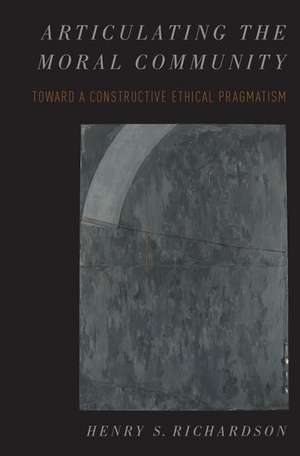
Articulating the Moral Community: Toward a Constructive Ethical Pragmatism: Oxford Moral Theory
Autor Henry Richardsonen Limba Engleză Hardback – 18 oct 2018
Din seria Oxford Moral Theory
- 28%
 Preț: 437.92 lei
 - 31%
 Preț: 542.27 lei
 - 31%
 Preț: 591.47 lei
 - 28%
 Preț: 353.14 lei
 - 20%
 Preț: 303.36 lei
 - 19%
 Preț: 337.28 lei
 - 31%
 Preț: 596.74 lei
 - 31%
 Preț: 596.30 lei
 - 31%
 Preț: 595.44 lei
 - 19%
 Preț: 335.75 lei
 - 12%
 Preț: 500.45 lei
 - 34%
 Preț: 573.68 lei
 - 31%
 Preț: 569.73 lei
 - 32%
 Preț: 528.16 lei
 - 31%
 Preț: 667.47 lei
 - nou
 Preț: 169.29 lei
Preț: 382.28 lei
Preț vechi: 494.01 lei
-23%
Puncte Express: 573
Carte tipărită la comandă
Livrare economică 20 noiembrie-01 decembrie
Livrare prin curier în România Termenul estimat este afișat lângă disponibilitate.
Transport gratuit de la 400.00 lei Plată online sau ramburs, în funcție de opțiunile comenzii.
Retur gratuit în 14 zile Comandă securizată și suport în română.
Specificații
ISBN-13: 9780190247744
ISBN-10: 0190247746
Pagini: 328
Dimensiuni: 239 x 157 x 25 mm
Greutate: 0.59 kg
Editura: Oxford University Press
Colecția OUP USA
Seria Oxford Moral Theory
Locul publicării:New York, United States
ISBN-10: 0190247746
Pagini: 328
Dimensiuni: 239 x 157 x 25 mm
Greutate: 0.59 kg
Editura: Oxford University Press
Colecția OUP USA
Seria Oxford Moral Theory
Locul publicării:New York, United States
Recenzii
clearly written ... well-researched
In the impressive Articulating the Moral Community, Henry Richardson argues for a dynamic idea of morality as at once resting on an "objective core" and able to be responsive to challenges that come from new technologies and our expanding moral awareness. The argument is rich, fully engaged with current normative and meta-ethical discussion, and filled with instructive examples that demand new standards of response. Centering the argument in the idea that the community of persons has the authority to extend morality, while preserving the objectivity morality requires, Richardson offers us a powerful alternative to standard forms of moral theorizing that compels our attention.
Morality is a social institution, created and developed over time in complex ways. At the same time, it is a rational institution, aiming at objectivity. Henry Richardson, one of the foremost moral philosophers of our time, shows how these two aspects go together from the perspective of constructive ethical pragmatism. There is moral progress and innovation, as he shows, and there is progress in philosophy, as this book proves.
In the impressive Articulating the Moral Community, Henry Richardson argues for a dynamic idea of morality as at once resting on an "objective core" and able to be responsive to challenges that come from new technologies and our expanding moral awareness. The argument is rich, fully engaged with current normative and meta-ethical discussion, and filled with instructive examples that demand new standards of response. Centering the argument in the idea that the community of persons has the authority to extend morality, while preserving the objectivity morality requires, Richardson offers us a powerful alternative to standard forms of moral theorizing that compels our attention.
Morality is a social institution, created and developed over time in complex ways. At the same time, it is a rational institution, aiming at objectivity. Henry Richardson, one of the foremost moral philosophers of our time, shows how these two aspects go together from the perspective of constructive ethical pragmatism. There is moral progress and innovation, as he shows, and there is progress in philosophy, as this book proves.
Notă biografică
Henry S. Richardson is Professor of Philosophy at Georgetown University. From 2008-18, he was the editor of Ethics. His previous books include Practical Reasoning about Final Ends (1994), Democratic Autonomy (2002), and Moral Entanglements (2012). He has held fellowships sponsored by the Alexander von Humboldt Foundation, the National Endowment for the Humanities, and the University Center for Human Values at Princeton University.