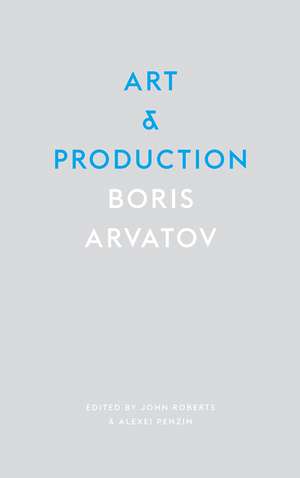
Art and Production
Autor Boris Arvatov Editat de John Roberts, Alexai Penzinen Limba Engleză Paperback – 15 noi 2017
Boris Arvatov's Art and Production is a classic of the early Soviet avant-garde. Now nearing a century since its first publication, it is a crucial intervention for those seeking to understand the social dynamic of art and revolution during the period.
Derived from the internal struggles of Soviet Constructivism, as it confronted the massive problems of cultural transformation after 'War Communism', Arvatov's writing is a major force in the split that occurred in the revolutionary horizons of Constructivism in the early 1920s. Critical of early Constructivism's social-aesthetic process of art's transformation of daily life - epitomised in studio-based painting, photography and object making - Arvatov polemicises for the devolution of artistic skills directly into the relations of production and the factory.
Whilst acknowledging the problems of a pure factory-based Productivism, Arvatov remains overwhelmingly committed to a new role and function for art outside the conventional studio and traditional gallery. Addressing issues such as artistic labour and productive labour, the artist as technician, art and multidisciplinarity and a life for art beyond 'art' - finding new relevance amidst the extensive social turn of contemporary participatory art - Art and Production offers a timely and compelling manifesto.
Derived from the internal struggles of Soviet Constructivism, as it confronted the massive problems of cultural transformation after 'War Communism', Arvatov's writing is a major force in the split that occurred in the revolutionary horizons of Constructivism in the early 1920s. Critical of early Constructivism's social-aesthetic process of art's transformation of daily life - epitomised in studio-based painting, photography and object making - Arvatov polemicises for the devolution of artistic skills directly into the relations of production and the factory.
Whilst acknowledging the problems of a pure factory-based Productivism, Arvatov remains overwhelmingly committed to a new role and function for art outside the conventional studio and traditional gallery. Addressing issues such as artistic labour and productive labour, the artist as technician, art and multidisciplinarity and a life for art beyond 'art' - finding new relevance amidst the extensive social turn of contemporary participatory art - Art and Production offers a timely and compelling manifesto.
Preț: 162.71 lei
Puncte Express: 244
Preț estimativ în valută:
28.76€ • 34.30$ • 24.95£
28.76€ • 34.30$ • 24.95£
Carte tipărită la comandă
Livrare economică 16-30 martie
Specificații
ISBN-13: 9780745337364
ISBN-10: 0745337368
Pagini: 192
Dimensiuni: 152 x 229 x 23 mm
Greutate: 0.2 kg
Editura: PLUTO PRESS
Colecția Pluto Press
ISBN-10: 0745337368
Pagini: 192
Dimensiuni: 152 x 229 x 23 mm
Greutate: 0.2 kg
Editura: PLUTO PRESS
Colecția Pluto Press
V-ar putea interesa
-
 Soviet Factography: Reality without RealismDevin ForePreț: 274.80 lei
 -
 Reclaiming Art in the Age of ArtificeJ. F. Martel-28%Preț: 93.15 lei129.69 lei
 -
 The Dehumanization of Art and Other Essays on Art, Culture, and LiteratureJosé Ortega Y. GassetPreț: 86.15 lei
 -
 Feminism. Art. Capitalism.Angela DimitrakakiPreț: 176.63 lei
 -
 Theory Of The Avant-GardePeter BurgerPreț: 150.42 lei
 -
 SovietsDanzig BaldaevPreț: 131.37 lei
 -
 Preț: 355.38 leiRecomandat
 -
 The Dialectics of ArtJohn MolyneuxPreț: 147.30 lei
 -
 Cosmic Shift: Russian Contemporary Art WritingBart De Baere-25%Preț: 171.83 lei227.82 lei
 -
 Subject-Object Art TheoryPyotr PavlenskyPreț: 165.16 lei
 -
 Art and RevolutionJohn BergerPreț: 79.95 lei
 -
 Preț: 296.70 lei
 -
 Monuments AskewMaria CorriganPreț: 185.75 lei
 -
 Komar & Melamid: A Lesson in HistoryJulia Tulovsky-17%Preț: 285.51 lei345.63 lei
 -
 The Social Organization of Arts: A Theoretical CompendiumVolker Kirchberg-19%Preț: 284.25 lei352.81 lei
 -
 Technologies for the RevolutionMeghan ForbesPreț: 379.12 lei
 -
 Preț: 382.81 lei
Notă biografică
Boris Arvatov (1896-1940) was a leading theorist in the post-revolutionary Soviet avant garde. He critiqued art, literature and film, and was one of the founding members of the influential Left Front of the Arts journal. John Roberts is professor of art and aesthetics at the University of Wolverhampton, in England. He is the author of a number of books, including Philosophising the Everyday, also published by Pluto Press.
Cuprins
Acknowledgements
Introduction Art and ‘Life-building’: The legacy of Boris Arvatov, by John Roberts
1 Capitalism and the Artistic Industry
The Form of the Artistic Industry
Art and Craft
The Art of Commodity Capitalism
The Artistic Manufactures of Monarchistic Absolutism
Applied Art in the Age of Machine Capitalism
Technical Intelligentsia and the Birth of New Forms
Architecture
2 Easel Art
The Origins of Easelism
The Degradation of Sculpture
Painting
Flight from the Easel
Constructivism
3 Art and Production in the History of the Workers’ Movement
Petty Bourgeois Utopianism
Art and the October Revolution
Productionist Art and LEF
4 Art in the System of Proletarian Culture
Methodology
Technique
Collaboration in Art
Ideology of Artists
Art and Everyday Life
Depictiveness in Art
Afterword The ‘Electrification of Art’: Boris Arvatov’s Programme for Communist Life, by Alexei Penzin
Index
Introduction Art and ‘Life-building’: The legacy of Boris Arvatov, by John Roberts
1 Capitalism and the Artistic Industry
The Form of the Artistic Industry
Art and Craft
The Art of Commodity Capitalism
The Artistic Manufactures of Monarchistic Absolutism
Applied Art in the Age of Machine Capitalism
Technical Intelligentsia and the Birth of New Forms
Architecture
2 Easel Art
The Origins of Easelism
The Degradation of Sculpture
Painting
Flight from the Easel
Constructivism
3 Art and Production in the History of the Workers’ Movement
Petty Bourgeois Utopianism
Art and the October Revolution
Productionist Art and LEF
4 Art in the System of Proletarian Culture
Methodology
Technique
Collaboration in Art
Ideology of Artists
Art and Everyday Life
Depictiveness in Art
Afterword The ‘Electrification of Art’: Boris Arvatov’s Programme for Communist Life, by Alexei Penzin
Index
Recenzii
"A passionate proclamation of the sovereign right of art to give a form not only to the artworks but also to society, state and everyday life of the people. Today’s art tends to neglect this right—and that is why Arvatov’s text is so relevant for our time."
“The appearance of an English translation of Arvatov's 1926 book Art and Production, one of the key statements of Soviet contructivism, is long overdue and will be welcomed by all those interested in the relationship between art, politics and social change. Sandwiched between John Roberts's engaging and informative introduction and Alexei Penzin's erudite and stimulating afterword, Arvatov's text reveals the profundity of early Soviet engagements with the transformations of the role of art and of the artist in conditions of revolutionary change and industrial development. The text is much more than a historical curiosity, however, for it explores some of the questions we are still grappling with, such as the relation between cultural production and mass communication, fine and applied arts and the capacity of art to act as a base for the revolutionising of social consciousness. The appearance of this text both in its original Russian, and in subsequent translations, has inspired many new engagements that have renewed consideration of the central questions of artistic production. There is little doubt that its appearance in English in the centenary year of the Russian Revolution will once again arouse considerable interest and inspire new work on the subject.”
Descriere
A classic of Russian avant-garde writing, focusing on the Productivist art movement of the 1920s