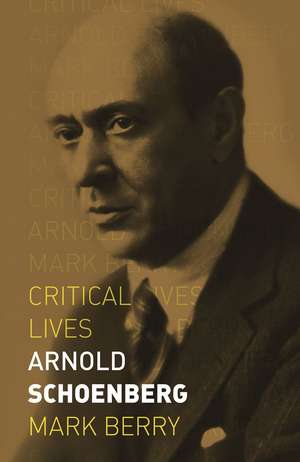
Arnold Schoenberg: Critical Lives
Autor Mark Berryen Limba Engleză Paperback – 11 mar 2019
Plecând de la arhivele ce documentează fuga sa precipitată din Berlinul anului 1933, sub amenințarea regimului hitlerist, volumul semnat de Mark Berry ne proiectează în centrul celei mai radicale transformări muzicale a secolului XX. Într-o noapte, un pilon al culturii de la Weimar devenea un fugar, luând cu el viziunea care avea să spulbere ierarhiile tonale tradiționale. Putem afirma că această biografie reușește să demistifice imaginea unui Arnold Schoenberg perceput fie ca erou, fie ca personaj negativ, plasându-l în „simfonia” vastă a istoriei europene și americane. Reținem modul în care autorul navighează prin etapele creative ale compozitorului: de la primele cvartete de coarde, ancorate în romantismul târziu, până la rigoarea matematică a metodei celor douăsprezece tonuri. În aceeași familie cu Schoenberg and His World de Walter Frisch, volumul adaugă o dimensiune narativă accesibilă, concentrându-se nu doar pe analiza tehnică, ci pe integritatea creativă în fața prejudecăților. Dacă în The Cambridge Companion to Wagner's Der Ring des Nibelungen autorul explora rădăcinile grandorii germane, aici el urmărește cum Schoenberg a preluat acea moștenire wagneriană pentru a o fragmenta și a o reconstrui în atonalitate. Credem că forța acestei lucrări rezidă în capacitatea de a arăta cum exilul în Los Angeles a transformat un inovator european într-un catalizator pentru avangarda americană. Este o lectură despre reziliență și despre cum o singură minte a putut schimba definitiv gramatica sunetului, oferind un context uman necesar pentru a înțelege complexitatea muzicii moderne.
Din seria Critical Lives
-
 Preț: 91.04 lei
 -
 Preț: 90.23 lei
 - 5%
 Preț: 86.34 lei
 - 17%
 Preț: 85.53 lei
 -
 Preț: 181.07 lei
 - 15%
 Preț: 92.25 lei
 - 16%
 Preț: 90.96 lei
 - 15%
 Preț: 92.16 lei
 - 15%
 Preț: 92.50 lei
 - 16%
 Preț: 88.40 lei
 - 16%
 Preț: 90.96 lei
 - 15%
 Preț: 91.92 lei
 - 16%
 Preț: 90.94 lei
 - 16%
 Preț: 89.37 lei
 - 14%
 Preț: 93.38 lei
 -
 Preț: 133.18 lei
 - 18%
 Preț: 88.98 lei
 - 14%
 Preț: 93.38 lei
 - 15%
 Preț: 91.10 lei
 - 16%
 Preț: 89.74 lei
 - 15%
 Preț: 91.81 lei
 -
 Preț: 136.57 lei
 -
 Preț: 93.23 lei
 - 14%
 Preț: 92.65 lei
 -
 Preț: 91.86 lei
 -
 Preț: 87.68 lei
 -
 Preț: 136.11 lei
 - 17%
 Preț: 88.59 lei
 -
 Preț: 91.81 lei
 -
 Preț: 90.49 lei
 -
 Preț: 92.34 lei
 -
 Preț: 94.39 lei
 -
 Preț: 134.70 lei
 -
 Preț: 94.03 lei
 -
 Preț: 93.23 lei
 -
 Preț: 93.80 lei
 -
 Preț: 135.13 lei
 -
 Preț: 94.21 lei
 -
 Preț: 93.70 lei
 -
 Preț: 93.00 lei
 -
 Preț: 93.53 lei
 -
 Preț: 93.99 lei
 - 18%
 Preț: 77.07 lei
 - 5%
 Preț: 85.89 lei
 - 8%
 Preț: 145.80 lei
 - nou
 Preț: 96.03 lei
Preț: 92.65 lei
Preț vechi: 108.74 lei
-15%
Carte disponibilă
Livrare economică 17-24 noiembrie
Livrare express 03-07 noiembrie pentru 43.08 lei
Specificații
ISBN-10: 1789140870
Pagini: 240
Ilustrații: 35 halftones
Dimensiuni: 134 x 198 x 17 mm
Greutate: 0.36 kg
Ediția:1
Editura: REAKTION BOOKS
Colecția Critical Lives
Seria Critical Lives
V-ar putea interesa
-
 Korngold in America: Music, Myth, and HollywoodBen Winters-20%Preț: 193.76 lei241.79 lei
 -
 Arthur Schopenhauer: The Life and Thought of Philosophy’s Greatest PessimistDavid Bather WoodsPreț: 184.79 lei
 -
 Martinu and His WorldAles BrezinaPreț: 246.36 lei
 -
 Preț: 208.27 lei
 -
 The Lives Of The Great Composers: Third EditionHarold C. Schonberg-25%Preț: 92.91 lei124.11 lei
 -
 Lives of the Great Composers (Revised)Harold C Schonberg-11%Preț: 402.24 lei451.96 lei
 -
 ModulationMax RegerPreț: 44.67 lei
 -
 Richard WagnerBarry Millington-21%Preț: 158.05 lei199.10 lei
 -
 Structural Functions of HarmonyArnold SchoenbergPreț: 107.97 lei
 -
 Fundamentals of Musical CompositionArnold SchoenbergPreț: 121.98 lei
 -
 Words Without MusicPhilip GlassPreț: 108.51 lei
 -
 BeethovenJan SwaffordPreț: 315.24 lei
 -
 Arnold SchoenbergBojan Bujic-13%Preț: 105.14 lei120.97 lei
 -
 Preț: 126.02 lei
 -
 SchoenbergHarvey SachsPreț: 171.59 lei
 -
 Sergei ProkofievChristina GuillaumierPreț: 90.49 lei
 -
 Orpheus in the Underworld: Essays on Music and Its MediationTheodor W. AdornoPreț: 147.19 lei
 -
 Gustav MahlerStephen DownesPreț: 94.39 lei
 -
 E.T.A. HoffmannPaul ChrystalPreț: 93.23 lei
 -
 The Rest is NoiseAlex RossPreț: 142.42 lei
De ce să citești această carte
Recomandăm această carte pasionaților de istoria muzicii și a culturii europene care doresc să înțeleagă omul din spatele „zgomotului” revoluționar. Cititorul va descoperi cum contextul politic a forțat nașterea modernismului și va câștiga o perspectivă clară asupra modului în care sistemul dodecafonic a influențat totul, de la muzica de cameră la avangarda americană a lui John Cage.
Despre autor
Mark Berry este un istoric al culturii și muzicolog recunoscut, cu un interes profund pentru evoluția ideilor în spațiul european. Experiența sa academică este dublată de o capacitate remarcabilă de a sintetiza perioade istorice complexe, aspect vizibil și în lucrarea sa anterioară dedicată lui Wagner, The Cambridge Companion to Wagner's Der Ring des Nibelungen. Berry reușește să îmbine rigoarea cercetării cu o scriitură fluidă, fiind capabil să abordeze subiecte diverse, de la spiritualitate în A New Monastic Handbook până la istoria designului industrial, oferind mereu un context socio-cultural bogat personajelor sale.
Descriere scurtă
Born in the Jewish quarter of his beloved Vienna, Schoenberg left Austria for his early career in Berlin as a leading light of Weimar culture, before being forced to flee in the dead of night from Hitler’s Third Reich. He found himself in the United States, settling in Los Angeles, where he would inspire composers from George Gershwin to John Cage. Introducing all of Schoenberg’s major musical works, from his very first compositions, such as the String Quartet in D Major, to his invention of the twelve-tone method, Berry explores how Schoenberg’s revolutionary approach to musical composition incorporated Wagnerian late Romanticism and the brave new worlds of atonality and serialism. Essential reading for anyone interested in the music and history of the twentieth century, this book makes clear Schoenberg changed the history of music forever.