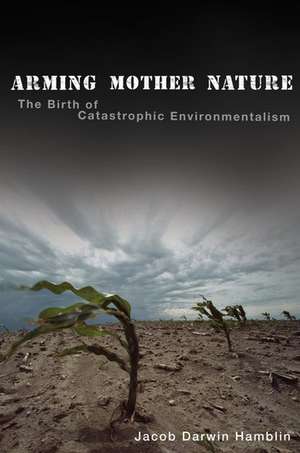
Arming Mother Nature: The Birth of Catastrophic Environmentalism
Autor Jacob Darwin Hamblinen Limba Engleză Hardback – 23 mai 2013
Considerăm că Arming Mother Nature de Jacob Darwin Hamblin propune o schimbare radicală de paradigmă, demonstrând cum interdisciplinaritatea dintre științele naturii, strategie militară și geopolitică a modelat înțelegerea noastră modernă asupra mediului. Autorul argumentează convingător că ecologismul contemporan și previziunile sale apocaliptice nu își au rădăcinile exclusiv în mișcările contra-culturale ale anilor '60, ci mai degrabă în laboratoarele finanțate de Pentagon în timpul Războiului Rece. Remarcăm o analiză riguroasă a modului în care natura a fost conceptualizată ca un potențial câmp de luptă global, unde manipularea proceselor naturale — de la ionosferă la fundul oceanului — era privită ca o metodă de anihilare în masă.
Textul dezvăluie proiecte tulburătoare, precum utilizarea armelor nucleare pentru a inunda orașe de coastă prin tsunami-uri artificiale sau planurile botaniștilor de la University of Oxford de a compromite agricultura inamică. Ritmul narativ este susținut de o documentare vastă în arhivele americane și europene, oferind o perspectivă lucidă asupra modului în care imperativul strategic a forțat oamenii de știință să gândească la scară planetară. Comparabil cu Environmental Histories of the Cold War de J. R. McNeill în rigurozitate, volumul lui Hamblin se diferențiază prin concentrarea pe transformarea intenționată a mediului în armă și pe modul în care aceste „ambiții întunecate” au pus bazele științei climatice actuale.
Această lucrare continuă preocupările autorului pentru intersecția dintre tehnologie și politică, teme explorate anterior în The Wretched Atom și Oceanographers and the Cold War. Dacă în lucrările precedente Hamblin analiza diplomația nucleară sau patronajul naval în oceanografie, aici el integrează aceste fire într-o istorie unitară a „ecocidului” planificat, oferind un context istoric esențial pentru dezbaterile actuale despre securitatea ecologică.
Preț: 194.47 lei
Preț vechi: 229.59 lei
-15%
Carte tipărită la comandă
Livrare economică 02-07 iulie
Specificații
ISBN-10: 0199740054
Pagini: 310
Ilustrații: 20 halftones
Dimensiuni: 164 x 241 x 28 mm
Greutate: 0.55 kg
Editura: Oxford University Press
Colecția OUP USA
Locul publicării:New York, United States
V-ar putea interesa
-
 Hippies, Indians, and the Fight for Red PowerSherry L. Smith-15%Preț: 279.44 lei330.17 lei
 -
 -27%Preț: 810.21 lei1106.41 lei
 -
 -22%Preț: 280.44 lei358.41 lei
 -
 Prostitution, Sexuality, and the Law in Ancient RomeThomas A. J. McGinn-11%Preț: 439.37 lei493.67 lei
 -
 A Question of Identity: Iberian Conversos in Historical PerspectiveRenee Levine Melammed-14%Preț: 546.41 lei635.35 lei
 -
 Preț: 152.23 lei
 -
 The Cultural Revolution: A Very Short IntroductionRichard Curt Kraus-22%Preț: 54.69 lei69.77 lei
 -
 Oceanographers and the Cold War – Disciples of Marine ScienceJacob Darwin Hamblin-23%Preț: 625.51 lei812.34 lei
 -
 Preț: 229.90 lei
 -
 -23%Preț: 466.58 lei605.94 lei
 -
 Taxation in Colonial AmericaAlvin RabushkaPreț: 469.17 lei
 -
 Poison in the Well: Radioactive Waste in the Oceans at the Dawn of the Nuclear AgeJacob Darwin HamblinPreț: 325.60 lei
 -
 Understanding Meaning and Purpose of Rock ArtD. Russel MicnhimerPreț: 91.89 lei
 -
 The Great Knowledge TranscendenceDengjian Jin-15%Preț: 575.98 lei677.62 lei
 -
 An Introduction to World PoliticsHerbert Adams Gibbons-18%Preț: 1629.82 lei1987.59 lei
 -
 Small Wars and Insurgencies in Theory and Practice, 1500-1850Beatrice Heuser-18%Preț: 1250.84 lei1525.41 lei
 -
 Preț: 260.68 lei
 -
 -19%Preț: 676.17 lei834.78 lei
 -
 Children and Youth in Premodern ScotlandJanay Nugent-19%Preț: 676.63 lei835.35 lei
 -
 The Haskins Society Journal 26 – 2014. Studies in Medieval HistoryLaura L. Gathagan-23%Preț: 696.49 lei904.54 lei
 -
 Science in the Early Twentieth Century: An EncyclopediaJacob Darwin Hamblin-45%Preț: 410.48 lei749.15 lei
 -
 Preț: 325.61 lei
 -
 ChrenecrudaEmil GoldmannPreț: 309.17 lei
 -
 Preț: 307.08 lei
 -
 Synesios Von Kyrene: Drei VortrageGeorg GrützmacherPreț: 421.07 lei
 -
 Preț: 453.71 lei
 -
 Preț: 286.42 lei
De ce să citești această carte
Această carte este esențială pentru cititorii interesați de istoria Războiului Rece și de originile neașteptate ale activismului climatic. Veți descoperi cum tehnologiile dezvoltate pentru a distruge mediul inamicului au devenit instrumentele prin care astăzi monitorizăm încălzirea globală. Este o lectură revelatoare care demonstrează că înțelegerea noastră despre planetă este, în mod paradoxal, un produs secundar al planificării militare pentru supraviețuire într-un conflict nuclear total.
Despre autor
Jacob Darwin Hamblin este profesor de istorie la Oregon State University, specializat în intersecția dintre știință, tehnologie și relații internaționale. Opera sa se concentrează pe istoria Războiului Rece, explorând modul în care cercetarea științifică a fost modelată de agendele politice și militare. Printre lucrările sale notabile se numără The Wretched Atom, Oceanographers and the Cold War și Poison in the Well, volume care analizează moștenirea tehnologică și ecologică a secolului XX. Expertiza sa în utilizarea documentelor declasificate îi permite să ofere perspective inedite asupra modului în care instituțiile statului au influențat discursul științific global.
Descriere
Notă biografică
Recenzii
[A] fascinating and often disturbing history
In Arming Mother Nature, Jacob Hamblin offers a far-reaching and provocative account of just how dependent narratives of global climate change are upon the military support, apocalyptic scenarios, and political ideology that shaped the growth of the modern environmental sciences during the Cold War.
[T]hought-provoking
This book advances the intriguing idea that 'catastrophic environmentalism' is not standard rhetoric warning the public about climate change and extinction of species, but a strategy developed by the Pentagon to fight the Cold War. Recommended.
A well-written and -documented challenge of some of the assumptions on both sides in the debate about global warming.
Jacob Hamblin's new book is a clearly and calmly told tale of the American effort to conscript nature -from the seafloor to the stratosphere -for potential active duty during the Cold War. Well researched in U.S. and European archives, it finds the roots of modern apocalyptic environmentalism in the hair-raising deeds and often hare-brained schemes of an American scientific-military complex under pressure to find ways to prevail against the USSR. It sheds new light on the old adage that is a miracle anyone survived the Cold War."