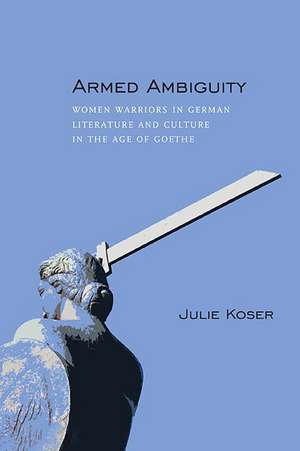
Armed Ambiguity: Women Warriors in German Literature and Culture in the Age of Goethe
Autor Julie Koseren Limba Engleză Paperback – 31 mar 2016
Armed Ambiguity is a fascinating examination of the tropes of the woman warrior constructed by print culture—including press reports, novels, dramatic works, and lyrical texts—during the decades-long conflict in Europe around 1800.
In it, Julie Koser sheds new light on how women’s bodies became a battleground for competing social, cultural, and political agendas in one of the most pivotal periods of modern history. She traces the women warriors in this work as reflections of the social and political climate in German-speaking lands, and she reveals how literary texts and cultural artifacts that highlight women’s armed insurrection perpetuated the false dichotomy of "public" versus "private" spheres along a gendered fault line. Koser illuminates how reactionary visions of "ideal femininity" competed with subversive fantasies of new femininities in the ideological battle being waged over the restructuring of German society.
In it, Julie Koser sheds new light on how women’s bodies became a battleground for competing social, cultural, and political agendas in one of the most pivotal periods of modern history. She traces the women warriors in this work as reflections of the social and political climate in German-speaking lands, and she reveals how literary texts and cultural artifacts that highlight women’s armed insurrection perpetuated the false dichotomy of "public" versus "private" spheres along a gendered fault line. Koser illuminates how reactionary visions of "ideal femininity" competed with subversive fantasies of new femininities in the ideological battle being waged over the restructuring of German society.
Preț: 274.49 lei
Puncte Express: 412
Preț estimativ în valută:
48.54€ • 56.96$ • 42.10£
48.54€ • 56.96$ • 42.10£
Carte indisponibilă temporar
Doresc să fiu notificat când acest titlu va fi disponibil:
Se trimite...
Specificații
ISBN-13: 9780810132320
ISBN-10: 081013232X
Pagini: 264
Dimensiuni: 152 x 229 x 16 mm
Greutate: 0.37 kg
Editura: Northwestern University Press
Colecția Northwestern University Press
ISBN-10: 081013232X
Pagini: 264
Dimensiuni: 152 x 229 x 16 mm
Greutate: 0.37 kg
Editura: Northwestern University Press
Colecția Northwestern University Press
Notă biografică
JULIE KOSER is an associate professor in the Department of Germanic Studies at the University of Maryland.
Recenzii
"Essential. Lower-division undergraduates through faculty; general readers." —CHOICE
“With extensive research, deep knowledge of the field, and persuasive argumentation, Julie Koser articulates the social and cultural importance of the woman warrior in the age of Goethe. I highly recommend this book.” —Patricia Anne Simpson, Professor of German Studies, Montana State University "Julie Koser’s Armed Ambiguity: Women Warriors in German Literature and Culture in the Age of Goethe presents a comprehensive and thoroughly researched study of the figure of the woman warrior around 1800. All in all, Koser’s book is both diligent and insightful. Koser does not confine women writers to the ghetto of trivial literature but situates them alongside male writers of the period and thus is able to offer readings that shed light on previously hidden connections within larger discursive contexts. Her interpretations are innovative and she does not overstate her claims. In short, her book has much to offer to scholars of late eighteenth- and early nineteenth-century German literature and to anyone interested in women writers of the period." —German Studies Review
“With extensive research, deep knowledge of the field, and persuasive argumentation, Julie Koser articulates the social and cultural importance of the woman warrior in the age of Goethe. I highly recommend this book.” —Patricia Anne Simpson, Professor of German Studies, Montana State University "Julie Koser’s Armed Ambiguity: Women Warriors in German Literature and Culture in the Age of Goethe presents a comprehensive and thoroughly researched study of the figure of the woman warrior around 1800. All in all, Koser’s book is both diligent and insightful. Koser does not confine women writers to the ghetto of trivial literature but situates them alongside male writers of the period and thus is able to offer readings that shed light on previously hidden connections within larger discursive contexts. Her interpretations are innovative and she does not overstate her claims. In short, her book has much to offer to scholars of late eighteenth- and early nineteenth-century German literature and to anyone interested in women writers of the period." —German Studies Review
“[A] complex exercise in pinpointing the extent to which the stereotypical gender hierarchy controlled even the efforts to resist it.” —Monatshefte
"Armed Ambiguity brilliantly combines new historicism, discourse analysis, and feminist thought to explore depictions of women warriors in German-language print culture, novels, dramas, and lyrical texts at the turn of the nineteenth century. Koser’s project is innovative, in that she sets male and female writers side by side and explores both canonical and noncanonical works between the outset of the French Revolution and the downfall of Napoleon... Overall, her writing is lucid, informative, and engaging—both in terms of her interaction with existing scholarship and her provocative close readings of texts—and Koser leaves the reader ready to set out into the world with a more critical eye and appreciation of (often ambiguous) depictions of warrior women." —Eighteenth-Century Studies
"Armed Ambiguity brilliantly combines new historicism, discourse analysis, and feminist thought to explore depictions of women warriors in German-language print culture, novels, dramas, and lyrical texts at the turn of the nineteenth century. Koser’s project is innovative, in that she sets male and female writers side by side and explores both canonical and noncanonical works between the outset of the French Revolution and the downfall of Napoleon... Overall, her writing is lucid, informative, and engaging—both in terms of her interaction with existing scholarship and her provocative close readings of texts—and Koser leaves the reader ready to set out into the world with a more critical eye and appreciation of (often ambiguous) depictions of warrior women." —Eighteenth-Century Studies
"In this elegantly written and well-researched book, Julie Koser explores the representation of the woman warrior in the late eighteenth and early nineteenth century. By treating all texts equally and unapologetically, Koser crystallizes late eighteenth- and early nineteenth-century attitudes towards women in the public sphere and the related crisis of masculinity in the aftermath of the Goethe Yearbook 303 French Revolutionary and Napoleonic Wars. This, in turn, enables her to establish a convincing connection in her epilogue to present-day debates on women in the military." —Goethe Yearbook
"A central strength to Armed Ambiguity is that Koser approaches texts that have been long overdue for attention, such as those by Naubert, Huber, von Günderrode, and de la Motte Fouqué. Koser’s insightful readings contribute to the ongoing project of questioning the male representation of women as well as perform equally rigorous analyses of female-authored representations." —Eighteenth Century Fiction
"A key question for this study is about the role of literature in the growth and development of this myth of the female militant . . . These canonical works are, in light of Koser's reading, full of contradictions and brimming with unexpected reversals. They rarely seem to result, in the end, in a domestic order that is fully restored . . . The literary texts that Koser analyzes seem, at times even in spite of themselves, to heighten and make explicit this ambiguity." —Peter Erickson, Seminar
"A central strength to Armed Ambiguity is that Koser approaches texts that have been long overdue for attention, such as those by Naubert, Huber, von Günderrode, and de la Motte Fouqué. Koser’s insightful readings contribute to the ongoing project of questioning the male representation of women as well as perform equally rigorous analyses of female-authored representations." —Eighteenth Century Fiction
"A key question for this study is about the role of literature in the growth and development of this myth of the female militant . . . These canonical works are, in light of Koser's reading, full of contradictions and brimming with unexpected reversals. They rarely seem to result, in the end, in a domestic order that is fully restored . . . The literary texts that Koser analyzes seem, at times even in spite of themselves, to heighten and make explicit this ambiguity." —Peter Erickson, Seminar
Descriere
Armed Ambiguity interrogates tropes of the woman warrior constructed by print culture—including press reports, novels, dramatic works, and lyrical texts—during the decades-long conflict in Europe around 1800.