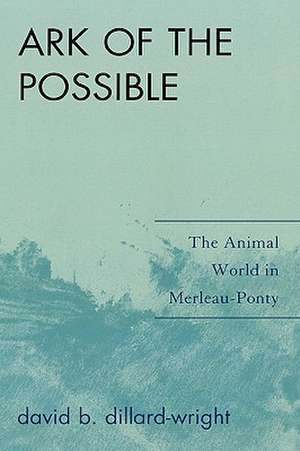
Ark of the Possible: The Animal World in Merleau-Ponty
Autor David B. Dillard-Wrighten Limba Engleză Hardback – 16 mai 2009
Preț: 540.50 lei
Preț vechi: 835.39 lei
-35%
Puncte Express: 811
Carte tipărită la comandă
Livrare economică 05-19 iunie
Specificații
ISBN-13: 9780739129371
ISBN-10: 0739129376
Pagini: 130
Dimensiuni: 161 x 240 x 15 mm
Greutate: 0.35 kg
Ediția:New.
Editura: Bloomsbury Publishing
Colecția Lexington Books
Locul publicării:New York, United States
ISBN-10: 0739129376
Pagini: 130
Dimensiuni: 161 x 240 x 15 mm
Greutate: 0.35 kg
Ediția:New.
Editura: Bloomsbury Publishing
Colecția Lexington Books
Locul publicării:New York, United States
V-ar putea interesa
-
 NauseaJean-Paul SartrePreț: 74.96 lei
 -
 Existentialism: A Very Short IntroductionThomas Flynn-21%Preț: 53.41 lei67.74 lei
 -
 -34%Preț: 510.10 lei774.18 lei
 -
 The Measure of Things: Humanism, Humility, and MysteryDavid E. CooperPreț: 329.38 lei
 -
 Thomas Hobbes: Writings on Common Law and Hereditary RightAlan Cromartie-23%Preț: 349.05 lei450.60 lei
 -
 Objectivity and InsightMark Sacks-14%Preț: 355.83 lei414.59 lei
 -
 -19%Preț: 359.77 lei442.41 lei
 -
 Phenomenology and Philosophy of MindDavid Woodruff Smith-24%Preț: 356.91 lei467.05 lei
 -
 Irrational ManWilliam BarrettPreț: 93.27 lei
 -
 Existentialism and HumanismJean-Paul SartrePreț: 72.37 lei
 -
 The Jargon of AuthenticityTheodor AdornoPreț: 125.10 lei
 -
 Essays on Heidegger and Others: Philosophical PapersRichard RortyPreț: 161.68 lei
 -
 PathmarksMartin HeideggerPreț: 214.93 lei
 -
 Heidegger's Being and Time: An IntroductionPaul GornerPreț: 354.10 lei
 -
 Introduction to PhenomenologyRobert SokolowskiPreț: 188.01 lei
 -
 Genesis and Structure of Hegel's "Phenomenology of Spirit"Jean HyppolitePreț: 234.07 lei
Cuprins
Part 1 Introduction: Imagining Animals
Chapter 2 1. God is World: Merleau-Ponty's Implicit Theology
Chapter 3 2. The Animal World in Merleau-Ponty
Chapter 4 3. Habits of the World: Phenomenological Pragmatism as the Basis for an Animal Ethic
Chapter 5 4. Thinking Across Species Boundaries: General Sociality and Embodied Meaning
Chapter 6 5. Ark of the Possible: The Earth as Ground in Merleau-Ponty
Part 7 Conclusion: A Proto-Ethics of Incarnation
Chapter 2 1. God is World: Merleau-Ponty's Implicit Theology
Chapter 3 2. The Animal World in Merleau-Ponty
Chapter 4 3. Habits of the World: Phenomenological Pragmatism as the Basis for an Animal Ethic
Chapter 5 4. Thinking Across Species Boundaries: General Sociality and Embodied Meaning
Chapter 6 5. Ark of the Possible: The Earth as Ground in Merleau-Ponty
Part 7 Conclusion: A Proto-Ethics of Incarnation
Recenzii
Ark of the Possible knits together the philosophic traditions of phenomenology and pragmatism to weave a wonderful tapestry of intellectual reflection on animals, nature, and humankind. Dillard-Wright bridges the oft-contested divide between inter-species morality and environmental ethics, and what's more he develops a profound exploration of animality into a full-blown philosophy of life and world. Students of animal studies will find his essay an enlightening enquiry indeed.
Adding to the burgeoning literature on animal issues from the tradition of Continental thought, Dillard-Wright provides a careful exegesis and innovative extension of Merleau-Ponty's philosophy of the lived-body/lived- world. Common to humans and other animals, bodily knowledge of the immediately given sense of our physical capabilities and vulnerability provides the ground of a proto-ethic that encompasses the treatment of individual animals and species preservation. 'When species disappear, words disappear, worlds disappear.' Individuals suffer and we are all impoverished.
Adding to the burgeoning literature on animal issues from the tradition of Continental thought, Dillard-Wright provides a careful exegesis and innovative extension of Merleau-Ponty's philosophy of the lived-body/lived- world. Common to humans and other animals, bodily knowledge of the immediately given sense of our physical capabilities and vulnerability provides the ground of a proto-ethic that encompasses the treatment of individual animals and species preservation. 'When species disappear, words disappear, worlds disappear.' Individuals suffer and we are all impoverished.