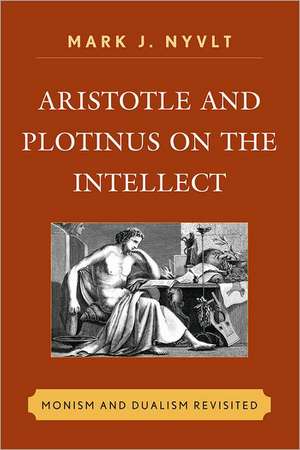
Aristotle and Plotinus on the Intellect: Monism and Dualism Revisited
Autor Mark J. Nyvlten Limba Engleză Hardback – 17 noi 2011
Preț: 659.90 lei
Preț vechi: 1053.96 lei
-37%
Puncte Express: 990
Carte tipărită la comandă
Livrare economică 21 noiembrie-05 decembrie
Livrare prin curier în România Termenul estimat este afișat lângă disponibilitate.
Transport gratuit pentru acest produs Plată online sau ramburs, în funcție de opțiunile comenzii.
Retur gratuit în 14 zile Comandă securizată și suport în română.
Specificații
ISBN-13: 9780739167755
ISBN-10: 0739167758
Pagini: 263
Dimensiuni: 164 x 239 x 23 mm
Greutate: 0.57 kg
Editura: Bloomsbury Publishing
Colecția Lexington Books
Locul publicării:New York, United States
ISBN-10: 0739167758
Pagini: 263
Dimensiuni: 164 x 239 x 23 mm
Greutate: 0.57 kg
Editura: Bloomsbury Publishing
Colecția Lexington Books
Locul publicării:New York, United States
Cuprins
Foreword by Klaus Brinkmann
Acknowledgements
Introduction
Part I
Chapter One: Aristotle On The Platonic Two-Principles Doctrine:
The One and The Indefinite Dyad
Chapter Two: Speusippus and Aristotle
Chapter Three: Aristotelian Henology
Chapter Four: The Anatomy of Aristotle's Metaphysics
Chapter Five: The Unmoved Mover and The Simplicity and Priority of nou:V: Metaphysics L 7, De Anima III.4-5, and Metaphysics L 9
Part II
Chapter Six: The =Epistrofhv of the One and The Derivation of nou:V
Chapter Seven: Plotinus On Phantasia: Phantasia As The Home Of Self-Consciousness Within The Soul
Chapter Eight: Alcinous and Alexander On The Intelligibles Within nou:V
Chapter Nine: Plotinus On The Simplicity of nou:V: An Appropriation And Critique Of Aristotle's Noetic Doctrine
Conclusion
Acknowledgements
Introduction
Part I
Chapter One: Aristotle On The Platonic Two-Principles Doctrine:
The One and The Indefinite Dyad
Chapter Two: Speusippus and Aristotle
Chapter Three: Aristotelian Henology
Chapter Four: The Anatomy of Aristotle's Metaphysics
Chapter Five: The Unmoved Mover and The Simplicity and Priority of nou:V: Metaphysics L 7, De Anima III.4-5, and Metaphysics L 9
Part II
Chapter Six: The =Epistrofhv of the One and The Derivation of nou:V
Chapter Seven: Plotinus On Phantasia: Phantasia As The Home Of Self-Consciousness Within The Soul
Chapter Eight: Alcinous and Alexander On The Intelligibles Within nou:V
Chapter Nine: Plotinus On The Simplicity of nou:V: An Appropriation And Critique Of Aristotle's Noetic Doctrine
Conclusion
Recenzii
The philosophical ambitions of this study are wonderful. . . .Nyvlt tries to avoid broad strokes and boldly strides into the scholarly controversies concerning his historical study. . . .Nyvlt's study will be a stimulating. . . .read for scholars interested in the philosophy of God and in ancient philosophy. Let us look forward to his future work.
The strength of Nyvlt's book lies in its discussion of Nous in the larger context of the
first principles of ancient metaphysics, and the extensive analysis of the historical influences
on Plotinian Nous.
When Hegel and Heidegger said of a book or play that it is an impressive technical achievement, but we are not changed by experiencing it, they claim we encounter an Erlebnis, a mere entertainment or an interlude. When they say we have been transformed by a work, we experience an Erfahrung. Plotinus and Aristotle on the Intellect is more than a highly original and insightful study of a foundational metaphysical principle, an Erlebnis. This work is among those surprising books which forces us to rethink traditional explanations of Aristotle, Alexander, and Plotinus. The author compels us to examine Nous and the One within the history of ancient philosophy and beyond. What follows from such a request is a significant transformation of our understanding of Intellect's metaphysical significance. It is in this sense that this book is an Erfahrung.
Nyvlt's opus provides us with new, creative insights into the Ancient metaphysics of the first principle. An advocate of the Aristotelian position of the supremacy of the Nous, Nyvlt's comparative approach of Aristotle and Plotinus remains always fair and non partisan. His reading is scrupulous and intelligent and if one may not agree with all his conclusions, one cannot but acknowledge the solidity and subtlety of his argumentation.
The strength of Nyvlt's book lies in its discussion of Nous in the larger context of the
first principles of ancient metaphysics, and the extensive analysis of the historical influences
on Plotinian Nous.
When Hegel and Heidegger said of a book or play that it is an impressive technical achievement, but we are not changed by experiencing it, they claim we encounter an Erlebnis, a mere entertainment or an interlude. When they say we have been transformed by a work, we experience an Erfahrung. Plotinus and Aristotle on the Intellect is more than a highly original and insightful study of a foundational metaphysical principle, an Erlebnis. This work is among those surprising books which forces us to rethink traditional explanations of Aristotle, Alexander, and Plotinus. The author compels us to examine Nous and the One within the history of ancient philosophy and beyond. What follows from such a request is a significant transformation of our understanding of Intellect's metaphysical significance. It is in this sense that this book is an Erfahrung.
Nyvlt's opus provides us with new, creative insights into the Ancient metaphysics of the first principle. An advocate of the Aristotelian position of the supremacy of the Nous, Nyvlt's comparative approach of Aristotle and Plotinus remains always fair and non partisan. His reading is scrupulous and intelligent and if one may not agree with all his conclusions, one cannot but acknowledge the solidity and subtlety of his argumentation.