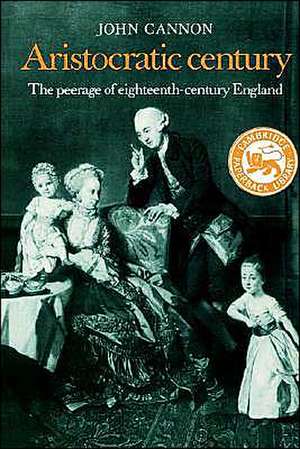
Aristocratic Century: The Peerage of Eighteenth-Century England: The Wiles Lectures
Autor John Cannonen Limba Engleză Paperback – 6 mai 1987
Analiza fundamentelor stabilității sociale în Anglia secolului al XVIII-lea constituie tema centrală a acestui volum, pornind de la prelegerile Wiles susținute de John Cannon. Subliniem modul în care autorul reușește să ofere o interpretare coerentă unei perioade care, în istoriografia tradițională post-1930, apărea adesea atomizată și lipsită de o viziune unitară. În loc să se concentreze pe diviziunile religioase sau pe conflictele de partid, Aristocratic Century evidențiază modul în care acceptarea valorilor și leadership-ului aristocratic a oferit societății engleze o coerență intelectuală și politică remarcabilă.
Considerăm că punctul forte al lucrării este deconstrucția argumentată a „mitului elitei deschise”. În timp ce mulți istorici au susținut că nobilimea britanică era permeabilă și constant împrospătată de burghezia viguroasă, John Cannon demonstrează că, în realitate, peerage-ul englez era mai exclusivist decât multe dintre corespondentele sale de pe continent. Cititorii familiarizați cu Public Life and the Propertied Englishman 1689-1798 de Paul Langford vor aprecia modul în care Cannon abordează aceeași perioadă, însă, spre deosebire de Langford, care pune accent pe creativitatea instituțională a claselor de mijloc, Cannon se concentrează pe persistența și acceptarea hegemoniei patriciene.
Structura narativă urmărește cronologic restabilirea controlului aristocrației asupra guvernării după 1688 și culminează cu un capitol dedicat fundamentelor ideologice care au menținut acest sistem până la apariția forțelor industriale ce aveau să îl înlocuiască. Stilul este cel al unui istoric clasic, lucrarea fiind marcată de o claritate analitică ce face accesibile mecanismele complexe ale puterii funciare într-o epocă de tranziție economică spre industrializare.
Din seria The Wiles Lectures
-
 Preț: 293.66 lei
 -
 Preț: 219.42 lei
 -
 Preț: 310.43 lei
 -
 Preț: 231.58 lei
 -
 Preț: 331.57 lei
 -
 Preț: 268.44 lei
 -
 Preț: 320.80 lei
 -
 Preț: 208.15 lei
 -
 Preț: 123.47 lei
 -
 Preț: 292.97 lei
 -
 Preț: 294.87 lei
 -
 Preț: 335.16 lei
 -
 Preț: 165.68 lei
 -
 Preț: 198.99 lei
 -
 Preț: 286.70 lei
 -
 Preț: 140.49 lei
 -
 Preț: 293.17 lei
 -
 Preț: 290.20 lei
 -
 Preț: 286.70 lei
 -
 Preț: 264.15 lei
 -
 Preț: 268.35 lei
 -
 Preț: 316.63 lei
 -
 Preț: 285.59 lei
 -
 Preț: 285.01 lei
 -
 Preț: 266.16 lei
 -
 Preț: 251.95 lei
 -
 Preț: 188.16 lei
 -
 Preț: 298.88 lei
 -
 Preț: 285.59 lei
 - 14%
 Preț: 774.61 lei
 -
 Preț: 119.41 lei
Preț: 301.15 lei
Carte tipărită la comandă
Livrare economică 05-19 iunie
Specificații
ISBN-10: 0521335663
Pagini: 204
Dimensiuni: 155 x 228 x 15 mm
Greutate: 0.3 kg
Ediția:Revised
Editura: Cambridge University Press
Colecția Cambridge University Press
Seria The Wiles Lectures
Locul publicării:Cambridge, United Kingdom
V-ar putea interesa
-
 A Dictionary of British HistoryJohn Cannon-19%Preț: 98.73 lei121.73 lei
 -
 The Kings and Queens of BritainJohn Cannon-20%Preț: 81.97 lei102.75 lei
 -
 The Oxford Companion to British HistoryJohn Cannon-28%Preț: 409.49 lei568.28 lei
 -
 Preț: 332.72 lei
 -
 The Cambridge History of War: Volume 4, War and the Modern WorldRoger Chickering-14%Preț: 1051.45 lei1222.61 lei
 -
 Captain Cook's Merchant ShipsStephen BainesPreț: 157.66 lei
 -
 Preț: 240.53 lei
 -
 HistoryDavid NashPreț: 74.40 lei
 -
 -14%Preț: 166.06 lei193.87 lei
 -
 Four Ball One TracerAndrew HudsonPreț: 182.64 lei
 -
 -12%Preț: 80.03 lei91.24 lei
De ce să citești această carte
Această ediție revizuită este esențială pentru studenții și cercetătorii istoriei moderne, oferind o perspectivă critică asupra structurilor de putere britanice. Cititorul câștigă o înțelegere profundă a modului în care o elită restrânsă a gestionat stabilitatea politică în timpul primei revoluții industriale, demontând prejudecăți despre mobilitatea socială în epoca hanoveriană. Este o lecție magistrală despre supraviețuirea și adaptarea instituțională a aristocrației.
Despre autor
John Cannon a deținut catedra de Istorie Modernă la Newcastle upon Tyne până în 1992, fiind recunoscut ca unul dintre cei mai rafinați istorici britanici contemporani. Expertiza sa vastă în istoria politică și constituțională este reflectată în lucrări de referință precum The Oxford Companion to British History și The Illustrated History of the British Monarchy. Opera sa se distinge prin rigoarea documentară și capacitatea de a sintetiza perioade complexe, elemente vizibile și în volume precum The Historian At Work. Prin activitatea sa editorială și academică, Cannon a influențat decisiv modul în care este studiat secolul al XVIII-lea englez.
Descriere scurtă
Cuprins
Recenzii
'To some the scope of these revised Wiles Lectures may appear narrow, but the gusto and wit with which they are carried along bring a coherence to the eighteenth century that it has not known since Lewis Namier's day, and import a lightness of touch that carries a heavy load of facts and figures without strain.' F. M. L. Thompson, The Times Higher Education Supplement
' … distinguished by the lucidity, urbanity and gentle wit which have made the author one of the most civilised of English istorians writing today.' John Kenyon, The Observer