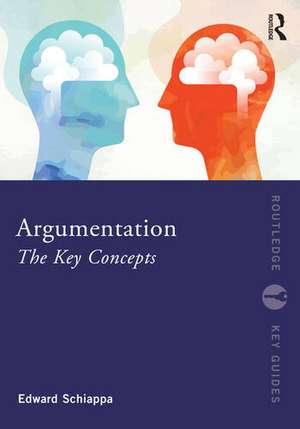
Argumentation: The Key Concepts: Routledge Key Guides
Autor Edward Schiappaen Limba Engleză Paperback – 27 noi 2025
Providing an encyclopedic‑style synthesis, the book defines and describes 175 essential concepts of argumentation, and provides discussion of the meaning, application, and impact, as well as offering suggestions for further reading. Readers are introduced to foundational reasoning methods—deductive, inductive, and abductive—as well as key argumentative models such as the Toulmin Model and Pragma‑Dialectics. The text delves into the identification and analysis of fallacies, the evaluation of evidence, and the crucial roles of context, audience adaptation, and argumentative style. It explores the ethical dimensions of argument, the impact of cognitive bias, and the influence of cultural and discourse communities.
The first of its kind and a key entry point to understanding the fundamental principles of the field, this guidebook is ideal for undergraduate and graduate courses in argumentation, debate, rhetoric, and communication studies as well as other related disciplines. It will also be of interest to the general reader looking to improve their analytical and decision‑making abilities.
| Toate formatele și edițiile | Preț | Express |
|---|---|---|
| Paperback (1) | 375.16 lei 6-8 săpt. | +35.38 lei 10-14 zile |
| Taylor & Francis – 27 noi 2025 | 375.16 lei 6-8 săpt. | +35.38 lei 10-14 zile |
| Hardback (1) | 1019.31 lei 6-8 săpt. | |
| Taylor & Francis – 27 noi 2025 | 1019.31 lei 6-8 săpt. |
Din seria Routledge Key Guides
-
 Preț: 261.26 lei
 -
 Preț: 266.44 lei
 -
 Preț: 249.16 lei
 -
 Preț: 230.57 lei
 -
 Preț: 273.43 lei
 -
 Preț: 317.68 lei
 -
 Preț: 180.90 lei
 -
 Preț: 273.89 lei
 -
 Preț: 258.00 lei
 -
 Preț: 265.46 lei
 -
 Preț: 272.59 lei
 -
 Preț: 314.05 lei
 -
 Preț: 268.03 lei
 -
 Preț: 356.11 lei
 -
 Preț: 276.69 lei
 -
 Preț: 251.13 lei
 -
 Preț: 268.12 lei
 -
 Preț: 230.66 lei
 -
 Preț: 320.32 lei
 -
 Preț: 289.11 lei
 -
 Preț: 252.46 lei
 -
 Preț: 191.02 lei
 -
 Preț: 328.62 lei
 -
 Preț: 237.63 lei
 -
 Preț: 265.91 lei
 -
 Preț: 209.57 lei
 -
 Preț: 238.10 lei
 -
 Preț: 171.40 lei
 -
 Preț: 203.76 lei
 -
 Preț: 286.95 lei
 -
 Preț: 247.46 lei
 -
 Preț: 206.24 lei
 -
 Preț: 212.12 lei
 -
 Preț: 268.78 lei
 -
 Preț: 185.64 lei
 -
 Preț: 338.81 lei
 -
 Preț: 224.19 lei
 -
 Preț: 356.37 lei
 -
 Preț: 240.57 lei
 -
 Preț: 301.22 lei
 -
 Preț: 271.10 lei
 - 18%
 Preț: 869.37 lei
 - 18%
 Preț: 808.04 lei
 -
 Preț: 275.54 lei
 -
 Preț: 234.65 lei
 -
 Preț: 259.64 lei
 -
 Preț: 234.74 lei
Preț: 375.16 lei
Nou
Puncte Express: 563
Preț estimativ în valută:
66.44€ • 77.59$ • 57.72£
66.44€ • 77.59$ • 57.72£
Carte tipărită la comandă
Livrare economică 21 februarie-07 martie
Livrare express 20-24 ianuarie pentru 45.37 lei
Preluare comenzi: 021 569.72.76
Specificații
ISBN-13: 9781032730745
ISBN-10: 1032730749
Pagini: 248
Ilustrații: 4
Dimensiuni: 138 x 216 mm
Greutate: 0.46 kg
Ediția:1
Editura: Taylor & Francis
Colecția Routledge
Seria Routledge Key Guides
Locul publicării:Oxford, United Kingdom
ISBN-10: 1032730749
Pagini: 248
Ilustrații: 4
Dimensiuni: 138 x 216 mm
Greutate: 0.46 kg
Ediția:1
Editura: Taylor & Francis
Colecția Routledge
Seria Routledge Key Guides
Locul publicării:Oxford, United Kingdom
Public țintă
Academic, General, Postgraduate, Undergraduate Advanced, and Undergraduate CoreCuprins
List of Figures
Acknowledgements
Preface
Index
Acknowledgements
Preface
- Abduction (Abductive Reasoning)
- Affirming a Disjunct (argument by dilemma)
- Analogical reasoning
- Antecedent
- Argument
- Argumentative pattern
- Argumentative style
- Argumentum ad baculum (appeal to force)
- Argumentum ad hominem (fallacy)
- Argumentum ad hominem (in philosophy)
- Argumentum ad misericordium (appeal to pity)
- Argumentum ad populum (bandwagon fallacy)
- Argumentum ad rem (argument to the matter)
- Argument diagramming
- Argument evaluation
- Argument from analogy
- Argument from authority
- Argument from ignorance
- Argument metaphors
- Argument reconstruction
- Argument strength
- Argumentation and advocacy
- Argumentation ethics
- Argumentative grammar
- Argumentativity
- Artificial Intelligence and argument
- Audience adaptation
- Axiom
- Backing
- Biconditionals
- Bivalent logic
- Burden of proof
- Burden of rejoinder
- Causal argument
- Circular reasoning
- Claim
- Cogency
- Cognitive biases
- Cognitive research on argumentation
- Commitment
- Common knowledge (Sensus Communis)
- Communicative Action Theory
- Computational Models of Argument
- Conclusion
- Conjunction
- Consensus
- Consequent
- Constructive argumentation
- Constructive dilemma
- Context
- Contradiction
- Controversy
- Cooperative argument
- Counterfactual
- Counterplan
- Critical Discourse Analysis
- Critical thinking
- Cultural norms of argumentation
- Debate
- Deductive reasoning
- Defeasible reasoning
- Definitions and definitional argument
- Deliberative rhetoric
- Destructive dilemma
- Dialectic
- Dialogical argumentation
- Discourse community
- Discovery and invention
- Disjunctive reasoning
- Doublespeak
- Elaboration Likelihood Model
- Embodiment
- Emotive arguments
- Enactment
- Enthymeme
- Eristic
- Ethos
- Evidence
- Evidence-based reasoning
- Explanatory arguments
- Factual claims
- Fallacies
- Fallacy of relative privation
- False cause (post hoc fallacy)
- Feminine style
- Feminist argument theory
- Fields of argument
- Formal logic
- Framing analysis
- Identity argument
- Incommensurability
- Inductive reasoning
- Inference
- Informal logic
- Information seeking
- Inquiry
- Interpersonal argument
- Justification
- Lemma
- Linguistic approaches to argument studies
- Logical operators
- Logical Positivism
- Logos
- Meta-argumentation
- Metacognition
- Misinformation
- Modal logic
- Modus ponens and modus tollens
- Multimodal argument
- Narrative argument
- Natural argument
- Negotiation
- Non sequitor
- Normative reasoning
- Obligation Game
- Parody and satire
- Pathos
- Personal sphere of argument
- Persuasion
- Policy claims
- Pragma-Dialectics
- Pragmatics
- Predicate logic
- Premise
- Presumption
- Proof
- Proposition
- Public sphere of argument
- Qualifier
- Quantifier
- Quantitative reasoning
- Racist argument
- Radical argumentativism
- Rationality
- Reason
- Rebuttal
- Reconstructive analysis
- Red herring
- Reductio ad absurdum
- Relevance
- Rhetoric
- Rhetorical analysis
- Scientific rhetoric
- Selfhood and argument
- Semantics
- Sign reasoning
- Significance
- Slippery slope
- Socratic method
- Solvency
- Soundness
- Standpoint analysis
- Stasis
- Stock Issues
- Strategic design
- Strategic maneuvering
- Straw person argument
- Style
- Syllogistic reasoning
- Tautology
- Technical sphere of argument
- Theorem
- Topoi
- Toulmin Model
- Transposition
- Tu quoque fallacy
- Unexpressed premise
- Universal audience
- Universal generalization
- Validity, formal
- Validity, informal
- Value Based Argumentation Frameworks
- Value claims
- Visual argumentation
- Warrant
Index
Notă biografică
Edward Schiappa is the John E. Burchard Professor of Humanities at the Massachusetts Institute of Technology, USA. His recent publications include Argumentation: Keeping Faith with Reason (Routledge, 2024) and The Transgender Exigency: Defining Sex & Gender in the 21st Century (Routledge, 2022).
Recenzii
“Argumentation is the root of philosophy and communication. But what exactly is it? The conceptual pillars of argument analysis, interpretation, and evaluation are explained in this book with stunning clarity and accessibility. It is a reference book, an introductory manual, a comprehensive guide for understanding how we put our reasoning in words.”
Fabrizio Macagno, University of Lisbon, Portugal
“With concise entries covering an expansive array of concepts, this resource guide is essential for any who study or practice argumentation. It offers clear definitions, illustrative examples, and further readings. The book is an essential glossary for anyone reading argumentation literature.”
Catherine Palczewski, University of Northern Iowa, USA
“In Argumentation: The Key Concepts, Edward Schiappa provides an invaluable introduction and bibliography covering 175 central ideas that have shaped the study of public argument and formal logic. The book should be on the shelf of every argumentation scholar.”
Robert C. Rowland, University of Kansa, USA
Fabrizio Macagno, University of Lisbon, Portugal
“With concise entries covering an expansive array of concepts, this resource guide is essential for any who study or practice argumentation. It offers clear definitions, illustrative examples, and further readings. The book is an essential glossary for anyone reading argumentation literature.”
Catherine Palczewski, University of Northern Iowa, USA
“In Argumentation: The Key Concepts, Edward Schiappa provides an invaluable introduction and bibliography covering 175 central ideas that have shaped the study of public argument and formal logic. The book should be on the shelf of every argumentation scholar.”
Robert C. Rowland, University of Kansa, USA
Descriere
This book is an essential and accessible reference guide to the key concepts associated with argumentation theory, criticism, and pedagogy.