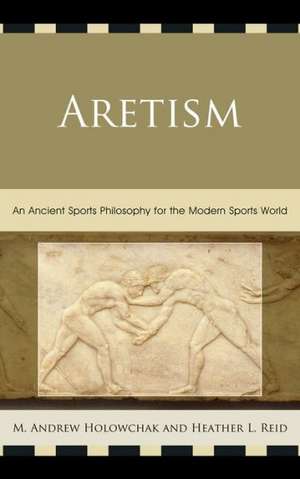
Aretism: An Ancient Sports Philosophy for the Modern Sports World
Autor Heather Reid, Mark Holowchaken Limba Engleză Paperback – 13 feb 2013
Holowchak and Reid present Aretism as a tripartite model of athletic excellence focused on personal, civic, and global integration. They reject the personal and social separation characteristics of much of contemporary moral reasoning. Aretism creates a critical and normative framework within which athletic agents can aim for spirited, but morally sensitive, competition by seeking the betterment not only of themselves, through athletic competition, but also of their teammates, fellow competitors, and even their communities.
Holowchak and Reid also present a historical overview of sport and a critique of two traditional models-the martial/commercial model and the aesthetic/recreational model. This book is most applicable to students and academics concerned with the philosophy of sport, but will be of interest to all those in sports professions, including coaches, trainers, and athletes.
Preț: 337.35 lei
Preț vechi: 436.19 lei
-23%
Puncte Express: 506
Carte tipărită la comandă
Livrare economică 21 noiembrie-05 decembrie
Livrare prin curier în România Termenul estimat este afișat lângă disponibilitate.
Transport gratuit de la 400.00 lei Plată online sau ramburs, în funcție de opțiunile comenzii.
Retur gratuit în 14 zile Comandă securizată și suport în română.
Specificații
ISBN-13: 9780739182086
ISBN-10: 0739182080
Pagini: 214
Dimensiuni: 155 x 230 x 17 mm
Greutate: 0.39 kg
Editura: Bloomsbury Publishing
Colecția Lexington Books
Locul publicării:New York, United States
ISBN-10: 0739182080
Pagini: 214
Dimensiuni: 155 x 230 x 17 mm
Greutate: 0.39 kg
Editura: Bloomsbury Publishing
Colecția Lexington Books
Locul publicării:New York, United States
Cuprins
Chapter 1 Preface
Part 2 PART I. How Did Sports Get Here From There?
Chapter 3 Chapter 1. The Roots of Competitive Sport
Chapter 4 Chapter 2. Medieval, Renaissance, and Enlightenment Sport
Chapter 5 Chapter 3. Compensatory Athleticism
Chapter 6 Chapter 4. Sport Propagandized
Chapter 7 Chapter 5. Sport Commodified
Part 8 PART II. What is Wrong With Sports Today?
Chapter 9 Chapter 6. The Martial/Commercial Model
Chapter 10 Chapter 7. Drugs and Competitive Sport
Chapter 11 Chapter 8. Problems of Performance Enhancement
Chapter 12 Chapter 9. Gender, Aggression, and Violence
Chapter 13 Chapter 10. Sport by the Numbers
Chapter 14 Chapter 11. Sensationalism and Ego-Puffing
Part 15 PART III. Why Can't We Just Enjoy Sports?
Chapter 16 Chapter 12. The Aesthetic/Recreational Model
Chapter 17 Chapter 13. Aesthetic Spectacle
Chapter 18 Chapter 14. Playful Integrity
Chapter 19 Chapter 15. The Aesthetics of Journeying
Chapter 20 Chapter 16. Beauty as Unity
Chapter 21 Chapter 17. Economy of Performance
Part 22 PART IV. How Should Sports Be Reformed?
Chapter 23 Chapter 18. The Aretic Model
Chapter 24 Chapter 19. Aretism and Values
Chapter 25 Chapter 20. Aretism and Education
Chapter 26 Chapter 21. Aretism and Society
Chapter 27 Chapter 22. Is Sport a Good?
Part 2 PART I. How Did Sports Get Here From There?
Chapter 3 Chapter 1. The Roots of Competitive Sport
Chapter 4 Chapter 2. Medieval, Renaissance, and Enlightenment Sport
Chapter 5 Chapter 3. Compensatory Athleticism
Chapter 6 Chapter 4. Sport Propagandized
Chapter 7 Chapter 5. Sport Commodified
Part 8 PART II. What is Wrong With Sports Today?
Chapter 9 Chapter 6. The Martial/Commercial Model
Chapter 10 Chapter 7. Drugs and Competitive Sport
Chapter 11 Chapter 8. Problems of Performance Enhancement
Chapter 12 Chapter 9. Gender, Aggression, and Violence
Chapter 13 Chapter 10. Sport by the Numbers
Chapter 14 Chapter 11. Sensationalism and Ego-Puffing
Part 15 PART III. Why Can't We Just Enjoy Sports?
Chapter 16 Chapter 12. The Aesthetic/Recreational Model
Chapter 17 Chapter 13. Aesthetic Spectacle
Chapter 18 Chapter 14. Playful Integrity
Chapter 19 Chapter 15. The Aesthetics of Journeying
Chapter 20 Chapter 16. Beauty as Unity
Chapter 21 Chapter 17. Economy of Performance
Part 22 PART IV. How Should Sports Be Reformed?
Chapter 23 Chapter 18. The Aretic Model
Chapter 24 Chapter 19. Aretism and Values
Chapter 25 Chapter 20. Aretism and Education
Chapter 26 Chapter 21. Aretism and Society
Chapter 27 Chapter 22. Is Sport a Good?
Recenzii
With the news dominated by college sports scandals, and professional athletics by strikes, lockouts, and superstar athletes' demands for ever larger contracts, this book's claim that contemporary sports is dominated by a martial/commercial model rings true. The commercial aspect is all too apparent. The martial aspect emphasizes winning at all costs, treats opponents as the enemy, and embraces aggression and individualism as means to external goals. This book also rejects an opposite approach-the aesthetic/recreational model, which sees sports as just for fun. Instead Holowchak (Rider Univ.) and Reid (Morningside College) propose returning sports to the ancient Greek ideal of arete, or excellence. Aretism demands 'respect for human limitations' as well as the view that 'victory in sport has no intrinsic value and that competitive sport is a good insofar as it is a means to human improvement.' The authors offer aretism as the Aristotelian mean between the martial/commercial and aesthetic/recreational approaches. Sports in higher education should promote virtue (in the sense of arete) or be abolished, which the authors acknowledge is not likely to happen. Copious endnotes to the 22 chapters and a good index make this book a useful resource. Summing Up: Recommended. Lower-level undergraduates and above; general readers.
Aretism: An Ancient Sports Philosophy for the Modern Sports World is accessible, rigorous, and contains numerous historical and contemporary sporting examples that are both helpful and interesting. It will be very beneficial as a text in courses dealing with the history and philosophy of sport. The book could also be profitably used in a more general course in ethics. Aretism should be read by academics and students interested in the history, philosophy, and contemporary significance of sport. Moreover, I would urge athletes, coaches, administrators, fans, parents, and other sport practitioners to read and then seek to cultivate in their respective contexts this valuable and excellent approach to the human practice of sport.
Their book provides a substantial and necessary critique of modern sport, yet pushes back against those who envision school-related sport as merely recreational. ... Each chapter is less than 10 pages in length, allowing a snapshot of important issues and engagement with numerous (and predominantly) American sporting examples. Many examples will resonate with readers, while each is supported by concise argumentation. For instance, a particular strength of the book is its timely raising of significant examples that question gender stereotypes and inequalities in sport. ... The book broadens educators' perspectives and provides another avenue for the incorporation of virtue-based ethics.
Aretism is a subtle and engaging attempt to show historical connections between the prized character traits of classical antiquity and modern commercialized sports. Written in uncluttered prose and full of great examples, it is an accessible and thought-provoking re-statement of sporting virtues.
Aretism will be one of the most valuable books for those interested in the history of sport, and even more so for those who want to think about the cultural significance of sport-and its problems-in our own times. Reid and Holowchak have thought long and hard about these issues, and this book is a gift to us all.
Just what we have come to expect from these two authors: a broad sweep at the historical level, a comprehensive account at the theoretical level, married with punchy and insightful analyses of particular issues and events. The sheer scope of the enterprise, together with the telling detail, is astonishing. I read this like an 'I couldn't put it down' novel. An impressive achievement.
Aretism: An Ancient Sports Philosophy for the Modern Sports World is accessible, rigorous, and contains numerous historical and contemporary sporting examples that are both helpful and interesting. It will be very beneficial as a text in courses dealing with the history and philosophy of sport. The book could also be profitably used in a more general course in ethics. Aretism should be read by academics and students interested in the history, philosophy, and contemporary significance of sport. Moreover, I would urge athletes, coaches, administrators, fans, parents, and other sport practitioners to read and then seek to cultivate in their respective contexts this valuable and excellent approach to the human practice of sport.
Their book provides a substantial and necessary critique of modern sport, yet pushes back against those who envision school-related sport as merely recreational. ... Each chapter is less than 10 pages in length, allowing a snapshot of important issues and engagement with numerous (and predominantly) American sporting examples. Many examples will resonate with readers, while each is supported by concise argumentation. For instance, a particular strength of the book is its timely raising of significant examples that question gender stereotypes and inequalities in sport. ... The book broadens educators' perspectives and provides another avenue for the incorporation of virtue-based ethics.
Aretism is a subtle and engaging attempt to show historical connections between the prized character traits of classical antiquity and modern commercialized sports. Written in uncluttered prose and full of great examples, it is an accessible and thought-provoking re-statement of sporting virtues.
Aretism will be one of the most valuable books for those interested in the history of sport, and even more so for those who want to think about the cultural significance of sport-and its problems-in our own times. Reid and Holowchak have thought long and hard about these issues, and this book is a gift to us all.
Just what we have come to expect from these two authors: a broad sweep at the historical level, a comprehensive account at the theoretical level, married with punchy and insightful analyses of particular issues and events. The sheer scope of the enterprise, together with the telling detail, is astonishing. I read this like an 'I couldn't put it down' novel. An impressive achievement.