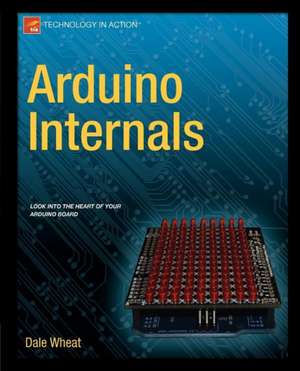
Arduino Internals
Autor Dale Wheaten Limba Engleză Paperback – 15 noi 2011
În domeniul sistemelor embedded, trecerea de la simpla utilizare a unei platforme la înțelegerea profundă a mecanismelor sale interne reprezintă un pas critic pentru orice dezvoltator. Observăm că Arduino Internals nu se mulțumește să prezinte rețete de utilizare, ci descompune placa Arduino în elementele sale constitutive, de la microcontrolerul ATmega8 până la interfața cu mediul exterior. Ne-a atras atenția rigoarea cu care Dale Wheat analizează „inima hardware” a platformei, oferind cititorului informațiile necesare pentru a modifica, îmbunătăți sau chiar înlocui componentele standard cu alternative mai performante. Suntem de părere că această lucrare completează excelent peisajul tehnic actual. Dacă Arduino Software Internals de Norman Dunbar v-a oferit cadrul teoretic pentru înțelegerea codului AVR C++ și a bibliotecilor de bază, Arduino Internals aduce instrumentele practice necesare pentru a stăpâni hardware-ul. Autorul nu se limitează la suprafață, ci investighează toolchain-ul compilatorului și modul în care software-ul interacționează cu memoria și perifericele în condiții de resurse limitate. Structura cărții este una progresivă, culminând cu capitole dedicate designului de shield-uri și protocoalelor de comunicație, esențiale pentru proiecte complexe. În contextul operei sale, această carte reprezintă o evoluție naturală a preocupărilor autorului. Dacă în Building Your Own Electronics Lab, Dale Wheat punea bazele infrastructurii necesare unui pasionat de electronică, aici el aplică aceleași principii de organizare și rigoare tehnică asupra ecosistemului Arduino. Este un volum tehnic, scris într-un limbaj precis, care încurajează colaborarea open source și inovația dincolo de specificațiile de referință.
Preț: 371.87 lei
Preț vechi: 464.85 lei
-20%
Carte tipărită la comandă
Livrare economică 01-15 decembrie
Specificații
ISBN-10: 1430238828
Pagini: 392
Ilustrații: XX, 392 p.
Dimensiuni: 208 x 235 x 28 mm
Greutate: 0.69 kg
Ediția:1st ed.
Editura: Apress
Locul publicării:Berkeley, CA, United States
V-ar putea interesa
-
 Code: The Hidden Language of Computer Hardware and SoftwareCharles Petzold-20%Preț: 188.58 lei235.72 lei
 -
 Principles of Computer HardwareAlan Clements-29%Preț: 602.71 lei846.14 lei
 -
 -14%Preț: 410.00 lei475.32 lei
 -
 -31%Preț: 441.34 lei639.30 lei
 -
 Adventures in ArduinoBecky StewartPreț: 111.83 lei
 -
 Preț: 245.96 lei
 -
 Arduino for DummiesJohn Nussey-20%Preț: 143.21 lei179.01 lei
 -
 -26%Preț: 274.68 lei373.40 lei
 -
 -31%Preț: 176.73 lei257.72 lei
 -
 Make: Arduino Bots and GadgetsTero KarvinenPreț: 210.49 lei
 -
 -20%Preț: 227.97 lei283.73 lei
 -
 -35%Preț: 229.61 lei354.03 lei
 -
 -35%Preț: 205.68 lei318.48 lei
 -
 -19%Preț: 281.92 lei348.18 lei
 -
 -20%Preț: 264.19 lei330.24 lei
 -
 -36%Preț: 284.35 lei440.95 lei
 -
 Arduino VISteven F. BarrettPreț: 481.88 lei
 -
 Arduino VIISteven F. Barrett-18%Preț: 930.85 lei1135.17 lei
Public țintă
Popular/generalDe ce să citești această carte
Recomandăm această carte inginerilor și pasionaților de robotică sau sisteme embedded care doresc să depășească limitele mediului de dezvoltare standard. Veți câștiga expertiza necesară pentru a proiecta propriile plăci și periferice compatibile Arduino, înțelegând exact cum circulă datele între procesor și cod. Este resursa ideală pentru a trece de la statutul de utilizator la cel de creator de hardware personalizat.
Despre autor
Dale Wheat este un expert recunoscut în electronică și sisteme embedded, cu o experiență vastă în zona de hardware hacking și design de laborator. Autorul este cunoscut pentru abilitatea sa de a explica arhitecturi complexe într-un mod accesibil, dar riguros din punct de vedere tehnic. În lucrările sale, precum Building Your Own Electronics Lab, pune un accent deosebit pe crearea unui mediu de lucru eficient pentru inventatori. Prin Arduino Internals, el își consolidează rolul de mentor pentru comunitatea maker, oferind detalii de implementare care sunt adesea trecute cu vederea în documentația oficială.
Descriere scurtă
Furthermore, Arduino Internals offers important information about the CPU running the Arduino board, the memory contained within it and the peripherals mounted on it. To be able to write software that runs optimally on what is a fairly small embedded board, one must understand how the different parts interact. Later in the book, you'll learn how to replace certain parts with more powerful alternatives and how to design Arduino peripherals and shields.
Since Arduino Internals addresses both sides of the Arduino hardware-software boundary, the author analyzes the compiler toolchain and again provides suggestions on how to replace it with something more suitable for your own purposes. You'll also learn about how libraries enable you to change the way Arduino and software interact, and how to write your own library implementing algorithms you've devised yourself. Arduino Internals also suggests alternative programming environments, since many Arduino hackers have a background language other than C or Java.
Of course, it is possible to optimize the way in which hardware and software interact—an entire chapter is dedicated to this field.
Arduino Internals doesn't just focus on the different parts of Arduino architecture, but also on the ways in which example projects can take advantage of the new and improved Arduino board. Wheat employs example projects to exemplify the hacks and algorithms taught throughout the book.
Arduino projects straddling the hardware-software boundary often require collaboration between people of different talents and skills which cannot be taken for granted. For this reason, Arduino Internals contains a whole chapter dedicated to collaboration and open source cooperation to make those tools and skills explicit.
One of the crowning achievements of an Arduino hacker is to design a shield or peripheral residing on the Arduino board, which is the focus of the following chapter. A later chapter takes specialization further by examining Arduino protocols and communications, a field immediately relevant to shields and the communication between peripherals and the board.
Finally, Arduino Internals integrates different skills and design techniques by presenting several projects that challenge you to put your newly-acquired skills to the test!
Please note: the print version of this title is black & white; the eBook is full color.
Caracteristici
Cuprins
- Hardware
- Software
- Atmel AVR
- Supporting Hardware
- Arduino Software
- Optimizations
- Hardware and Software Combined
- Example Projects
- Project Management
- Hardware Design
- Software Design
- Networking
- Tabletop Robot Project