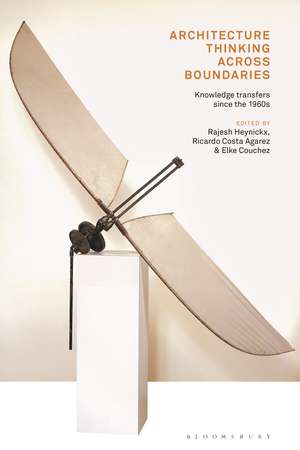
Architecture Thinking across Boundaries: Knowledge transfers since the 1960s
Editat de Rajesh Heynickx, Ricardo Costa Agarez, Elke Couchezen Limba Engleză Paperback – 28 iul 2022
Architecture Thinking across Boundaries looks at architectural theory through the lens of intellectual history. Eleven original essays explore a variety of themes and contexts, each examining how architectural knowledge has been transferred across social, spatial and disciplinary boundaries - whether through the international circulation of ideas, transdisciplinary exchanges, or transfers from design practice to theory and back again.
Dissecting the frictions, transformations and resistances that mark these journeys, the essays in this book reflect upon the myriad routes that architectural knowledge has taken while developing into architectural theory. They critically enquire the interstices - geographical, temporal and epistemological - that lie beyond fixed narratives. They show how unstable, vital and eminently mobile the processes of thinking about architecture have been.
Preț: 203.52 lei
Preț vechi: 279.10 lei
-27%
Puncte Express: 305
Carte tipărită la comandă
Livrare economică 25 noiembrie-09 decembrie
Livrare prin curier în România Termenul estimat este afișat lângă disponibilitate.
Transport gratuit de la 400.00 lei Plată online sau ramburs, în funcție de opțiunile comenzii.
Retur gratuit în 14 zile Comandă securizată și suport în română.
Specificații
ISBN-13: 9781350202139
ISBN-10: 1350202134
Pagini: 216
Ilustrații: 40 bw illus
Dimensiuni: 154 x 232 x 16 mm
Greutate: 0.34 kg
Editura: Bloomsbury Publishing
Colecția Bloomsbury Visual Arts
Locul publicării:London, United Kingdom
ISBN-10: 1350202134
Pagini: 216
Ilustrații: 40 bw illus
Dimensiuni: 154 x 232 x 16 mm
Greutate: 0.34 kg
Editura: Bloomsbury Publishing
Colecția Bloomsbury Visual Arts
Locul publicării:London, United Kingdom
Cuprins
List of Illustrations
List of Contributors
Introduction
Part One: Translations and Appropriations
1. Deconstruction and Architecture: translation as a matter of speculative theory
2. Gehry's Lou Ruvo Center in Las Vegas as a Housing Critique
3. "Boomerang Effect": The Repercussions of Critical Regionalism in 1980s Greece
4.The Autonomy of Theory: Tendenzen - Neuere Architektur im Tessin, ETH Zurich, 1975
SECTION 2: Imprints and Undercurrents
5. Royston Landau and the Research Programmes of Architecture
6. Theoretical a/gnosticisms: Paul Tillich, Colin Rowe, and the theology of architecture
SECTION 3: Vehicles
7. Cedric Price's Chats: Orality and the Production of Architectural Theory
8. Alternative Facts: Towards a Theorisation of Oral History in Architecture
9. Abandoning the Plan
10. Deltiology as History. Informal Communication as Praxis.
11. Theorizing from the South. The Seminar of Latin American Architecture (SAL)
Index
List of Contributors
Introduction
Part One: Translations and Appropriations
1. Deconstruction and Architecture: translation as a matter of speculative theory
2. Gehry's Lou Ruvo Center in Las Vegas as a Housing Critique
3. "Boomerang Effect": The Repercussions of Critical Regionalism in 1980s Greece
4.The Autonomy of Theory: Tendenzen - Neuere Architektur im Tessin, ETH Zurich, 1975
SECTION 2: Imprints and Undercurrents
5. Royston Landau and the Research Programmes of Architecture
6. Theoretical a/gnosticisms: Paul Tillich, Colin Rowe, and the theology of architecture
SECTION 3: Vehicles
7. Cedric Price's Chats: Orality and the Production of Architectural Theory
8. Alternative Facts: Towards a Theorisation of Oral History in Architecture
9. Abandoning the Plan
10. Deltiology as History. Informal Communication as Praxis.
11. Theorizing from the South. The Seminar of Latin American Architecture (SAL)
Index
Recenzii
Buildings stay still, but theory is always on the move. This simple fact, often noticed but little acted upon, is one of the two catalysts for this engaging collection of essays on architecture's recent past. The other - the chronic uncertainty as to whether architecture is at heart a practical, or a theoretical, discipline - is exploited to good effect through a series of lively and provocative discussions.
In Architecture Thinking Across Boundaries, the figure of the architect, the historian, the theorist is refreshingly reconfigured as one of the many players in a nexus of relationships between ideas, texts, exhibitions, lectures, dialogical practices and people.
In Architecture Thinking Across Boundaries, the figure of the architect, the historian, the theorist is refreshingly reconfigured as one of the many players in a nexus of relationships between ideas, texts, exhibitions, lectures, dialogical practices and people.