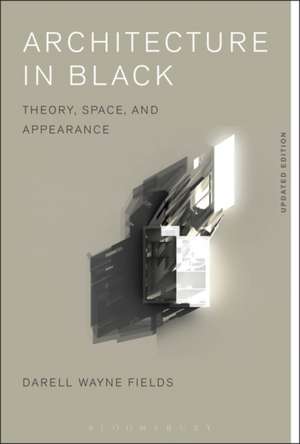
Architecture in Black: Theory, Space and Appearance
Autor Darell Wayne Fieldsen Limba Engleză Paperback – 22 sep 2016
Arguing that architecture, as an aesthetic practice, and blackness, as a linguistic practice, operate within the same semiotic paradigm, Darell Fields employs a technique whereby works are related through the repetition and revision of their semiotic structures. Fields reconstructs the genealogy of a black racial subject, represented by the simultaneous reading of a range of canonical texts from Hegel to Saussure to Henry Louis Gates, Jr.
Combining an historical survey of racial discourse with new readings resulting from advanced semiotic techniques doubling as spatial arrangements, Architecture in Black is an important contribution to studies of the racial in Western thought and its impact on architecture, space and time.
| Toate formatele și edițiile | Preț | Express |
|---|---|---|
| Paperback (1) | 263.51 lei 6-8 săpt. | |
| Bloomsbury Publishing – 22 sep 2016 | 263.51 lei 6-8 săpt. | |
| Hardback (1) | 1185.29 lei 6-8 săpt. | |
| Bloomsbury Publishing – 4 ian 2000 | 1185.29 lei 6-8 săpt. | |
| Hardback (1) | 793.66 lei 6-8 săpt. | |
| Bloomsbury Publishing – 12 mar 2015 | 793.66 lei 6-8 săpt. |
Preț: 263.51 lei
Preț vechi: 357.73 lei
-26%
Puncte Express: 395
Preț estimativ în valută:
46.64€ • 54.50$ • 40.49£
46.64€ • 54.50$ • 40.49£
Carte tipărită la comandă
Livrare economică 20 februarie-06 martie
Preluare comenzi: 021 569.72.76
Specificații
ISBN-13: 9781350009875
ISBN-10: 1350009873
Pagini: 232
Dimensiuni: 156 x 234 x 17 mm
Greutate: 0.33 kg
Ediția:NIPPOD
Editura: Bloomsbury Publishing
Colecția Bloomsbury Academic
Locul publicării:London, United Kingdom
ISBN-10: 1350009873
Pagini: 232
Dimensiuni: 156 x 234 x 17 mm
Greutate: 0.33 kg
Ediția:NIPPOD
Editura: Bloomsbury Publishing
Colecția Bloomsbury Academic
Locul publicării:London, United Kingdom
V-ar putea interesa
-
 Architecture in Detail IIGraham Bizley-22%Preț: 342.49 lei436.85 lei
 -
 The Poetics of SpaceGaston Bachelard-31%Preț: 70.34 lei102.06 lei
 -
 Architecture DependsJeremy TillPreț: 131.52 lei
 -
 GwyneddRichard Haslam-15%Preț: 430.50 lei506.47 lei
 -
 Why We BuildRowan Moore-43%Preț: 59.32 lei103.32 lei
 -
 Form and ForcesEdward Allen-11%Preț: 648.71 lei728.88 lei
 -
 Architect's Handbook of Construction DetailingDavid Kent Ballast-23%Preț: 611.32 lei793.93 lei
 -
 Palm Springs Mid-Century ModernDolly Faibyshev-29%Preț: 157.86 lei222.98 lei
 -
 Architecture and Ritual: How Buildings Shape SocietyProfessor Peter Blundell Jones-17%Preț: 209.75 lei253.34 lei
 -
 Designing Your Business: Professional Practices for Interior DesignersGordon T. Kendall-34%Preț: 561.06 lei846.95 lei
 -
 Digital Drawing for Designers: A Visual Guide to AutoCAD® 2017Douglas R. Seidler-30%Preț: 558.31 lei801.34 lei
 -
 Programming and Research: Skills and Techniques for Interior DesignersRose Mary Botti-Salitsky-34%Preț: 559.64 lei845.94 lei
 -
 Stone BuildingsPatrick McAfeePreț: 135.11 lei
 -
 Thinking ArchitecturePeter ZumthorPreț: 261.74 lei
Cuprins
List of Illustrations
Acknowledgements
Introduction to Second Edition
Foreword
PART I: THEORY
Forethought: On Blackness and Time
Introduction to Part I
1. Hegel's Tropes: History, Architecture and the Black Subject
Philosophy and Aesthetics: A Total Model of History
The Subject Identified
Full Force of the Effect: The Negation of the Black Subject
The Symbolic Category: Architecture's Blackness
Transcending the Black Subject
2. Scheming the Scheme: The Technique of Revision
A Racial Model of the Dialectic
The Consistency of Ideas
A Comprehensive Diagram
A Linguistic Revision of Aesthetics
Reintroduction of the Black Subject
3. Tropological Cases: the Racial Object in Architectural Discourse
Signification of the First Order: Laws of Emergence
Case 1: An Original Essay on Style
Case 2: A Reflective Essay on Style
Case 3: A Philosophical Essay on Style
Signification of the Second Order: Operations on a Black Signifier
Contemporary Architectural Theory: Talking Black
Afterthought
A Monkey Reading ... Fanon
PART II: ORDERS OF SPACE AND APPEARANCE
Forethought: The Negative Constructs
Introduction to Part II
4. Black Autonomy
The Classical (P)eriod
Space and Time: Kant and the Indivisible
The Medieval as Symbolic: An Other Space, Another Time
Kant, Blackness and Autonomy: Towards a Black Formalism
5. Space and Time in the Classical (P)eriod
From Space to Appearance
Spatial Orders in the Birth of Tragedy
Visualizing Autonomy: A Reflection on a History of Styles
The Spatial Diagrammatic
6. Architecture and the Classical (P)eriod
Building on Language: Black Architectonics
Spatial Linguistics and the Hall of Mirrors
The Black Architectonic: A Methodological Note
Now Imagine a Monkey Sitting in a Dark Place Trying to See Architecture for the First Time
Étienne-Louis Boullée (1728-1799)
Claude-Nicolas Ledoux (1736-1806)
Lebbeus Woods (1940-2012)
John Hejduk (1929-2000)
Darell Fields (1962-)
Afterthought
The End: Of Absence
Works Cited
Index
Acknowledgements
Introduction to Second Edition
Foreword
PART I: THEORY
Forethought: On Blackness and Time
Introduction to Part I
1. Hegel's Tropes: History, Architecture and the Black Subject
Philosophy and Aesthetics: A Total Model of History
The Subject Identified
Full Force of the Effect: The Negation of the Black Subject
The Symbolic Category: Architecture's Blackness
Transcending the Black Subject
2. Scheming the Scheme: The Technique of Revision
A Racial Model of the Dialectic
The Consistency of Ideas
A Comprehensive Diagram
A Linguistic Revision of Aesthetics
Reintroduction of the Black Subject
3. Tropological Cases: the Racial Object in Architectural Discourse
Signification of the First Order: Laws of Emergence
Case 1: An Original Essay on Style
Case 2: A Reflective Essay on Style
Case 3: A Philosophical Essay on Style
Signification of the Second Order: Operations on a Black Signifier
Contemporary Architectural Theory: Talking Black
Afterthought
A Monkey Reading ... Fanon
PART II: ORDERS OF SPACE AND APPEARANCE
Forethought: The Negative Constructs
Introduction to Part II
4. Black Autonomy
The Classical (P)eriod
Space and Time: Kant and the Indivisible
The Medieval as Symbolic: An Other Space, Another Time
Kant, Blackness and Autonomy: Towards a Black Formalism
5. Space and Time in the Classical (P)eriod
From Space to Appearance
Spatial Orders in the Birth of Tragedy
Visualizing Autonomy: A Reflection on a History of Styles
The Spatial Diagrammatic
6. Architecture and the Classical (P)eriod
Building on Language: Black Architectonics
Spatial Linguistics and the Hall of Mirrors
The Black Architectonic: A Methodological Note
Now Imagine a Monkey Sitting in a Dark Place Trying to See Architecture for the First Time
Étienne-Louis Boullée (1728-1799)
Claude-Nicolas Ledoux (1736-1806)
Lebbeus Woods (1940-2012)
John Hejduk (1929-2000)
Darell Fields (1962-)
Afterthought
The End: Of Absence
Works Cited
Index
Recenzii
Darell Field's pioneering book is the first theoretical treatment of race in architecural discourse. The first mature attempt to engage in a sophisticated theoretical discourse about architecture and race using the tools of cultural studies and Afro-American literary theory. In this way, Fields has opened new critical and constructive possibilities for our intellectual discussions of modernity, architecture, and race.
Emerging from a context in which architectural theory increasingly avoids difficult questions, Architecture in Black engages them in a distinctive way. Beginning with a rereading of Hegel's Aesthetics and The Philosophy of History, Fields conjures an encounter between architectural theory and semiotic structures that mines the gaps of history to reconstruct the black subject in a manner that is diagrammatic, projective, and defiantly autonomous and unfixed. Interrogating both history and dialectics to unveil alternative realities, this is an important contribution to the exploration of aporias in architectural theory.
A bold and invigorating discussion of the intersection between architecture and race. By excavating the racialized history of architecture, the book opens up new territories for a wider interdisciplinary debate and discussion. An enormously important book.
It is best to think of this text as an allegorical demonstration of its central thesis: using the critical tools of semiotics, Darell Fields uncovers the black subjectivities hidden with the architectonic structures of Continental Philosophy. Working as the fabled 'trickster' of old, Fields cleverly uses his prose to revise the critical aims of philosophy by constructing a new world from its multiple fragments. While both serious and critical in tone, Architecture in Black is delightfully irreverent in its transformation of the very system it relies upon for existence. The results are both haunting and revelatory. The disembodied voice of its 'Black Subject' is freed of its nineteenth-century prison in time to exert its will upon the projective logic of contemporary architecture.
Emerging from a context in which architectural theory increasingly avoids difficult questions, Architecture in Black engages them in a distinctive way. Beginning with a rereading of Hegel's Aesthetics and The Philosophy of History, Fields conjures an encounter between architectural theory and semiotic structures that mines the gaps of history to reconstruct the black subject in a manner that is diagrammatic, projective, and defiantly autonomous and unfixed. Interrogating both history and dialectics to unveil alternative realities, this is an important contribution to the exploration of aporias in architectural theory.
A bold and invigorating discussion of the intersection between architecture and race. By excavating the racialized history of architecture, the book opens up new territories for a wider interdisciplinary debate and discussion. An enormously important book.
It is best to think of this text as an allegorical demonstration of its central thesis: using the critical tools of semiotics, Darell Fields uncovers the black subjectivities hidden with the architectonic structures of Continental Philosophy. Working as the fabled 'trickster' of old, Fields cleverly uses his prose to revise the critical aims of philosophy by constructing a new world from its multiple fragments. While both serious and critical in tone, Architecture in Black is delightfully irreverent in its transformation of the very system it relies upon for existence. The results are both haunting and revelatory. The disembodied voice of its 'Black Subject' is freed of its nineteenth-century prison in time to exert its will upon the projective logic of contemporary architecture.