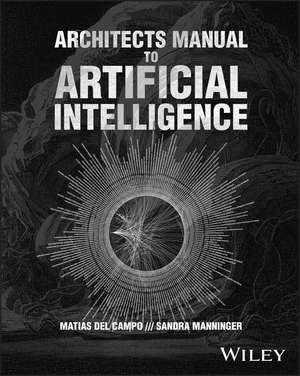
Architects Manual to Artificial Intelligence
Autor Matias Del Campo, Sandra Manningeren Limba Engleză Paperback – 7 dec 2026
Architects and computational designers lack a single resource that integrates AI theory, critical discourse, and working code within an architectural context. The Architects Manual to Artificial Intelligence, written by the co-founders of SPAN, addresses this directly. Covering CNNs, GANs, transformers, diffusion models, and more, the book provides both the conceptual frameworks and executable Python scripts needed to deploy AI in design practice.
The manual introduces a distinctive pedagogical system: Grey Boxes catalog architectural applications for specific AI models, while Black Boxes supply executable Python code for tasks such as generating structural details with Pix2Pix, creating 3D terrain with 3DGAN, and optimizing spatial layouts with TransformerGAN. Original frameworks including Vibe Coding, Concatenation, and the AI Iceberg structure the theoretical discourse.
The book also covers:
- Proprietary datasets including the Baroque Plan Dataset of over 2,000 annotated plans used in real project workflows
- Detailed analysis of GraphCNN, TransformerGAN, Gaussian Splatting, CycleGAN, and other architectures beyond standard image-generator discourse
- Real-world project breakdowns from SPAN including the Deep House using StyleGAN2 and the Robot Garden workflow
- A dual-channel structure enabling simultaneous use as a technical coding workshop and a critical design seminar
- Examination of how AI reorganizes authorship, form-making, material reasoning, and architectural representation across the built environment
Preț: 345.88 lei
Precomandă
Puncte Express: 519
Carte nepublicată încă
Livrare prin curier în România Precomanda se expediază când titlul devine disponibil.
Transport gratuit de la 400.00 lei Plată online sau ramburs, în funcție de opțiunile comenzii.
Retur gratuit în 14 zile Comandă securizată și suport în română.
Doresc să fiu notificat când acest titlu va fi disponibil:
Se trimite...
Specificații
Notă biografică
Matias del Campo is an architect, designer, and theorist whose work examines the role of artificial intelligence and computational design in contemporary architecture. As co-founder of the design practice SPAN, his research investigates the aesthetic and epistemological implications of algorithmic processes in form generation and design culture. His work has been exhibited internationally, including at the Venice Architecture Biennale, MAK Vienna, and Archilab. Del Campo is the author and editor of several publications, including Neural Architecture: Design and Artificial Intelligence (2022) and Diffusions in Architecture: Artificial Intelligence and Image Generators (2024). He is a recipient of the ACADIA Innovative Research Award of Excellence.
Sandra Manninger is an Associate Professor at the School of Architecture + Design at the New York Institute of Technology and the Co-Founder | Director of the Architecture + Artificial Intelligence Laboratory (AR2ILab).
Sandra Manninger's research focuses on exploring architecture as a representation of the social, cultural, political, mathematical, and physical forces that shape our environment. She engages with technologies not just as design tools but as instruments that uncover and reveal the underlying forces and fields that constitute our domains.
Sandra Manninger has taught internationally, and her award-winning projects have been published and exhibited, for example, at La Biennale di Venezia 14/16/18/21, the MAK, the Autodesk Pier 1 and have been included in the permanent collections of the FRAC Centre-Val de Loire, The Design Museum/Die Neue Sammlung in Munich, or the MAK and Albertina in Vienna.
Sandra Manninger is an Associate Professor at the School of Architecture + Design at the New York Institute of Technology and the Co-Founder | Director of the Architecture + Artificial Intelligence Laboratory (AR2ILab).
Sandra Manninger's research focuses on exploring architecture as a representation of the social, cultural, political, mathematical, and physical forces that shape our environment. She engages with technologies not just as design tools but as instruments that uncover and reveal the underlying forces and fields that constitute our domains.
Sandra Manninger has taught internationally, and her award-winning projects have been published and exhibited, for example, at La Biennale di Venezia 14/16/18/21, the MAK, the Autodesk Pier 1 and have been included in the permanent collections of the FRAC Centre-Val de Loire, The Design Museum/Die Neue Sammlung in Munich, or the MAK and Albertina in Vienna.