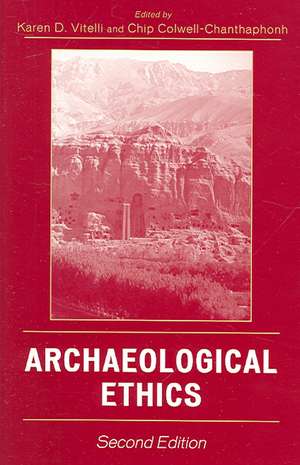
Archaeological Ethics
Editat de Karen D. Vitelli, Chip Colwell-Chanthaphonh Contribuţii de Roger Atwood, Michael Bawya, Maria Braden, Michel Brent, Kathleen Bryant, Arlen F. Chase, Diane Z. Chase, Andrew Curry, James P. Delgado, Blake Edgar, Stacey O. Espenlaub, Brian Fagan, Micah Garen, Juliet Golden, Yuval Goren, Julie Hollowell, Jarrett Lobell, Roderick J. McIntosh, Susan Keech McIntosh, Clement W. Meighan, Mark Michel, Janet Monge, George Nicholas, Robert W. Preucel, David Price, Marilyn Raschka, Elaine Robbins, Kristin M. Romey, Neil Asher Silberman, Tereba Togola, Harriot W. Topsey, Joe Watkins, Lucy F. Williamsen Limba Engleză Paperback – 2 feb 2006
Preț: 359.06 lei
Preț vechi: 506.74 lei
-29%
Puncte Express: 539
Carte tipărită la comandă
Livrare economică 30 noiembrie-14 decembrie
Livrare prin curier în România Termenul estimat este afișat lângă disponibilitate.
Transport gratuit de la 400.00 lei Plată online sau ramburs, în funcție de opțiunile comenzii.
Retur gratuit în 14 zile Comandă securizată și suport în română.
Specificații
ISBN-13: 9780759109636
ISBN-10: 075910963X
Pagini: 239
Dimensiuni: 148 x 226 x 16 mm
Greutate: 0.39 kg
Ediția:2. Auflage.
Editura: Bloomsbury Publishing
Colecția AltaMira Press
Locul publicării:New York, United States
ISBN-10: 075910963X
Pagini: 239
Dimensiuni: 148 x 226 x 16 mm
Greutate: 0.39 kg
Ediția:2. Auflage.
Editura: Bloomsbury Publishing
Colecția AltaMira Press
Locul publicării:New York, United States
V-ar putea interesa
-
 Essays on the History of EthicsMichael Slote-31%Preț: 600.41 lei871.78 lei
 -
 Reading Seneca: Stoic Philosophy at RomeBrad Inwood-28%Preț: 389.88 lei540.65 lei
 -
 -20%Preț: 57.15 lei71.12 lei
 -
 Deadly VicesGabriele Taylor-13%Preț: 323.24 lei370.66 lei
 -
 Reasons and the GoodRoger Crisp-12%Preț: 320.12 lei362.30 lei
 -
 A Theory of Virtue: Excellence in Being for the GoodRobert Merrihew Adams-13%Preț: 302.92 lei347.04 lei
 -
 The Constitution of Agency: Essays on Practical Reason and Moral PsychologyChristine M. Korsgaard-11%Preț: 363.03 lei407.60 lei
 -
 Slaves of the PassionsMark Schroeder-11%Preț: 359.81 lei405.93 lei
 -
 Ethics and War in the 21st CenturyChristopher CokerPreț: 442.04 lei
 -
 The Choice Of Hercules: Pleasure, Duty And The Good Life In The 21st CenturyProf A.C. GraylingPreț: 65.31 lei
 -
 -16%Preț: 131.91 lei157.81 lei
 -
 Sharing TimeElizabeth VerdickPreț: 57.49 lei
 -
 -25%Preț: 94.15 lei126.32 lei
Cuprins
Chapter 1 Introduction
Part 2 Part I: Who Owns the Past?
Chapter 3 Chapter 1: Archaeology and the Ethics of Collecting
Chapter 4 Chapter 2: Trafficking in Treasures
Chapter 5 Chapter 3: Guardians of the Dead
Chapter 6 Chapter 4: The World Wide Web of Antiquities
Chapter 7 Chapter 5: Faking Biblical History
Chapter 8 Chapter 6: Anasazi in the Backyard
Chapter 9 Chapter 7: Celebrating Twenty-Five Years of Preservation
Part 10 Part II: Archaeology and (Inter)National Politics
Chapter 11 Chapter 8: The Race to Save Afghan Culture
Chapter 12 Chapter 9: The War Within the War
Chapter 13 Chapter 10: Beirut Digs Out
Chapter 14 Chapter 11: Flashpoint Ayodhya
Chapter 15 Chapter 12: Cloak and Trowel
Part 16 Part III: Affected Peoples
Chapter 17 Chapter 13: People Without History
Chapter 18 Chapter 14: When Artifacts are Commodities
Chapter 19 Chapter 15: The Rape of Mali
Chapter 20 Chapter 16: Archaeotourism
Part 21 Part IV: Reburial, Repatriation, and Representation
Chapter 22 Chapter 17: Burying American Archaeology or Sharing Control of the Past-Burying American Archaeology; Sharing Control of the Past
Chapter 23 Chapter 18: Banned Books
Chapter 24 Chapter 19: Out of Heaviness, Enlightenment
Chapter 25 Chapter 20: Remembering Chelmno
Chapter 26 Chapter 21: The New Acropolis Museum
Part 27 Part V: The Professional Archaeologist
Chapter 28 Chapter 22: Archaeology's Dirty Secret
Chapter 29 Chapter 23: Intellectual Property Issues in Archaeology?
Chapter 30 Chapter 24: Lure of the Deep
Chapter 31 Chapter 25: Chronicler of Ice Age Life
Chapter 32 Chapter 26: Writing Unwritten History
Part 2 Part I: Who Owns the Past?
Chapter 3 Chapter 1: Archaeology and the Ethics of Collecting
Chapter 4 Chapter 2: Trafficking in Treasures
Chapter 5 Chapter 3: Guardians of the Dead
Chapter 6 Chapter 4: The World Wide Web of Antiquities
Chapter 7 Chapter 5: Faking Biblical History
Chapter 8 Chapter 6: Anasazi in the Backyard
Chapter 9 Chapter 7: Celebrating Twenty-Five Years of Preservation
Part 10 Part II: Archaeology and (Inter)National Politics
Chapter 11 Chapter 8: The Race to Save Afghan Culture
Chapter 12 Chapter 9: The War Within the War
Chapter 13 Chapter 10: Beirut Digs Out
Chapter 14 Chapter 11: Flashpoint Ayodhya
Chapter 15 Chapter 12: Cloak and Trowel
Part 16 Part III: Affected Peoples
Chapter 17 Chapter 13: People Without History
Chapter 18 Chapter 14: When Artifacts are Commodities
Chapter 19 Chapter 15: The Rape of Mali
Chapter 20 Chapter 16: Archaeotourism
Part 21 Part IV: Reburial, Repatriation, and Representation
Chapter 22 Chapter 17: Burying American Archaeology or Sharing Control of the Past-Burying American Archaeology; Sharing Control of the Past
Chapter 23 Chapter 18: Banned Books
Chapter 24 Chapter 19: Out of Heaviness, Enlightenment
Chapter 25 Chapter 20: Remembering Chelmno
Chapter 26 Chapter 21: The New Acropolis Museum
Part 27 Part V: The Professional Archaeologist
Chapter 28 Chapter 22: Archaeology's Dirty Secret
Chapter 29 Chapter 23: Intellectual Property Issues in Archaeology?
Chapter 30 Chapter 24: Lure of the Deep
Chapter 31 Chapter 25: Chronicler of Ice Age Life
Chapter 32 Chapter 26: Writing Unwritten History
Recenzii
Ethics matter! Archaeology is too important, and what archaeologists do affects too many groups of people: we cannot just push ahead without really thinking through the consequences of what we do. This new edition updates this first-rate guide to what should be in all our minds.
Archaeological Ethics is a central text for our discipline and represents our global engagement with archaeology's many, diverse stakeholders.
Amongst practicing archaeologists, K. D. Vitelli is the premier scholar of archaeological ethics, and her student Chip Colwell-Chanthaphonh is following closely in her footsteps. Together they have put together a wholly revised second edition of Archaeological Ethics that is sure to become a standard handbook for both teachers and researchers. The range of articles in the book includes both the classical statements of issues as well as new considerations and theoretical developments, formulated neatly along with presentations of concrete examples of doing archaeology well at the same time that archaeologists 'do good.' Many members of the discipline, both Classical and New World archaeologists, have come to rely on Vitelli as a touchstone for understanding ethics in archaeology; needless to say, with her editorial work on this new volume, she has not let us down.
Issues in archaeological ethics are rarely black and white; by avoiding simplistic answers to complex issues, this volume teaches rather than preaches. Instead of focusing on answers, it helps archaeologists ask the right questions. It covers a wide range of archaeological issues, and encourages reflection on the reasons underlying them. No archaeologist can afford to ignore the issues this volume addresses, neither can they afford to assume they know the answers to the questions it poses. Steal this book!
The second edition of Archaeological Ethics is as enthralling, timely, and effective for teaching purposes as was the first. Beginning, in the Introduction, with a philosophical discussion of morals and ethics, subsequent chapters consider the facts and the problems of excavations, legal and illegal, in many parts of the world. While perhaps intended for archaeologists, this book provides an invaluable resource for all those who study and teach the history and peoples of the past.
Vitelli and Colwell-Chanthaphonh have done an outstanding job updating an already significant collection of essays related to archaeological ethics. The authors address a wide span of issues that are relevant to the discipline. This volume is a major contribution to the field and it should become a standard text in the field. It is a must read for students and scholars.
With case-studies from around the world, this book demonstrates that archaeology is a field of considerable political currency. Topics discussed include, among many others, the rights and interests of indigenous people; demands for the reburial and repatriation of archaeological finds; looting, fakes, and the ethics of collecting; the archaeology of a Nazi extermination site; archaeologists as secret agents; saving cultural heritage in Afghanistan and Iraq; archaeology and religious fundamentalism; and the depiction of prehistory in Jean Auel's bestselling novels. Well-written throughout, each case-study engages readers far more than the usual academic writing. Challenging questions for discussion after each chapter make Archaeological Ethics an ideal textbook. The book is essential reading for students of many fields within the humanities and social sciences, and it will intrigue a general audience about the politics of the past in the modern world.
Articles are well-written....Both volumes present important analyses and case studies of ethical issues facing our discipline today.
Archaeological Ethics is a central text for our discipline and represents our global engagement with archaeology's many, diverse stakeholders.
Amongst practicing archaeologists, K. D. Vitelli is the premier scholar of archaeological ethics, and her student Chip Colwell-Chanthaphonh is following closely in her footsteps. Together they have put together a wholly revised second edition of Archaeological Ethics that is sure to become a standard handbook for both teachers and researchers. The range of articles in the book includes both the classical statements of issues as well as new considerations and theoretical developments, formulated neatly along with presentations of concrete examples of doing archaeology well at the same time that archaeologists 'do good.' Many members of the discipline, both Classical and New World archaeologists, have come to rely on Vitelli as a touchstone for understanding ethics in archaeology; needless to say, with her editorial work on this new volume, she has not let us down.
Issues in archaeological ethics are rarely black and white; by avoiding simplistic answers to complex issues, this volume teaches rather than preaches. Instead of focusing on answers, it helps archaeologists ask the right questions. It covers a wide range of archaeological issues, and encourages reflection on the reasons underlying them. No archaeologist can afford to ignore the issues this volume addresses, neither can they afford to assume they know the answers to the questions it poses. Steal this book!
The second edition of Archaeological Ethics is as enthralling, timely, and effective for teaching purposes as was the first. Beginning, in the Introduction, with a philosophical discussion of morals and ethics, subsequent chapters consider the facts and the problems of excavations, legal and illegal, in many parts of the world. While perhaps intended for archaeologists, this book provides an invaluable resource for all those who study and teach the history and peoples of the past.
Vitelli and Colwell-Chanthaphonh have done an outstanding job updating an already significant collection of essays related to archaeological ethics. The authors address a wide span of issues that are relevant to the discipline. This volume is a major contribution to the field and it should become a standard text in the field. It is a must read for students and scholars.
With case-studies from around the world, this book demonstrates that archaeology is a field of considerable political currency. Topics discussed include, among many others, the rights and interests of indigenous people; demands for the reburial and repatriation of archaeological finds; looting, fakes, and the ethics of collecting; the archaeology of a Nazi extermination site; archaeologists as secret agents; saving cultural heritage in Afghanistan and Iraq; archaeology and religious fundamentalism; and the depiction of prehistory in Jean Auel's bestselling novels. Well-written throughout, each case-study engages readers far more than the usual academic writing. Challenging questions for discussion after each chapter make Archaeological Ethics an ideal textbook. The book is essential reading for students of many fields within the humanities and social sciences, and it will intrigue a general audience about the politics of the past in the modern world.
Articles are well-written....Both volumes present important analyses and case studies of ethical issues facing our discipline today.