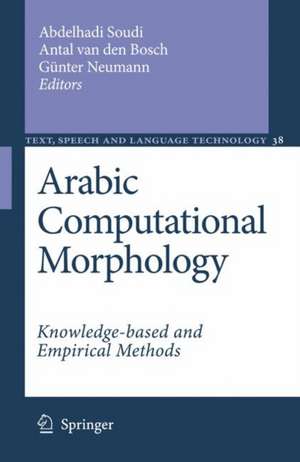
Arabic Computational Morphology
Editat de Abdelhadi Soudi, Antal Van Den Bosch, Günter Neumannen Limba Engleză Hardback – 11 sep 2007
ACTUALIZAREA: Notăm cu interes că acest volum de referință constituie prima sinteză exhaustivă a tehnologiilor de procesare a morfologiei arabe, un domeniu care s-a transformat radical odată cu trecerea de la sistemele rigide, bazate pe reguli, la modelele hibride și empirice. Reținem că Arabic Computational Morphology nu este doar o colecție de studii, ci un cadru metodologic care abordează sistemul complex de rădăcini și tipare („root-and-pattern”) specific limbilor semitice. Cititorul care a aplicat conceptele fundamentale din Introduction to Arabic Natural Language Processing de Nizar Y. Habash va găsi aici instrumentele necesare pentru a aprofunda implementările tehnice specifice. În timp ce lucrarea lui Habash oferă o privire de ansamblu asupra întregului spectru lingvistic, volumul editat de Abdelhadi Soudi se concentrează chirurgical pe provocările morfologice, oferind soluții concrete pentru analiza silabică și generarea morfologică. Structura volumului este organizată riguros în două mari direcții: metode bazate pe cunoaștere și metode empirice. Primele capitole analizează fundamentele teoretice, de la transliterație la moștenirea morfologică a verbelor, în timp ce a doua parte a cărții explorează frontierele învățării automate (supervised și unsupervised learning). Credem că un punct forte al cuprinsului este integrarea morfologiei în aplicații practice de anvergură, precum sistemele de traducere automată și tehnicile de „light stemming” pentru recuperarea informației. Această progresie de la teorie lingvistică la algoritmi de procesare a textului standard modern face din această lucrare un instrument tehnic indispensabil cercetătorilor din inteligența artificială.
Preț: 1030.56 lei
Preț vechi: 1288.20 lei
-20%
Carte tipărită la comandă
Livrare economică 04-18 decembrie
Specificații
ISBN-10: 1402060459
Pagini: 308
Ilustrații: VIII, 308 p.
Dimensiuni: 165 x 244 x 27 mm
Greutate: 0.6 kg
Ediția:2007 edition
Editura: Springer
Locul publicării:Dordrecht, Netherlands
V-ar putea interesa
-
 -32%Preț: 716.80 lei1061.76 lei
 -
 -16%Preț: 197.09 lei234.49 lei
 -
 Oxford Essential Arabic DictionaryOxford LanguagesPreț: 67.49 lei
 -
 -14%Preț: 71.46 lei83.33 leiRecomandat
 -
 Preț: 272.84 lei
 -
 A New Arabic Grammar of the Written LanguageH M NahmadPreț: 316.98 lei
 -
 The Queer Arab GlossaryMarwan KaabourPreț: 123.10 lei
 -
 Arabic Through the Qur''anAlan JonesPreț: 124.73 lei
 -
 Arabic For Dummies, 3rd EditionAmine BouchentoufPreț: 132.88 lei
 -
 Mastering Arabic GrammarJane Wightwick-23%Preț: 200.77 lei259.14 lei
 -
 Mastering Arabic Script: A Guide to HandwritingJane Wightwick-25%Preț: 200.34 lei265.53 lei
 -
 AlgospeakAdam AleksicPreț: 122.02 leiRecomandat
 -
 Upper Intermediate Arabic Through DiscussionNevenka Korica SullivanPreț: 310.63 lei
 -
 Mastering Modern Standard Arabic IdiomsAsmaa ShehataPreț: 260.55 lei
 -
 The evolution of the derivational verbal system in ArabicVera TsukanovaPreț: 487.25 lei
 -
 Zeitschrift für Arabische Linguistik 78 (2024) 2Werner ArnoldPreț: 461.63 lei
 -
 -20%Preț: 313.10 lei391.37 lei
 -
 -20%Preț: 1066.18 lei1332.72 lei
 -
 Patterns and Representation in Arabic Place AssimilationIslam Youssef-14%Preț: 1037.69 lei1206.63 lei
Public țintă
ResearchDe ce să citești această carte
Recomandăm această carte cercetătorilor și inginerilor NLP care se confruntă cu natura non-concatenativă a limbii arabe. Cititorul câștigă o înțelegere profundă a modului în care metodele statistice pot fi combinate cu regulile lingvistice pentru a optimiza motoarele de căutare și sistemele de traducere automată. Este o resursă esențială pentru depășirea barierelor tehnice impuse de morfologia complexă a limbilor semitice.
Cuprins
Textul de pe ultima copertă
The book’s subtitle aims to reflect that widely different computational approaches to the Arabic morphological system have been proposed. These accounts fall into two main paradigms: the knowledge-based and the empirical. Since morphological knowledge plays an essential role in any higher-level understanding and processing of Arabic text, the book also features a part on the role of Arabic morphology in larger applications, i.e. Information Retrieval (IR) and Machine Translation (MT).