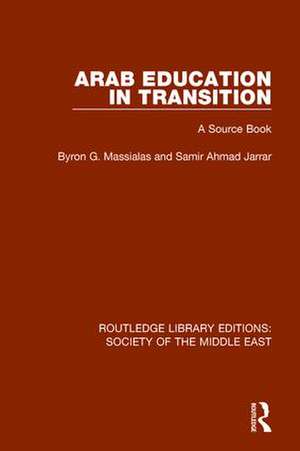
Arab Education in Transition: A Source Book: Routledge Library Editions: Society of the Middle East
Autor Byron G. Massialas, Samir Ahmad Jarraren Limba Engleză Paperback – 13 sep 2017
Din seria Routledge Library Editions: Society of the Middle East
-
 Preț: 428.25 lei
 - 16%
 Preț: 281.86 lei
 - 16%
 Preț: 286.61 lei
 -
 Preț: 373.74 lei
 -
 Preț: 443.03 lei
 -
 Preț: 387.65 lei
 -
 Preț: 379.88 lei
 - 17%
 Preț: 277.10 lei
 - 16%
 Preț: 281.39 lei
 - 17%
 Preț: 279.95 lei
 - 17%
 Preț: 277.58 lei
 - 16%
 Preț: 281.86 lei
 - 17%
 Preț: 280.92 lei
 - 40%
 Preț: 180.66 lei
 - 17%
 Preț: 199.36 lei
 - 17%
 Preț: 278.53 lei
 - 14%
 Preț: 297.30 lei
 - 34%
 Preț: 19409.99 lei
Preț: 185.25 lei
Preț vechi: 303.44 lei
-39%
Puncte Express: 278
Carte indisponibilă temporar
Doresc să fiu notificat când acest titlu va fi disponibil:
Se trimite...
Specificații
ISBN-13: 9781138643017
ISBN-10: 1138643017
Pagini: 272
Dimensiuni: 156 x 234 mm
Greutate: 0.36 kg
Ediția:1
Editura: Taylor & Francis
Colecția Routledge
Seria Routledge Library Editions: Society of the Middle East
Locul publicării:Oxford, United Kingdom
ISBN-10: 1138643017
Pagini: 272
Dimensiuni: 156 x 234 mm
Greutate: 0.36 kg
Ediția:1
Editura: Taylor & Francis
Colecția Routledge
Seria Routledge Library Editions: Society of the Middle East
Locul publicării:Oxford, United Kingdom
Public țintă
Postgraduate and UndergraduateCuprins
1. The Arab Society in Transition 2. Educational Policy Issues Revisited 3. The Formal Curriculum: Tradition and Change 4. Arabization: A Key to Change 5. The Hidden Curriculum in Arab Schools 6. Education and Social Change 7. Towards the 21st Century 8. Annotated Bibliography
Descriere
The operation of schools in the Arab world is a topic about which very little is known in the West. This volume, first published in 1991, provides information about the Arab school and thus contributes to an understanding of what is taught, by whom, and under what conditions. It seeks to define the interaction between traditional elements and innovative forces impinging on the Arab school, as well as reviewing policies that concern the education of Arab children. It is maintained that Arab schools are in a state of transition, reproducing society and its norms on one hand while on the other operating as agents seeking to transform society. This work examines this claim in detail, providing a unique discussion about education in the Arab world.