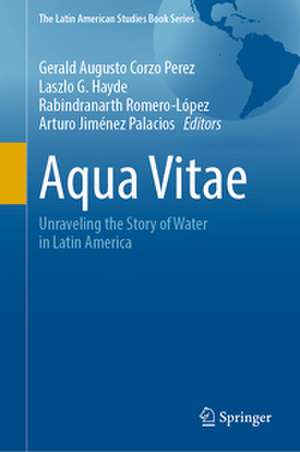
Aqua Vitae: The Latin American Studies Book Series
Editat de Gerald Augusto Corzo Perez, Laszlo G. Hayde, Rabindranarth Romero-López, Arturo Jiménez Palaciosen Limba Engleză Hardback – 19 feb 2025
Recomandăm Aqua Vitae ca o resursă academică fundamentală pentru specialiștii care activează în hidrologie și planificare teritorială, fiind de o relevanță majoră pentru înțelegerea sistemelor de gestionare a apei în contextul acreditărilor profesionale de mediu din America Latină. Lucrarea, publicată sub egida Springer, oferă un fundament teoretic solid pentru cercetătorii care doresc să integreze dimensiunea istorică și culturală în proiectele de infrastructură modernă.
Considerăm că volumul se distinge prin modul în care suprapune rigoarea inginerească peste analiza evoluției societăților latino-americane. Structura este organizată logic în trei piloni: Tehnologie, Management și Impact Socio-Economic. Primele capitole explorează venerarea apei în cultura Inca și managementul resurselor în imperiul Aztec, trecând apoi spre analize tehnice ale bazinului râului Paraná din Brazilia și cronologia exploatării apei în Cuba, sub presiunea schimbărilor climatice. Comparabil cu Ancient Water Technologies de L. Mays în rigurozitate, volumul de față este actualizat pentru provocările specifice ale secolului XXI, punând un accent mai mare pe politicile publice și conflictele economice derivate din accesul la resurse.
Această lucrare reprezintă o evoluție în opera editorilor, în special pentru Gerald Augusto Corzo Perez. Dacă în Hybrid models for Hydrological Forecasting acesta se concentra pe modele matematice și integrarea datelor, în Aqua Vitae abordarea devine holistică, integrând „soft sciences” (istoria, sociologia) în cadrul tehnic. Textul demonstrează cum practicile străvechi de irigații din valea Quíbor sau cosmologia Maya nu sunt doar curiozități istorice, ci lecții de reziliență aplicabile în managementul integrat al bazinelor hidrografice de astăzi.
Din seria The Latin American Studies Book Series
-
 Preț: 406.47 lei
 - 18%
 Preț: 697.55 lei
 - 18%
 Preț: 1119.57 lei
 - 15%
 Preț: 668.13 lei
 - 17%
 Preț: 514.82 lei
 - 15%
 Preț: 503.50 lei
 - 18%
 Preț: 762.43 lei
 -
 Preț: 395.03 lei
 - 15%
 Preț: 633.77 lei
 - 18%
 Preț: 1130.85 lei
 - 18%
 Preț: 895.00 lei
 - 5%
 Preț: 816.50 lei
 -
 Preț: 380.40 lei
 - 24%
 Preț: 825.14 lei
 - 24%
 Preț: 906.96 lei
 - 24%
 Preț: 899.64 lei
 - 20%
 Preț: 634.41 lei
 - 24%
 Preț: 1021.92 lei
 - 18%
 Preț: 943.27 lei
 - 20%
 Preț: 624.50 lei
 - 15%
 Preț: 455.72 lei
 - 15%
 Preț: 634.13 lei
 - 20%
 Preț: 614.83 lei
 - 20%
 Preț: 563.28 lei
 - 24%
 Preț: 642.45 lei
 - 15%
 Preț: 614.19 lei
 - 18%
 Preț: 894.17 lei
 - 20%
 Preț: 613.95 lei
 - 24%
 Preț: 728.93 lei
 - 18%
 Preț: 903.90 lei
 - 24%
 Preț: 711.32 lei
 -
 Preț: 368.62 lei
 - 15%
 Preț: 564.27 lei
Preț: 860.93 lei
Preț vechi: 1049.90 lei
-18%
Carte disponibilă
Livrare economică 28 octombrie-11 noiembrie
Specificații
ISBN-10: 3031577302
Pagini: 184
Ilustrații: I, 1 p.
Dimensiuni: 160 x 241 x 16 mm
Greutate: 0.48 kg
Ediția:2024
Editura: Springer
Colecția The Latin American Studies Book Series
Seria The Latin American Studies Book Series
Locul publicării:Cham, Switzerland
De ce să citești această carte
Această carte se adresează inginerilor hidrologi, experților în politici publice și istoricilor tehnologiei. Cititorul câștigă o perspectivă unică asupra modului în care infrastructura apei modelează identitatea unei regiuni. Este un instrument esențial pentru a înțelege de ce soluțiile pur tehnice eșuează adesea dacă nu iau în calcul contextul socio-cultural și moștenirea istorică a managementului resurselor naturale.
Despre autor
Gerald Augusto Corzo Perez este un specialist recunoscut în hidrologie, cu o experiență vastă în modelarea datelor și utilizarea sistemelor GIS pentru infrastructura de apă. Alături de co-editorii Laszlo G. Hayde, Rabindranarth Romero-López și Arturo Jiménez Palacios, acesta coordonează studii interdisciplinare ce vizează regiunea Americii Latine. Lucrările sale anterioare au pus bazele utilizării teledetecției în managementul resurselor naturale, iar expertiza sa tehnică este acum aplicată pentru a documenta intersecția dintre tehnologia hidraulică și dezvoltarea socio-economică istorică.
Descriere scurtă
The book's exploration into water's perception and usage throughout history provides key insights into how human activity has impacted water resources and vice versa. It presents a meticulous examination of water as both a natural and cultural phenomenon, identifying its essential role in sustaining life and ecosystems, as well as its potential for causing devastation through disease and natural disasters. We delve into the complexities of water's role in society, illustrating how it is woven into the fabric of everyday life, religious ceremonies, and global events. The book also underscores the varying significance and implications of water across different regions within Latin America.
The narrative unfolds across three major sections: Technology, Water Management, and Socio-Cultural-Economical Impact. The 'Technology' section examines the evolution of water-related technologies and their significant socio-economic implications. The 'Water Management' part offers a holistic perspective on water resource management practices, both historical and contemporary. The final section delves into the societal implications of water use, including conflicts arising from political and economic decisions related to this crucial resource.
Designed for engineers, environmental scientists, and policy-makers, this book provides a unique blend of historical context, technical knowledge, and socio-cultural insights. It offers an invaluable resource for those seeking to understand the interplay between engineering practices, water resources, and societal developments in Latin America. It serves as a springboard for further research and informed decision-making in water resource management and policy, fostering a greater understanding of the myriad ways in which water influences and is influenced by human activity.
Cuprins
Notă biografică
Dr. Laszlo G. Hayde is Programme Manager of the Water and Sustainable Development Master Programmes and Senior Lecturer in Irrigation Engineering at IHE Delft. Since 2012 he is Honorary Associate Professor of the Faculty of Civil Engineering, Budapest University of Technology and Economics, and member of the General Directorate of Water Management - Scientific Advisory Council in Hungary since 2019. Dr. Hayde is Vice President Honorary of the International Commission on Irrigation and Drainage (ICID), member of the ICID Working Group on History of Irrigation, Drainage and Flood Control, and Associate Editor of the Journal of ICID: ‘Irrigation and Drainage’, published by John Wiley and Sons Ltd. He is also member of the International Water History Association (IWHA), established and has run courses on ‘History of Hydraulic Engineering’ and ‘World History of Water Management’. In 2020 he received the Major Award for the Advancement of Surface Irrigation of the American Society of Agricultural and Biological Engineers (ASABE).
Dr. Rabindranarth Romero-López is a Civil Engineer with a master’s degree in Engineering in the area of Integrated Water Management, Doctor in Environmental Sciences, with a postdoctoral stay at the École de Technologie Supérieure, in Montreal, Canada. Creator and founder of the Specialized Research Unit in Hydroinformatics and Environmental Technology (HITA). His lines of specialty include hydraulics, hydrology, Water management, climate variability and sustainability. He has given around 50 national and international conferences and has written around 40 publications including articles in national and international magazines, conferences, and books.
Arturo Jimenez Palacios currently is a student of a master program on environmental and ecological economics. He has a bachelor’s in economics and international business. His current line of research is on water resources and environmental economics, valuation of environmental quality, economics of climate change, water resources governance and circular economy. Also, he is a founding member of the Circular Economy Club in Xalapa-Enriquez, Veracruz.