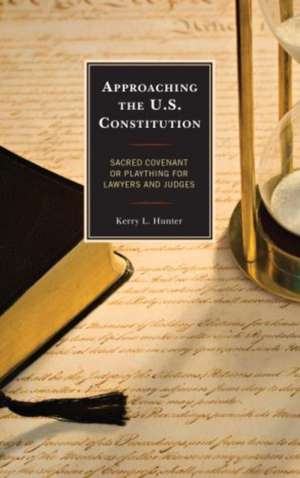
Approaching the U.S. Constitution: Sacred Covenant or Plaything for Lawyers and Judges: Lexington Books
Autor Kerry L. Hunteren Limba Engleză Paperback – 15 apr 2016
By emphasizing the legal expertise of judges alone, individuals such as Justice Scalia mistakenly demand that judges exercise no human ethical judgment whatsoever. Yet the more this happens, the more the "rule of law" is replaced by the rule of lawyers. Legal sophistry becomes the primary currency wherewith society's ethical and moral questions are resolved. Moreover, the alleged neutrality of legal analysis is deceptive with its claims of judicial modesty. It is not only undemocratic, it is dictatorial and highly elitist. Public debate over questions of fairness is replaced by an exclusive legalistic debate between lawyers over what is legal. The more Scalia and Garner realize their agenda, the more all appeals to what is moral will be effectively removed from political debate. 'Conservatives' lament the 'removing God from the classroom,' by 'liberals,' yet if the advocates of legalism get their way, God will be effectively removed from the polis altogether.
The answer to preserving both separation of powers and the American commitment to unalienable human rights is to view the Supreme Court in the same way early founders such as Hamilton did and in the way President Abraham Lincoln urged. The Court's most important function in exercising the power of judicial review is to serve as the nation's conscience just as it did in Brown v. Board of Education.
Din seria Lexington Books
- 19%
 Preț: 426.72 lei
 - 32%
 Preț: 729.20 lei
 - 59%
 Preț: 427.24 lei
 - 23%
 Preț: 318.57 lei
 - 25%
 Preț: 362.03 lei
 - 23%
 Preț: 322.75 lei
 - 27%
 Preț: 355.41 lei
 - 29%
 Preț: 345.71 lei
 - 25%
 Preț: 306.14 lei
 - 33%
 Preț: 710.24 lei
 - 31%
 Preț: 437.25 lei
 - 29%
 Preț: 342.12 lei
 - 25%
 Preț: 361.02 lei
 - 29%
 Preț: 344.18 lei
 - 28%
 Preț: 347.76 lei
 - 28%
 Preț: 346.74 lei
 - 23%
 Preț: 318.96 lei
 - 37%
 Preț: 660.07 lei
 - 24%
 Preț: 309.62 lei
 - 29%
 Preț: 599.98 lei
 - 24%
 Preț: 369.89 lei
 - 36%
 Preț: 730.77 lei
 - 33%
 Preț: 642.37 lei
 - 29%
 Preț: 345.71 lei
 - 27%
 Preț: 354.68 lei
 - 29%
 Preț: 342.63 lei
 - 28%
 Preț: 252.34 lei
 - 27%
 Preț: 354.28 lei
 - 22%
 Preț: 332.36 lei
 - 22%
 Preț: 338.89 lei
 - 23%
 Preț: 321.63 lei
 - 23%
 Preț: 319.79 lei
 - 28%
 Preț: 346.74 lei
 - 23%
 Preț: 321.53 lei
 - 35%
 Preț: 560.77 lei
 - 24%
 Preț: 308.07 lei
 - 23%
 Preț: 321.63 lei
 - 27%
 Preț: 263.04 lei
 - 23%
 Preț: 333.36 lei
 - 34%
 Preț: 630.22 lei
 - 22%
 Preț: 341.76 lei
 - 33%
 Preț: 358.06 lei
 - 34%
 Preț: 418.63 lei
 - 34%
 Preț: 601.39 lei
 - 35%
 Preț: 593.04 lei
 - 25%
 Preț: 884.44 lei
 - 33%
 Preț: 640.95 lei
Preț: 320.27 lei
Preț vechi: 415.99 lei
-23%
Puncte Express: 480
Carte tipărită la comandă
Livrare economică 23 noiembrie-07 decembrie
Livrare prin curier în România Termenul estimat este afișat lângă disponibilitate.
Transport gratuit de la 400.00 lei Plată online sau ramburs, în funcție de opțiunile comenzii.
Retur gratuit în 14 zile Comandă securizată și suport în română.
Specificații
ISBN-13: 9780739197219
ISBN-10: 0739197215
Pagini: 174
Dimensiuni: 148 x 226 x 12 mm
Greutate: 0.26 kg
Editura: Bloomsbury Publishing
Colecția Lexington Books
Seria Lexington Books
Locul publicării:New York, United States
ISBN-10: 0739197215
Pagini: 174
Dimensiuni: 148 x 226 x 12 mm
Greutate: 0.26 kg
Editura: Bloomsbury Publishing
Colecția Lexington Books
Seria Lexington Books
Locul publicării:New York, United States
Cuprins
Chapter One: Approaching the United States Constitution: Sacred Covenant or Mere Plaything For Lawyers and Judges
Chapter Two: American Utopian Constitutionalism
Chapter Three: Hamilton's Court as Conscience
Chapter Four: The Umpire Has No Clothes
Chapter Five: Toward Embracing Hamilton's Ideal
Chapter Two: American Utopian Constitutionalism
Chapter Three: Hamilton's Court as Conscience
Chapter Four: The Umpire Has No Clothes
Chapter Five: Toward Embracing Hamilton's Ideal
Recenzii
Hunter believes that judges should focus less on legal technicalities and more on natural law principles, which he believes undergird the US Constitution (and, he observes, RuhollahKhomeini's Islamic state). Drawing inspiration from New Zealand, which prefers principled aspirations to a written constitution, Hunter emphasizes that the American exercise of judicial review is itself an extra-constitutional development. . . .Summing Up: Recommended. All readership levels.
America's litigious excesses may be inhibiting rather than advancing the cause of justice, argues Kerry Hunter. In an inventive new approach, Hunter grapples with the central question of how we conceive of our Constitution, and who, by rights, may lay claim to its interpretation. Drawing on the case of New Zealand, where courts lack judicial review, and infusing a fresh view of Alexander Hamilton, Hunter rightly warns us that legal sophistry is not only no substitute for, but may be inimical to, American justice.
Professor Hunter has written an impassioned, original, and timely challenge to the legal sophistry and constitutional obsessions that are undermining U.S. politics. His argument is informed by a comparative cross-national perspective and long study of American legal practices. The result is a heady, provocative ethical defense of democratic ideals against narrow legalism and its corrosive effects on our polity.
America's litigious excesses may be inhibiting rather than advancing the cause of justice, argues Kerry Hunter. In an inventive new approach, Hunter grapples with the central question of how we conceive of our Constitution, and who, by rights, may lay claim to its interpretation. Drawing on the case of New Zealand, where courts lack judicial review, and infusing a fresh view of Alexander Hamilton, Hunter rightly warns us that legal sophistry is not only no substitute for, but may be inimical to, American justice.
Professor Hunter has written an impassioned, original, and timely challenge to the legal sophistry and constitutional obsessions that are undermining U.S. politics. His argument is informed by a comparative cross-national perspective and long study of American legal practices. The result is a heady, provocative ethical defense of democratic ideals against narrow legalism and its corrosive effects on our polity.