Cantitate/Preț
Produs

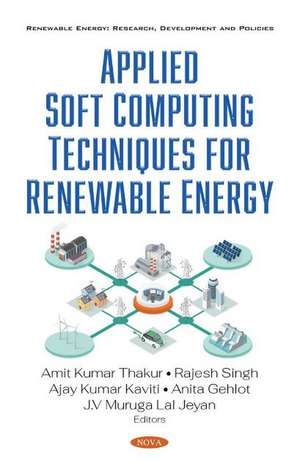
Applied Soft Computing Techniques for Renewable Energy

Editat de Amit Kumar Thakur
en Limba Engleză Hardback – 17 iul 2020

Adresat în egală măsură studenților de la facultățile de energetică, cercetătorilor și practicienilor din ingineria sistemelor sustenabile, volumul Applied Soft Computing Techniques for Renewable Energy propune o trecere necesară de la experimentele fizice costisitoare la modelarea computațională avansată. Observăm o abordare pragmatică a crizei combustibililor fosili, autorii argumentând că utilizarea algoritmilor de tip „soft computing” — precum rețelele neuronale artificiale (ANN) sau sistemele fuzzy — reprezintă singura cale viabilă pentru a optimiza performanța motoarelor și a reduce emisiile într-un timp record.

Structura volumului este riguros segmentată, pornind de la baze teoretice și evoluând spre studii de caz complexe. Apreciem în mod deosebit capitolele care analizează micro-rețelele reconfigurabile prin hibrizi Fuzzy-MFO și analiza comparativă a amestecurilor de butanol-diesel. Această progresie de la micro la macro indică o acoperire exhaustivă a domeniului. Cartea completează perspectiva oferită de Soft Computing in Green and Renewable Energy Systems, adăugând o componentă tehnică detaliată despre siguranța manipulării hidrogenului și tehnici specifice de conservare a energiei în industria alimentară, elemente care lipsesc din tratatele generale.

Editorul Amit Kumar Thakur continuă direcția de cercetare începută în lucrarea Internet of Things for Agriculture 4.0, transferând expertiza sa în domeniul senzorilor și al conectivității către sectorul energetic. Dacă în lucrarea anterioară accentul era pus pe Wi-Fi și monitorizare, aici accentul cade pe validarea și predicția parametrilor de ardere și emisie, oferind o metodologie robustă pentru ingineria mecanică modernă.

Citește tot Restrânge

Preț: 106022 lei

Preț vechi: 142385 lei
-26%

Puncte Express: 1590

Carte disponibilă

Livrare economică 28 mai-11 iunie


Specificații

ISBN-13: 9781536181807
ISBN-10: 1536181803
Pagini: 278
Greutate: 0.51 kg
Editura: Nova Science Publishers Inc
Colecția Nova Science Publishers Inc
Locul publicării:United States

De ce să citești această carte

Această lucrare este esențială pentru inginerii care doresc să înlocuiască testele de laborator costisitoare cu simulări computaționale precise. Cititorul câștigă o înțelegere aplicată a modului în care logica fuzzy și rețelele neuronale pot prezice performanța combustibililor alternativi. Este un instrument valoros pentru cei care lucrează la intersecția dintre informatică și energie regenerabilă, oferind soluții concrete pentru optimizarea sistemelor fotovoltaice și eoliene.


Descriere

This book provides a better understanding of Fuzzy set theory, Fuzzy logic and Neural Networks and various other techniques seem very well suited for modelling and controlling a real system. Energy is of major importance to civilisation, because it is driving force which binds human race. The estimation of energy in the form of renewable and sustainable is one of the important aspects to understand the how resources are harnessed and to predict what might happen under various possible future conditions. Using available modelling techniques to generate the best algorithms, the objective is to determine the best solution in terms of comparing the performances of the solutions through different parameters for a specific case. Consumption of Fossil fuels at a rapid pace has generated an alarming situation and with the subsequent increase in the number of vehicle the pollution level has reached well beyond human's control. This is frightening enough to observe the fact that the pollution level has surpassed all records and the need of the hour is to find an alternate fuel which can really be of great assistance in reducing the exhaust emission and augment the performance parameters of engine. Major researches are carried out on various engines to draw closer towards a realistic solution. Experiments performed on various engines are considered to be time consuming and the expenses met to perform these experiments are too costly, so the need of soft computing techniques involved in this area. Soft computing can be better described as the process to find the solution to an inexact problem. Soft computing has showed lot of potential in giving the researchers the exact solution may be in case of validating or predicting the performance and emission parameters. Artificial Neural Network (ANN), Adaptive Neuro Fuzzy Inference system (ANFIS), Fuzzy Expert System (FES), Response Surface Methodology (RSM) and Support Vector Machine (SVM) are the various soft computing techniques widely used. This book focuses on to carry out the comprehensive review and various other experimental works of various researchers who have carried out the work on these various soft computing techniques on various engines with various alternative fuels on the basis of modelling techniques, time is saved to a great extent and the capital investment involved is comparably very low. Various modelling techniques are being readily used to predict the performance parameters for various engines and modelling techniques have become the readily available tool to compare and validate the experimental work being carried out by researchers to get accurate matching with the experimental data. The benefit of this issue will be at large in connecting with varieties of work done in the field of Biomass which includes wood and wood waste, municipal solid waste. Landfill gas and biogas. Ethanol, Biodiesel, Hydropower, Geothermal, Wind, Solar. Thus soft computing techniques are fast and reliable hence, they can be a substitute for conventional experiments.

Cuprins

Preface; Investigation of Wind and Photovoltaic Energy Systems for Daily Load Dispatch on Reconfigurable Microgrid through Hybrid Fuzzy-MFO; Biomass; Hydrogen: Present and Future Energy; Safety Aspects in Handling and Storage of Ultra High Purity Gaseous Hydrogen; Review on the Performance, Combustion, and Emissions of Butanol-Diesel Mixes in Compression Ignition Engine; Specific Soft Computing Strategies for Evaluating the Performance and Emissions of a Spark-Ignition Engine Using Alcohol-Gasoline Blended Fuels: A Comprehensive Analysis; Energy Conservation Techniques for Food Processing and Manufacturing Industries; Effect of Biodiesel on Performance, Emissions and Combustion; Sustainable Development through Learning Climate Change: Adaptation Mitigation and Finance; Index.