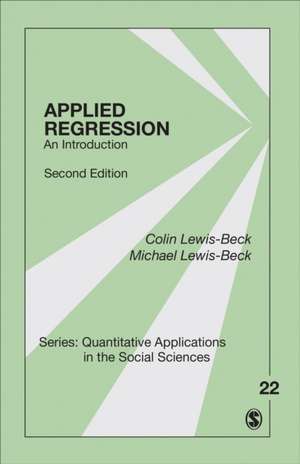
Applied Regression
Autor Colin Lewis-Beck, Michael Lewis-Becken Limba Engleză Paperback – 13 iul 2015
Preț: 327.85 lei
Puncte Express: 492
Carte tipărită la comandă
Livrare economică 19 noiembrie-03 decembrie
Livrare prin curier în România Termenul estimat este afișat lângă disponibilitate.
Transport gratuit de la 400.00 lei Plată online sau ramburs, în funcție de opțiunile comenzii.
Retur gratuit în 14 zile Comandă securizată și suport în română.
Specificații
ISBN-13: 9781483381473
ISBN-10: 1483381471
Pagini: 120
Ilustrații: illustrations
Dimensiuni: 140 x 216 x 7 mm
Greutate: 0.16 kg
Ediția:2. Auflage
Editura: Sage Publications, Inc
Locul publicării:Thousand Oaks, United States
ISBN-10: 1483381471
Pagini: 120
Ilustrații: illustrations
Dimensiuni: 140 x 216 x 7 mm
Greutate: 0.16 kg
Ediția:2. Auflage
Editura: Sage Publications, Inc
Locul publicării:Thousand Oaks, United States
V-ar putea interesa
-
 -15%Preț: 427.58 lei503.04 lei
 -
 Internet Research SkillsNiall O. Dochartaigh-15%Preț: 550.76 lei647.95 lei
 -
 Qualitative InterviewingHerbert J. Rubin-15%Preț: 635.85 lei748.06 lei
 -
 Case Studies in Interdisciplinary ResearchAllen F Repko-15%Preț: 642.07 lei755.38 lei
 -
 100 Questions (and Answers) About Research MethodsNeil J. SalkindPreț: 343.22 lei
 -
 Do the Math!John K. WhitePreț: 337.31 lei
 -
 Projects in Linguistics and Language StudiesAlison WrayPreț: 416.74 lei
Recenzii
This is a great book to acquaint students with the world of linear models. It is perfect to use in combination with other texts, or as a stand-along book in introductory courses. The Lewis-Beck’s have updated the presentation, provided additional examples, and included more discussion of regression diagnostics. I am sure that it will, once again, be a best seller!
This is an excellent update and extension of a wonderfully clear exposition of bivariate and multiple regression analysis for beginning practitioners and students. I was a fan of the first edition, and I am even more pleased with the revision.
This is one of the best resources on basic regression techniques available on the market today and it remains my go-to guide for my own research. Applied Regression is the quintessential text for graduate students pursuing degrees in the quantitative social sciences; it has helped train several generations of social science researchers over the course of the last four decades. The second edition will remain instrumental in training social scientists for years to come.
The new edition of Applied Regression maintains the excellence of the original edition while modernizing and extending it. Its highpoint is how the Lewis-Becks state everything with complete precision. From the assumptions of OLS to the ways of coping with outliers and to the methods of detecting multicollinearity, the authors tell readers exactly what they need to know to perform regression analysis.
This is an excellent update and extension of a wonderfully clear exposition of bivariate and multiple regression analysis for beginning practitioners and students. I was a fan of the first edition, and I am even more pleased with the revision.
This is one of the best resources on basic regression techniques available on the market today and it remains my go-to guide for my own research. Applied Regression is the quintessential text for graduate students pursuing degrees in the quantitative social sciences; it has helped train several generations of social science researchers over the course of the last four decades. The second edition will remain instrumental in training social scientists for years to come.
The new edition of Applied Regression maintains the excellence of the original edition while modernizing and extending it. Its highpoint is how the Lewis-Becks state everything with complete precision. From the assumptions of OLS to the ways of coping with outliers and to the methods of detecting multicollinearity, the authors tell readers exactly what they need to know to perform regression analysis.
Cuprins
Series Editor's Introduction
Preface
Acknowledgments
About the Authors
1. Bivariate Regression: Fitting a Straight Line
2. Bivariate Regression: Assumptions and Inferences
3. Multiple Regression: The Basics
4. Multiple Regression: Special Topics
Appendix
References
Index
Preface
Acknowledgments
About the Authors
1. Bivariate Regression: Fitting a Straight Line
2. Bivariate Regression: Assumptions and Inferences
3. Multiple Regression: The Basics
4. Multiple Regression: Special Topics
Appendix
References
Index
Notă biografică
Colin Lewis-Beck is a PhD candidate in Statistics at Iowa State University. He holds a BA from Middlebury College and a dual MPP/MA in Public Policy and Applied Statistics from the University of Michigan. While at Michigan, he received an Outstanding Teaching Award from the Department of Statistics. Also, he has worked as a Teaching Assistant and a Computer Consultant, during multiple summers at the Inter-University Consortium for Political and Social Research (ICPSR) Summer Program, University of Michigan. His research experiences in statistics are varied, and including serving as a Statistician in the Economic Analysis and Statistics Division of the OECD (Paris), and at STATinMED, a health outcomes research firm in Ann Arbor, MI. His interests are applied statistics related to social science research, causal inference, and spatial statistics. Mr. Lewis-Beck has co-authored papers on the quality of life and work productivity, modeling health care costs, and technology use in educational performance.
Descriere
Updates to this new edition include: more coverage of regression assumptions and model fit; additional material on residual analysis; more examples of transformations; and the inclusion of the measures of tolerance and VIF within the discussion about collinearity.