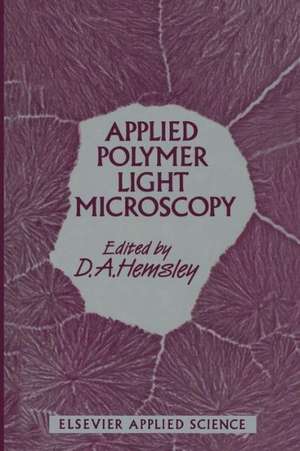
Applied Polymer Light Microscopy
Editat de Derek A. Hemsleyen Limba Engleză Paperback – 20 mar 2012
Preț: 375.69 lei
Puncte Express: 564
Carte tipărită la comandă
Livrare economică 14-28 noiembrie
Livrare prin curier în România Termenul estimat este afișat lângă disponibilitate.
Transport gratuit de la 400.00 lei Plată online sau ramburs, în funcție de opțiunile comenzii.
Retur gratuit în 14 zile Comandă securizată și suport în română.
Specificații
ISBN-13: 9789401174763
ISBN-10: 9401174768
Pagini: 300
Ilustrații: XII, 282 p.
Dimensiuni: 152 x 229 x 17 mm
Greutate: 0.44 kg
Ediția:Softcover reprint of the original 1st ed. 1989
Editura: Springer
Locul publicării:Dordrecht, Netherlands
ISBN-10: 9401174768
Pagini: 300
Ilustrații: XII, 282 p.
Dimensiuni: 152 x 229 x 17 mm
Greutate: 0.44 kg
Ediția:Softcover reprint of the original 1st ed. 1989
Editura: Springer
Locul publicării:Dordrecht, Netherlands
V-ar putea interesa
-
 Carbohydrate ChemistryB. G. Davis-14%Preț: 246.82 lei285.65 lei
 -
 The Equilibrium Theory of Inhomogeneous PolymersGlenn Fredrickson-25%Preț: 597.69 lei797.98 lei
 -
 -9%Preț: 1462.30 lei1606.92 lei
 -
 Rubberlike ElasticityJames E. Mark-14%Preț: 948.21 lei1102.56 lei
 -
 -9%Preț: 1216.53 lei1336.84 lei
 -
 Surface Chemistry of SurfactanKronberg-8%Preț: 681.77 lei741.06 lei
 -
 Polyurethane Casting PrimerI.R. Clemitson-18%Preț: 1467.42 lei1789.53 lei
 -
 Polymer Phase BehaviorTimothy P Ehlers-26%Preț: 1255.05 lei1706.19 lei
Public țintă
ResearchCuprins
1 Specimen Preparation.- 1.1 Introduction.- 1.2 Initial Approach to Preparing the Specimen.- 1.3 Area of the Specimen.- 1.4 Surfaces.- 1.5 Sectioning (Sectional Slices).- 1.6 Melt Pressings.- 1.7 Staining.- 1.8 Final Comments.- 2 Basic Light Microscopy and the Phase Contrast Microscope.- 2.1 Introduction.- 2.2 Synthetic Polymers as Specimens for Light Microscopy.- 2.3 Light versus Electron Microscopy of Polymers.- 2.4 Basic Light Microscopy.- 2.5 Applications for Common Light Microscopy.- 2.6 Phase Contrast Microscopy ..- 2.7 Applications for Phase Contrast Microscopy.- 2.8 Dark Ground Microscopy.- References.- 3 Polarized Light: Theory and Measurements.- 3.1 Introduction.- 3.2 Light and Its Interaction with Matter.- 3.3 Elliptically and Circularly Polarized Light.- 3.4 The Uniaxial Indicatrix.- 3.5 The Biaxial Indicatrix.- 3.6 Methods of Producing Polarized Light.- 3.7 Types of Birefringence.- 3.8 The Passage of Polarized Light through Thin Birefringent Plates.- 3.9 Polarization Colours.- 3.10 Relation between Orientation and Birefringence.- 3.11 The Polarizing Microscope.- 3.12 Measurement of Optical Path Difference.- 3.13 Compensators.- 3.14 Dispersion of Birefringence.- 3.15 Spectrophotometric Method.- 3.16 The Wedge Method.- 3.17 Use of the Abbé Refractometer.- References.- 4 Polarized Light: Qualitative Microscopy.- 4.1 Introduction.- 4.2 Spherulites.- 4.3 Theory of Spherulitic Crystallization.- 4.4 Different Types of Spherulite.- 4.5 Spherulitic Forms of Polypropylene.- 4.6 Effect of Processing on Spherulites.- 4.7 Small Angle Light Scattering.- 4.8 Molecular Orientation.- References.- 5 Modulation Contrast and Differential Interference Contrast Techniques.- 5.1 Introduction.- 5.2 General Principles.- 5.3 The Modulation Contrast System.- 5.4 DifferentialInterference Contrast.- 5.5 Adjusting the Contrast Systems.- 5.6 Comparison with the Phase Contrast Microscope.- 5.7 Reflected Light Work.- 5.8 Image Interpretation.- 5.9 Applications to Polymers.- References.- 6 Interference Microscopy of Polymers.- 6.1 Introduction.- 6.2 The Basic Principles of Quantitative Microinterferometry.- 6.3 Reflected Light Applications.- 6.4 Interpretation of Surface Interferograms.- 6.5 Some Reflected Light Systems Applicable to Polymers.- 6.6 Transmitted Light Interference Microscopy.- 6.7 Transmitted Light Systems.- 6.8 Compensators.- References.- 7 Ultraviolet and Fluorescence Microscopy.- 7.1 Introduction.- 7.2 Equipment and Techniques.- 7.3 Applications to Non-polymer Materials.- 7.4 Non-Microscopic Applications of Fluorescence from Polymers.- 7.5 Applications of UV Microscopy to Synthetic Polymers.- References.