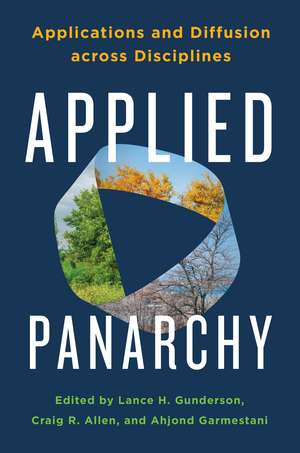
Applied Panarchy: Applications and Diffusion across Disciplines
Editat de Lance H. Gunderson, Craig Reece Allen, Dr. Ahjond Garmestani PhDen Limba Engleză Paperback – 21 apr 2022
Prezentat sub formă de manual academic și culegere de studii interdisciplinare, Applied Panarchy marchează o etapă esențială în evoluția teoriei sistemelor complexe. Suntem de părere că acest volum reușește să transforme cadrul teoretic abstract propus inițial de Lance H. Gunderson în instrumente pragmatice pentru gestionarea resurselor naturale. Apreciem în mod deosebit modul în care editorii au structurat progresia de la conceptele fundamentale, precum regulile naturii și ciclurile adaptive, către aplicații tehnice riguroase în inginerie și guvernare.
Remarcăm faptul că, spre deosebire de lucrările anterioare, această ediție pune un accent major pe „ciclul adaptiv” ca instrument de analiză, nu doar ca metaforă. Cititorii familiarizați cu Panarchy (2002) vor aprecia modul în care Applied Panarchy rafinează conceptele de reziliență cross-scale și regimuri spațiale, oferind o claritate metodologică necesară cercetării contemporane. Dacă volumul original punea bazele înțelegerii sistemelor ierarhice evolutive, această nouă lucrare demonstrează cum teoria poate influența direct administrarea mediului în era Antropocenului.
Structura volumului facilitează o învățare graduală: prima parte reiterează fundamentele panarhiei, în timp ce a doua parte explorează vizualizarea schimbărilor de mediu complexe și structurile discontinue. Comparativ cu The Science and Practice of Resilience, care oferă o perspectivă largă asupra metodelor de risc, Applied Panarchy rămâne fidel modelului sistemic al lui Gunderson, concentrându-se pe interacțiunile imprevizibile dintre sistemele umane și cele naturale, de la rețele electrice la guvernare urbană.
Preț: 351.66 lei
Carte disponibilă
Livrare economică 20 octombrie-03 noiembrie
Livrare express 03-09 octombrie pentru 37.82 lei
Specificații
ISBN-10: 1642830895
Pagini: 344
Ilustrații: 34 illustrations
Dimensiuni: 152 x 229 x 23 mm
Greutate: 0.45 kg
Editura: Island Press
Colecția Island Press
V-ar putea interesa
-
 Earth KeeperN Scott MomadayPreț: 103.71 lei
 -
 Instituting NatureAndrew S. MathewsPreț: 281.01 lei
 -
 Lost Worlds: Adventures in the Tropical RainforestBruce M. BeehlerPreț: 300.39 lei
 -
 Preț: 110.06 lei
 -
 Wonders of the Indian WildernessErach Bharucha-23%Preț: 1332.12 lei1730.02 lei
 -
 -27%Preț: 834.51 lei1143.17 lei
 -
 Wild New Jersey: Nature Adventures in the Garden StateMr. David WheelerPreț: 200.57 lei
 -
 Green Planet: How Plants Keep the Earth AliveProfessor Stanley A RicePreț: 204.40 lei
 -
 EcopsychologyCraig ChalquistPreț: 114.70 lei
 -
 Rebearths: Conversations with a World EnsouledCraig ChalquistPreț: 145.59 lei
 -
 Rowing Through the MistSherry BoasPreț: 95.54 lei
 -
 Panarchy: Understanding Transformations in Human and Natural SystemsLance H. GundersonPreț: 423.53 lei
 -
 The Grand Teton ReaderRobert W. RighterPreț: 117.02 lei
 -
 Preț: 88.82 lei
 -
 Umweltwahrnehmung und HochwasserrisikomanagementThomas GentschPreț: 469.85 lei
De ce să citești această carte
Recomandăm această carte profesioniștilor și studenților la master sau doctorat care doresc să înțeleagă dinamica sistemelor socio-ecologice. Cititorul câștigă acces la două decenii de cercetare aplicată, învățând cum să utilizeze teoria panarhiei pentru a anticipa colapsul sistemelor și pentru a construi strategii de adaptare în fața incertitudinii climatice și economice. Este un instrument indispensabil pentru o gestionare sustenabilă a resurselor.
Despre autor
Lance H. Gunderson este o figură centrală în ecologia sistemelor și managementul resurselor, fiind recunoscut pentru dezvoltarea teoriei panarhiei alături de C.S. Holling. Activitatea sa se concentrează pe reziliența ecosistemelor și pe modul în care instituțiile umane pot răspunde schimbărilor ecologice majore. În Applied Panarchy, el colaborează cu Dr. Ahjond Garmestani și Craig Reece Allen pentru a integra perspective din dreptul mediului și ecologia aplicată, continuând tradiția de a sparge barierele disciplinare pentru a aborda crizele de sustenabilitate contemporane.
Descriere scurtă
Panarchy describes the way systems—whether forests, electrical grids, agriculture, coastal surges, public health, or human economies and governance—are part of even larger systems that interact in unpredictable ways. Although humans desire resiliency and stability in our lives to help us understand the world and survive, nothing in nature is permanently stable. How can society anticipate and adjust to the changes we see around us? Where Panarchy proposed a framework to understand how these transformational cycles work and how we might influence them, Applied Panarchy takes the scholarship to the next level, demonstrating how these concepts have been modified and refined. The book shows how panarchy theory intersects with other disciplines, and how it directly influences natural resources management and environmental stewardship.
Intended as a text for graduate courses in environmental sciences and related fields, Applied Panarchy picks up where Panarchy left off, inspiring new generations of scholars, researchers, and professionals to put its ideas to work in practical ways.
Notă biografică
Craig R. Allen is a professor at the University of Nebraska-Lincoln, and serves on the board of directors for the Resilience Alliance. His research focuses on the links between land use and land cover change, biological invasions, extinctions, and resilience.
Ahjond Garmestani is a research scientist with the US Environmental Protection Agency's Office of Research and Development in Gulf Breeze, Florida, and the Utrecht Centre for Water, Oceans and Sustainability Law at the Utrecht University School of Law in Utrecht, the Netherlands. His research is transdisciplinary and focuses on governance of social-ecological systems.
Cuprins
Acknowledgments
Part I. Panarchy Concepts
Chapter 1. Panarchy: Nature’s Rules
Lance H. Gunderson, Ahjond Garmestani, and Craig R. Allen
Part II. Applications of Panarchy Theory
Chapter 2. Panarchy, Cross-Scale Resilience, and Discontinuous Structures and Processes
Shana M. Sundstrom, Craig R. Allen, and David G. Angeler
Chapter 3. The Adaptive Cycle: More Than a Metaphor
Shana M. Sundstrom and Craig R. Allen
Chapter 4. Scales of Coercion: Resilience, Regimes, and Panarchy
David G. Angeler and Craig R. Allen
Chapter 5. Applications of Spatial Regimes.
Craig R. Allen, David G. Angeler, Ahjond Garmestani, Caleb Roberts, Shana M. Sundstrom, Dirac Twidwell, and Dan R. Uden
Chapter 6. An Engineering Perspective on Managing for Resilience and Panarchy
Ian Pumo, Margaret Kurth, Stephanie Galaitsi, and Igor Linkov
Chapter 7. Mapping Panarchy to Improve Visualization of Complex Environmental Change
Dirac Twidwell, Daniel R. Uden, Caleb P. Roberts, Brady W. Allred, Matthew O. Jones, David E. Naugle and Craig R. Allen
Part III. Diffusion of Panarchy Concepts
Chapter 8. Capacities for Navigating Large-Scale Sustainability Transformations: Exploring the Revolt and Remembrance Mechanisms for Shaping Collapse and Renewal in Social-Ecological Systems
Per Olsson, Carl Folke, and Michele-Lee Moore
Chapter 9. Panarchy and Law in the Anthropocene
Robin Kundis Craig, Barbara Cosens, Ahjond Garmestani, and J.B. Ruhl
Chapter 10. Panarchy and the Economy
Josh Farley and Megan Egler
Chapter 11. Assessing Panarchy in Food Systems: Cross-Scale Interactions in Flint, Michigan
Jennifer Hodbod and Chelsea Wentworth
Chapter 12. Panarchy and the Governance of Social-Ecological Systems
Brian C. Chaffin
Chapter 13. Cross-Scale Social-Ecological Stewardship for Navigating toward More Sustainable and Just Futures
F. Stuart Chapin III, Reinette Biggs, Nadia Sitas, Carl Folke, and Gary P. Kofinas
Part IV. Summary, Synthesis, and Future Advances
Chapter 14. Applications and Diffusion of Panarchy Theory
Lance H. Gunderson, Craig R. Allen, and Ahjond Garmestani
About the Editors
Contributors
Index