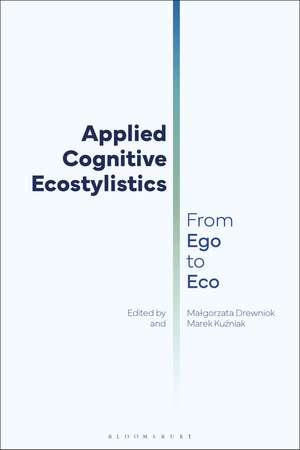
Applied Cognitive Ecostylistics: From Ego to Eco
Editat de Malgorzata Drewniok, Marek Kuzniaken Limba Engleză Hardback – 13 iun 2024
Cognitive ecostylistics invites a multidisciplinary approach to the study of the conceptual relations between oral or written texts and their impact on the environment. This volume is a collection of the latest research that seeks to apply the theory and methodology developed over the last 40 years to both literary and real-life texts, engaging with a wealth of examples from First World War poetry and Anne of Green Gables through to Condé Nast Traveller hotel descriptions. Exploring the cultural effects of the eco-turn, the collection engages the reader in the problem of the present-day Anthropocene, manifested as Ego-Eco tensions at the level of communicating self-needs and the needs of the Other. Divided into two parts, it considers first the human-angled semiotic interplay contained within the universe of people, before examining the problem of semiotic engagement of texts as extraneous to the human, highlighting crucial aspects of nature, culture, and beyond.
Preț: 614.65 lei
Preț vechi: 958.62 lei
-36%
Puncte Express: 922
Carte tipărită la comandă
Livrare economică 07-21 decembrie
Livrare prin curier în România Termenul estimat este afișat lângă disponibilitate.
Transport gratuit pentru acest produs Plată online sau ramburs, în funcție de opțiunile comenzii.
Retur gratuit în 14 zile Comandă securizată și suport în română.
Specificații
ISBN-13: 9781350362185
ISBN-10: 1350362182
Pagini: 256
Ilustrații: 10 bw illus
Dimensiuni: 162 x 238 x 22 mm
Greutate: 0.51 kg
Editura: Bloomsbury Publishing
Colecția Bloomsbury Academic
Locul publicării:London, United Kingdom
ISBN-10: 1350362182
Pagini: 256
Ilustrații: 10 bw illus
Dimensiuni: 162 x 238 x 22 mm
Greutate: 0.51 kg
Editura: Bloomsbury Publishing
Colecția Bloomsbury Academic
Locul publicării:London, United Kingdom
Cuprins
List of Figures
List of Tables
List of Contributors
Introduction: A New Ecology of Language, Peter Stockwell (University of Nottingham, UK)
Part I: From EGO: Self- Needs, Readership, Society
Overview
1. From Ego- to Eco-Centricity: Macro- and Micro-levels of Condé Nast Traveller Hotel Descriptions, A Cognitive-Linguistic Account, Malgorzata Drewniok (University of Lincoln, UK) and Marek Kuzniak (Wroclaw University, Poland)
2. A Diffractive Analysis of Readers' Responses to Julian Barnes's 'The Sense of an Ending', Amélie Doche (Birmingham City University, UK)
3. Cohesion and Solidarity in COVID-related Addresses to the Nation, Chris Fitzgerald (Mary Immaculate College, Ireland) and Helen Kelly-Holmes (Mary Immaculate College, Ireland)
4. Using Think-Aloud Data to Explore Pathetic Fallacy's Impact on Narrative Empathy, Kimberley Pager-McClymont (University of Aberdeen, UK) and Fransina Stradling (University of Huddersfield, UK)
5. Reader's Reactions to Descriptions of Landscape in Polish Translations of Anne of Green Gables, Beata Piecychna (University of Bialystok, Poland)
Part II: To ECO: Nature, Culture, and Beyond
Overview
6. Methodological Implications of Building the Corpus of News on Economic Inequality (1971-2020): Text Readable Data vs OCR Material, Eva Gómez Jiménez (University of Granada, Spain)
7. Modelling the Landscape of Wilfred Owen's 'Futility', Marcello Giovanelli (Aston University, UK)
8. Intralingual Eco-Translation Insights into 'Macbeth' in African American Urban Slang, Michal Garcarz (University of Wroclaw, Poland)
9. Fictional Ekphrasis Representing Childhood Trauma in M. Atwood's Cat's Eye, Polina Gavin (Aston University, UK)
10. Body, Mind, and Nature in Rossetti's 'For a Venetian Pastoral by Giorgione (In the Louvre)', Eirini Panagiotidou (West Chester University of Pennsylvania, USA)
Conclusion: Pathways to Eco, Malgorzata Drewniok, University of Lincoln, Marek Kuzniak (Wroclaw University, Poland)
Index
List of Tables
List of Contributors
Introduction: A New Ecology of Language, Peter Stockwell (University of Nottingham, UK)
Part I: From EGO: Self- Needs, Readership, Society
Overview
1. From Ego- to Eco-Centricity: Macro- and Micro-levels of Condé Nast Traveller Hotel Descriptions, A Cognitive-Linguistic Account, Malgorzata Drewniok (University of Lincoln, UK) and Marek Kuzniak (Wroclaw University, Poland)
2. A Diffractive Analysis of Readers' Responses to Julian Barnes's 'The Sense of an Ending', Amélie Doche (Birmingham City University, UK)
3. Cohesion and Solidarity in COVID-related Addresses to the Nation, Chris Fitzgerald (Mary Immaculate College, Ireland) and Helen Kelly-Holmes (Mary Immaculate College, Ireland)
4. Using Think-Aloud Data to Explore Pathetic Fallacy's Impact on Narrative Empathy, Kimberley Pager-McClymont (University of Aberdeen, UK) and Fransina Stradling (University of Huddersfield, UK)
5. Reader's Reactions to Descriptions of Landscape in Polish Translations of Anne of Green Gables, Beata Piecychna (University of Bialystok, Poland)
Part II: To ECO: Nature, Culture, and Beyond
Overview
6. Methodological Implications of Building the Corpus of News on Economic Inequality (1971-2020): Text Readable Data vs OCR Material, Eva Gómez Jiménez (University of Granada, Spain)
7. Modelling the Landscape of Wilfred Owen's 'Futility', Marcello Giovanelli (Aston University, UK)
8. Intralingual Eco-Translation Insights into 'Macbeth' in African American Urban Slang, Michal Garcarz (University of Wroclaw, Poland)
9. Fictional Ekphrasis Representing Childhood Trauma in M. Atwood's Cat's Eye, Polina Gavin (Aston University, UK)
10. Body, Mind, and Nature in Rossetti's 'For a Venetian Pastoral by Giorgione (In the Louvre)', Eirini Panagiotidou (West Chester University of Pennsylvania, USA)
Conclusion: Pathways to Eco, Malgorzata Drewniok, University of Lincoln, Marek Kuzniak (Wroclaw University, Poland)
Index
Recenzii
Applied Cognitive Ecostylistics is a welcome insight into the promise of a methodological shift from stylistics to ecostylistics, with applications to text analysis and understanding that center language as an embodied ecosystem nested in other ecosystems: social, cultural, and biological. Accessible yet written with academic rigor, the chapters will be of interest to scholars in the environmental humanities and anyone who recognizes language as the primary space in which an ecological civilization can be imagined, described, and dreamed into being - Marek Oziewicz, Professor of Literacy Education, University of Minnesota, USA.
This fascinating volume of essays demonstrates the rich field that is developing under the heading of ecostylistics and shows how the tension between EGO and ECO can be negotiated by a combination of textual analysis and contextual interpretation, making it truly stylistic and ecological in equal measure - Lesley Jeffries, Honorary Professor of Linguistics and English Language, University of Lancaster, UK.
This fascinating volume of essays demonstrates the rich field that is developing under the heading of ecostylistics and shows how the tension between EGO and ECO can be negotiated by a combination of textual analysis and contextual interpretation, making it truly stylistic and ecological in equal measure - Lesley Jeffries, Honorary Professor of Linguistics and English Language, University of Lancaster, UK.