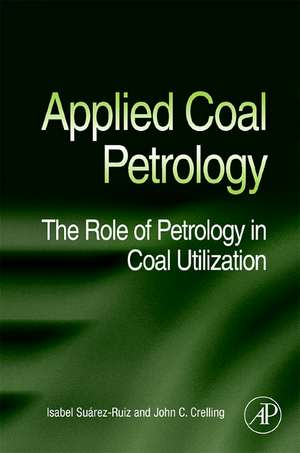
Applied Coal Petrology: The Role of Petrology in Coal Utilization
Editat de Isabel Suarez-Ruiz, John C. Crellingen Limba Engleză Hardback – 8 oct 2008
Coal petrology needs to be seen as a continuum of organic (macerals) and inorganic (minerals and trace elements) contributions to the total coal structure, with the overprint of coal rank. All this influences the behavior of coal in utilization, the coal by-products, the properties of coal as a reservoir for methane or a sequestration site for carbon dioxide, and the relationships of coal utilization with health and environmental issues.
The interaction of coal properties and coal utilization begins at the mine face. The breakage of the coal in mining influences its subsequent beneficiation. Beneficiation is fundamental to the proper combustion of coal and is vital to the preparation of the feedstock for the production of metallurgical coke. An understanding of basic coal properties is important for achieving reductions in trace element emissions and improving the efficiency of combustion and combined-cycle gasification. The production of methane from coal beds is related to the properties of the in situ coal. Similarly, coal bed sequestration of carbon dioxide produced from combustion is dependent on the reservoir properties. Environmental problems accompany coal on its way from the mine to the point of utilization and beyond. Health aspects related with coal mining and coal utilization are also included because, in planning for coal use, it is impossible to separate environmental and health issues from the discussion of coal utilization.
The book is aimed at a wide audience, ranging from researchers, lecturers and students to professionals in industry and discusses issues (such as the environmental, and health) that are of concern to the general public as a whole.
- This book focuses on the applications of coal (organic) petrology to our modern society
- It is an integrated approach to help the reader appreciate the importance of coal quality and coal utilization. Coal composition (macerals, mineral, trace elements) and the overprint of coal rank are treated together
- The book synthesises all the possibilities of the organic petrology as a tool for coal utilization in conventional applications (mining and beneficiation, coal combustion, gasification, liquefaction, carbonization), as a precursor of carbon materials and as a petroleum source and reservoir rock
- The role of applied petrology in the characterization of solid by-products from coal utilization is also discussed
- In addition, this book describes the present status of environmental and health problems linked to coal utilization and the ways in which such problems might be overcome in the future
Preț: 1304.89 lei
Preț vechi: 1517.31 lei
-14%
Puncte Express: 1957
Carte disponibilă
Livrare economică 05-19 octombrie
Livrare prin curier în România Termenul estimat este afișat lângă disponibilitate.
Transport gratuit pentru acest produs Plată online sau ramburs, în funcție de opțiunile comenzii.
Retur gratuit în 14 zile Comandă securizată și suport în română.
Specificații
ISBN-13: 9780080450513
ISBN-10: 0080450512
Pagini: 408
Ilustrații: Illustrated
Dimensiuni: 151 x 229 x 28 mm
Greutate: 0.79 kg
Editura: ELSEVIER SCIENCE
ISBN-10: 0080450512
Pagini: 408
Ilustrații: Illustrated
Dimensiuni: 151 x 229 x 28 mm
Greutate: 0.79 kg
Editura: ELSEVIER SCIENCE
V-ar putea interesa
-
 -26%Preț: 975.81 lei1320.00 lei
 -
 Introduction to Mineralogy and PetrologySwapan Kumar Haldar-20%Preț: 523.13 lei657.73 lei
 -
 Seismic Data Analysis Techniques in Hydrocarbon ExplorationEnwenode Onajite-9%Preț: 574.61 lei631.45 lei
 -
 Serpentinites: Recorders of Tectonic and Petrological HistoryDavid S. O'Hanley-33%Preț: 1316.96 lei1957.65 lei
 -
 -33%Preț: 981.62 lei1458.11 lei
 -
 The Hydrogeology of the Chalk of North-West EuropeR.A. DOWNING-30%Preț: 500.80 lei713.54 lei
 -
 Granite Landscapes of the WorldPiotr Migoń-33%Preț: 1997.32 lei2976.66 lei
 -
 Principles of Mathematical PetrophysicsJohn H. Doveton-31%Preț: 949.42 lei1379.42 lei
 -
 Earth's Pre-Pleistocene Glacial RecordHambrey M. J.-11%Preț: 561.49 lei630.89 lei
 -
 Ultrahigh Pressure MetamorphismRobert G. Coleman-11%Preț: 509.53 lei572.50 lei
 -
 Progress in Metamorphic and Magmatic PetrologyL. L. PerchukPreț: 475.50 lei
 -
 Sedimentation of Organic ParticlesAlfred Traverse-11%Preț: 571.10 lei641.68 lei
 -
 PetrologyHarvey Blatt-24%Preț: 620.63 lei811.33 lei
 -
 Petrogenesis and Experimental Petrology of Granitic RocksWilhelm Johannes-18%Preț: 858.10 lei1046.46 lei
Public țintă
This book is suitable for coal-fired utilities, power plants etc., steel companies/carbonization companies, Universities, Libraries, Public Organisms of Scientific and Applied Researchers and Industries using the coal and coal blends as precursor materials.Cuprins
1. Introduction
2. Basic factors controlling coal quality and technological behavior of coal
3. Mining and benefication
4. Coal combustion
5. Coal gasification
6. Coal liquefaction
7. Coal carbonization
8. Coal-derived carbons
9. Coal as a Petroleum Source Rock and Reservoir Rock
10. Environmental and health aspects
11. Other applications of coal petrology
2. Basic factors controlling coal quality and technological behavior of coal
3. Mining and benefication
4. Coal combustion
5. Coal gasification
6. Coal liquefaction
7. Coal carbonization
8. Coal-derived carbons
9. Coal as a Petroleum Source Rock and Reservoir Rock
10. Environmental and health aspects
11. Other applications of coal petrology