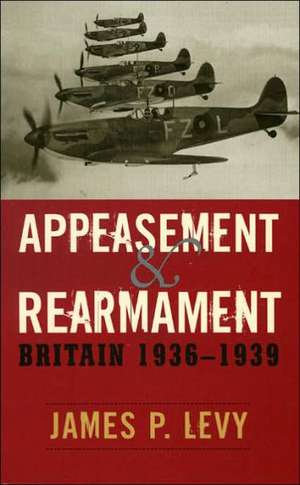
Appeasement and Rearmament: Britain, 1936–1939
Autor James P. Levyen Limba Engleză Paperback – 10 mar 2006
Preț: 219.16 lei
Preț vechi: 292.07 lei
-25%
Puncte Express: 329
Carte tipărită la comandă
Livrare economică 09-23 noiembrie
Livrare prin curier în România Termenul estimat este afișat lângă disponibilitate.
Transport gratuit de la 400.00 lei Plată online sau ramburs, în funcție de opțiunile comenzii.
Retur gratuit în 14 zile Comandă securizată și suport în română.
Specificații
ISBN-13: 9780742545380
ISBN-10: 0742545385
Pagini: 189
Ilustrații: Illustrations, ports.
Dimensiuni: 134 x 214 x 14 mm
Greutate: 0.26 kg
Editura: Bloomsbury Publishing
Colecția Rowman & Littlefield
Locul publicării:New York, United States
ISBN-10: 0742545385
Pagini: 189
Ilustrații: Illustrations, ports.
Dimensiuni: 134 x 214 x 14 mm
Greutate: 0.26 kg
Editura: Bloomsbury Publishing
Colecția Rowman & Littlefield
Locul publicării:New York, United States
V-ar putea interesa
-
 Britain and the Islamic World, 1558-1713Gerald MacLean-21%Preț: 521.81 lei661.75 lei
 -
 The Flyer: British Culture and the Royal Air Force 1939-1945Martin Francis-11%Preț: 346.48 lei389.81 lei
 -
 Seeking a Role: The United Kingdom 1951--1970Brian Harrison-21%Preț: 355.21 lei448.30 lei
 -
 -15%Preț: 616.15 lei724.89 lei
 -
 -27%Preț: 78.00 lei106.17 lei
 -
 Early Railways: 1569-1830Andy Guy-32%Preț: 41.29 lei60.48 lei
 -
 Boudica''s Last StandJohn WaitePreț: 85.99 lei
 -
 Sir Walter Raleigh: In Life and LegendDr Mark Nicholls-40%Preț: 302.32 lei506.43 lei
 -
 Love Letters of Henry VIII to Anne BoleynHenry ViiiPreț: 43.41 lei
 -
 A Brief History of IrelandRichard Killeen-27%Preț: 67.13 lei91.73 lei
 -
 Bletchley Park CodebreakersRalph ErskinePreț: 108.62 lei
Cuprins
1 Acknowledgment
2 Introduction
3 The Twenty-Year Truce
4 1936
5 Rearmament
6 1937-Chamberlain
7 1938-Munich
8 1939-To War
9 Epilogue: 1940
10 Conclusion
11 Bibliographical Essay
2 Introduction
3 The Twenty-Year Truce
4 1936
5 Rearmament
6 1937-Chamberlain
7 1938-Munich
8 1939-To War
9 Epilogue: 1940
10 Conclusion
11 Bibliographical Essay
Recenzii
It will be readily agreed that [Levy] has produced a lively argument that will stimulate discussion.
Forty years after his death, Winston Churchill's self-serving demonisation of the appeasers of the 1930s still holds the center-ground of popular historiography. It has much to answer for. Any political inadequate on the world stage can invite Churchillian comparison merely by curtailing diplomatic processes and urging pre-emptive aggression. In fact, diplomacy had impressive 'form' in British foreign policy-for example, towards France in the early 1900s, and towards the USA in the 1920s. And given Britain's strategic, political and economic situation, it made both pragmatic and ethical sense in the late '30s. James P. Levy's succinct and beautifully written synthesis of the case for the tandem policies of appeasement and rearmament places them in their proper context and relationship. It is a sorry indictment of the objectivity of the historical profession that such a book should still be so necessary.
Forty years after his death, Winston Churchill's self-serving demonisation of the appeasers of the 1930s still holds the center-ground of popular historiography. It has much to answer for. Any political inadequate on the world stage can invite Churchillian comparison merely by curtailing diplomatic processes and urging pre-emptive aggression. In fact, diplomacy had impressive 'form' in British foreign policy-for example, towards France in the early 1900s, and towards the USA in the 1920s. And given Britain's strategic, political and economic situation, it made both pragmatic and ethical sense in the late '30s. James P. Levy's succinct and beautifully written synthesis of the case for the tandem policies of appeasement and rearmament places them in their proper context and relationship. It is a sorry indictment of the objectivity of the historical profession that such a book should still be so necessary.