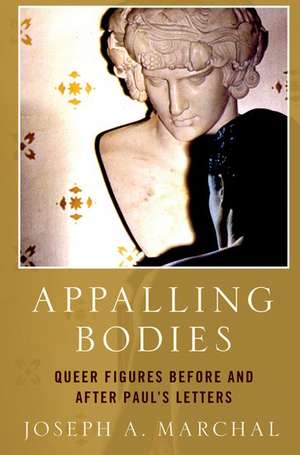
Appalling Bodies
Autor Joseph A Marchalen Limba Engleză Paperback – noi 2022
Preț: 251.47 lei
Preț vechi: 327.32 lei
-23%
Puncte Express: 377
Preț estimativ în valută:
44.48€ • 52.15$ • 38.70£
44.48€ • 52.15$ • 38.70£
Carte disponibilă
Livrare economică 13-18 februarie
Preluare comenzi: 021 569.72.76
Specificații
ISBN-13: 9780197668962
ISBN-10: 0197668968
Pagini: 328
Dimensiuni: 152 x 237 x 20 mm
Greutate: 0.49 kg
Editura: Oxford University Press
Locul publicării:New York, United States
ISBN-10: 0197668968
Pagini: 328
Dimensiuni: 152 x 237 x 20 mm
Greutate: 0.49 kg
Editura: Oxford University Press
Locul publicării:New York, United States
Recenzii
This book is rich in theory, in history, in how breaking rules (e.g., using anachronisms) and 'dwelling longer in zones of confusion' can be strategically effective in forming intersectional coalitions.
Marchal reaches across history—with an acknowledged debt to Carolyn Dinshaw's queer historiography (1999, 2012)—not to locate forebears from those distant years, but rather to illustrate the ways that gender and sexuality are constructed and contested in these texts, and to resist the ways they still influence the shape of gender and sexuality in our contemporary moment. In thinking about the androgyne, the eunuch, the slave, and the barbarian, Marchal performs a tour de force of theoretical and exegetical work.
Appalling Bodies is such a rich analysis of lives touched, traumatized, destroyed, and resurrected by sex. Paul's letters are the occasion. History and theory are the modes of inquiry. But joy, sorrow, love, and pain are the true subjects of this work, or that's how it seemed to me.
Simply stunning and exhilarating! Marchal travels back and forth in time to juxtapose fascinating (and often threatening) figures of the first and the twentyfirst century to show us a whole new way of reading Paul's letters without placing Paul at the center. This carefully researched, conspicuously erudite, and compellingly readable book will surprise, delight, and impress you.
Joseph Marchal has emerged as one of today's leading practitioners of queer biblical scholarship, and this volume amply demonstrates why. It will be required reading not only for scholars who are interested in the letters attributed to Paul and the assumptions made by those letters (and by their interpreters) about gender and sexuality, but also for anyone who seeks a model for queer engagement with ancient texts.
Appalling Bodies takes us beyond a kyriarchal focus on Paul to appreciation of the other figures that populate his letters for rhetorical effect- prophetic women, eunuchs, and slaves, whose gender and sexuality do not conform to imperial Roman elite male sexuality. Making partial and contingent touches across time to contemporary LGBTQI communities, Marchal troubles and complicates the sexual regimes Paul's letters are used to enforce. This brilliant book is sure to become a classic in studies of scripturalized sexual norms and queer engagements with the Bible.
This is an immensely exciting book, exceptionally original and stunningly creative, the first to limn out in full the contours of a queer historiography in biblical studies. It amounts to a dizzying defamiliarization of ground that has been endlessly trodden and retrodden by Pauline scholars. But it is not a specialist tome. It richly merits an audience beyond the boundaries of biblical studies, and even beyond religious studies.
Appalling Bodies is a deeply ethical book meant to improve human lives, especially those of the most marginalized among us. Theories can be opaque to general readers, but to show how these theories can make human lives more livable, Marchal explains them clearly. Marchal employs deliberate anachronism to shake up readers' belief that they know what Paul meant, thereby undercutting fundamentalisms. Fundamentalisms are resulting in deaths, whether through hate crimes or suicides, and Marchal understands the urgency of truly alternative biblical interpretation in which marginalized figures become central.
In Appalling Bodies: Queer Figures Before and After Paul's Letters-an excellent, detailed, and thorough study of queer figures in the Greco-Roman environment in which Paul writes his letters-Joseph Marchal engages in intentionally "anachronistic juxtaposition," a queering of time and history to highlight ancient attitudes towards androgynes, eunuchs, slaves, and foreigners. The book rewards the reader with a wealth of insight into both ancient and modern topics and will prove an essential text for any further scholarly engagement with corporeality in Paul.
Marchal reaches across history—with an acknowledged debt to Carolyn Dinshaw's queer historiography (1999, 2012)—not to locate forebears from those distant years, but rather to illustrate the ways that gender and sexuality are constructed and contested in these texts, and to resist the ways they still influence the shape of gender and sexuality in our contemporary moment. In thinking about the androgyne, the eunuch, the slave, and the barbarian, Marchal performs a tour de force of theoretical and exegetical work.
Appalling Bodies is such a rich analysis of lives touched, traumatized, destroyed, and resurrected by sex. Paul's letters are the occasion. History and theory are the modes of inquiry. But joy, sorrow, love, and pain are the true subjects of this work, or that's how it seemed to me.
Simply stunning and exhilarating! Marchal travels back and forth in time to juxtapose fascinating (and often threatening) figures of the first and the twentyfirst century to show us a whole new way of reading Paul's letters without placing Paul at the center. This carefully researched, conspicuously erudite, and compellingly readable book will surprise, delight, and impress you.
Joseph Marchal has emerged as one of today's leading practitioners of queer biblical scholarship, and this volume amply demonstrates why. It will be required reading not only for scholars who are interested in the letters attributed to Paul and the assumptions made by those letters (and by their interpreters) about gender and sexuality, but also for anyone who seeks a model for queer engagement with ancient texts.
Appalling Bodies takes us beyond a kyriarchal focus on Paul to appreciation of the other figures that populate his letters for rhetorical effect- prophetic women, eunuchs, and slaves, whose gender and sexuality do not conform to imperial Roman elite male sexuality. Making partial and contingent touches across time to contemporary LGBTQI communities, Marchal troubles and complicates the sexual regimes Paul's letters are used to enforce. This brilliant book is sure to become a classic in studies of scripturalized sexual norms and queer engagements with the Bible.
This is an immensely exciting book, exceptionally original and stunningly creative, the first to limn out in full the contours of a queer historiography in biblical studies. It amounts to a dizzying defamiliarization of ground that has been endlessly trodden and retrodden by Pauline scholars. But it is not a specialist tome. It richly merits an audience beyond the boundaries of biblical studies, and even beyond religious studies.
Appalling Bodies is a deeply ethical book meant to improve human lives, especially those of the most marginalized among us. Theories can be opaque to general readers, but to show how these theories can make human lives more livable, Marchal explains them clearly. Marchal employs deliberate anachronism to shake up readers' belief that they know what Paul meant, thereby undercutting fundamentalisms. Fundamentalisms are resulting in deaths, whether through hate crimes or suicides, and Marchal understands the urgency of truly alternative biblical interpretation in which marginalized figures become central.
In Appalling Bodies: Queer Figures Before and After Paul's Letters-an excellent, detailed, and thorough study of queer figures in the Greco-Roman environment in which Paul writes his letters-Joseph Marchal engages in intentionally "anachronistic juxtaposition," a queering of time and history to highlight ancient attitudes towards androgynes, eunuchs, slaves, and foreigners. The book rewards the reader with a wealth of insight into both ancient and modern topics and will prove an essential text for any further scholarly engagement with corporeality in Paul.
Notă biografică
Joseph A. Marchal is Professor of Religious Studies and affiliate faculty in Women's and Gender Studies at Ball State University. Marchal is the author and editor of ten books, most recently: After the Corinthian Women Prophets: Reimagining Rhetoric and Power (2021), Bodies on the Verge: Queering Pauline Epistles (2019), Sexual Disorientations: Queer Temporalities, Affects, Theologies (2018), and Philippians: Historical Problems, Hierarchical Visions, Hysterical Anxieties (2017).