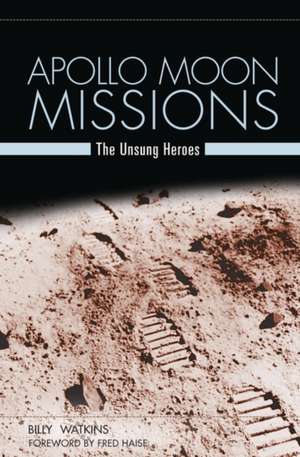
Apollo Moon Missions: The Unsung Heroes
Autor Billy W. Watkinsen Limba Engleză Hardback – 30 dec 2005
Relevanța acestei lucrări pentru studiile de istoria tehnologiei și managementului proiectelor complexe este incontestabilă, oferind o perspectivă rară asupra infrastructurii umane din spatele programului spațial american. În Apollo Moon Missions, găsim o cronică a ingeniozității colective care a răspuns provocării lansate de John F. Kennedy în 1961. Spre deosebire de narațiunile clasice axate pe figurile publice ale astronauților, apreciem aici efortul de a documenta contribuțiile celor peste 400.000 de oameni care au lucrat „în culise”.
Ne-a atras atenția modul în care Billy W. Watkins organizează materialul, trecând dincolo de cronologia simplă a lansărilor. Structura cărții, care include secțiuni precum „Thunder at the Cape” sau „Marriage, Missions, and Moon Cars”, ne ghidează prin experiențele unor figuri esențiale: de la Sonny Morea, designerul principal al roverului lunar, până la Joe Schmitt, tehnicianul responsabil pentru etanșeitatea costumelor spațiale. Această abordare oferă o profunzime sociologică și tehnică rar întâlnită în literatura de popularizare.
Ca alternativă la Chasing the Moon pentru cursurile de istorie contemporană sau științe generale, volumul de față vine cu avantajul unei focalizări stricte pe profilurile individuale ale experților tehnici, oferind detalii despre barierele rasiale și de gen depășite în epocă, exemplificate prin poveștile lui Hugh Brown și JoAnn Morgan. Ritmul este informativ, susținut de rigoarea jurnalistică a lui Watkins, transformând datele tehnice într-o narațiune umană despre sacrificiu și precizie.
Preț: 310.79 lei
Preț vechi: 391.23 lei
-21%
Carte tipărită la comandă
Livrare economică 01-15 decembrie
Specificații
ISBN-10: 0275987027
Pagini: 224
Dimensiuni: 156 x 235 x 23 mm
Greutate: 0.49 kg
Editura: Bloomsbury Publishing
Colecția Praeger
Locul publicării:New York, United States
V-ar putea interesa
-
 -30%Preț: 500.04 lei713.09 lei
 -
 -31%Preț: 451.38 lei654.29 lei
 -
 The Lessons and Non-Lessons of the Air and Missile Campaign in KosovoAnthony H. Cordesman-30%Preț: 503.92 lei715.36 lei
 -
 -32%Preț: 648.95 lei960.26 lei
 -
 India Changes Course: Golden Jubilee to MillenniumPaul R. Dettman-30%Preț: 473.79 lei675.16 lei
 -
 Ambiguous Memory: The Nazi Past and German National IdentitySiobhan Kattago-31%Preț: 450.35 lei653.67 lei
 -
 -30%Preț: 474.51 lei675.58 lei
 -
 -28%Preț: 498.75 lei688.83 lei
 -
 -44%Preț: 273.16 lei486.07 lei
 -
 The Break-up of Yugoslavia and International LawPeter Radan-18%Preț: 716.96 lei874.35 lei
 -
 MIG Alley to Mu Ghia Pass: Memoirs of a Korean War AceCecil G. FosterPreț: 150.23 lei
 -
 The Colombian Civil WarBert RuizPreț: 379.80 lei
 -
 Apollo Moon Missions: The Unsung HeroesBilly WatkinsPreț: 109.40 lei
 -
 Preț: 355.29 lei
 -
 Never Panic EarlyFred HaisePreț: 168.33 lei
 -
 Preț: 310.88 lei
 -
 Tage im TunnelNorbert OrtgiesPreț: 76.96 lei
De ce să citești această carte
Această carte este esențială pentru studenții la istorie și inginerie care doresc să înțeleagă logistica umană din spatele celui mai ambițios proiect al secolului XX. Cititorul câștigă o perspectivă detaliată asupra modului în care echipe diverse au colaborat sub presiune extremă. Este un omagiu adus celor care au asigurat succesul misiunilor Apollo fără a primi recunoașterea publică meritată.
Despre autor
Billy W. Watkins este un jurnalist american cu o carieră de peste trei decenii, premiat de peste 40 de ori la nivel regional și național pentru reportajele sale. Originar din Mississippi, stat unde au fost testate rachetele Saturn V la Stennis Space Center, Watkins și-a dedicat o mare parte din activitate recuperării poveștilor nespuse ale oamenilor obișnuiți care au realizat lucruri extraordinare. Experiența sa în jurnalism de investigație și sportiv îi conferă un stil narativ precis și alert, ideal pentru documentarea istoriei programului spațial.
Descriere
After Apollo moonwalker John Young told journalist Billy Watkins in a 1999 interview that nobody knows anything about the people who helped make those flights so successful, Watkins made it his mission to identify the unsung heroes and learn their stories.
His subjects include: Julian Scheer (NASA publicist); Sonny Morea, lead designer of the Lunar Rover; Hugh Brown, one of the few African Americans who worked on the Apollo program; JoAnn Morgan, one of the few women involved in the space program; Joan Roosa, widow of Apollo 14 astronaut Stuart Roosa; Joe Schmitt, veteran suit technician was responsible for making sure the suits were leak-proof and hooked up correctly; Joseph Laitin, who came up with the idea for the Apollo 8 astronauts to read the first ten verses of Genesis during their Christmas Eve television broadcast from the moon; and Clancy Hatelberg, the Navy diver, who plucked the first humans to walk on the moon from the Pacific Ocean after the Apollo 11 landing.
Cuprins
Preface
Acknowledgments
History of Apollo
".The Eagle has landed"
Steve Bales
Bruce McCandless
Richard Underwood
Clancy Hatleberg
"We're not the Soviets"
Julian Scheer
Joseph Laitin
Hugh Brown
"Thunder at the Cape"
JoAnn Morgan
Joe Schmitt
Jack King
"Marriage, Missions, and Moon Cars"
Joan Roosa
Rodney Rose
Gerry Griffin
Sonny Morea
U.S. Manned Missions Summary
Glossary
Recenzii
Journalist Watkins takes advantage of decades of close attention as he recounts the stories of some of the thousands of men and women who made getting to the moon their daily work and uncanny passion. He includes the story of a publicist who lobbied for a television camera on Apollo 11, without which we would not have seen Neil Armstrong take that step, specialists on signal-jamming USSR submarines and lightening, and the lucky folks who got to design the Moon Rover. It is clear Watkins would like to acknowledge the efforts of all (picking just 14 must have been agonizing) but those appearing here are truly representative of a breed of scientist and engineer, whose pie-in-the-sky thinking actually worked.