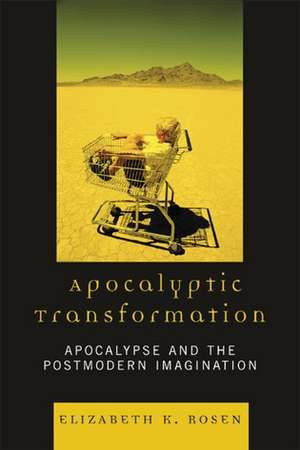
Apocalyptic Transformation: Apocalypse and the Postmodern Imagination
Autor Elizabeth K. Rosenen Limba Engleză Paperback – 15 feb 2008
Preț: 351.53 lei
Preț vechi: 483.26 lei
-27%
Puncte Express: 527
Carte tipărită la comandă
Livrare economică 28 noiembrie-12 decembrie
Livrare prin curier în România Termenul estimat este afișat lângă disponibilitate.
Transport gratuit de la 400.00 lei Plată online sau ramburs, în funcție de opțiunile comenzii.
Retur gratuit în 14 zile Comandă securizată și suport în română.
Specificații
ISBN-13: 9780739117910
ISBN-10: 0739117912
Pagini: 205
Dimensiuni: 148 x 226 x 16 mm
Greutate: 0.36 kg
Editura: Bloomsbury Publishing
Colecția Lexington Books
Locul publicării:New York, United States
ISBN-10: 0739117912
Pagini: 205
Dimensiuni: 148 x 226 x 16 mm
Greutate: 0.36 kg
Editura: Bloomsbury Publishing
Colecția Lexington Books
Locul publicării:New York, United States
V-ar putea interesa
-
 -18%Preț: 1123.53 lei1370.16 lei
 -
 Fifty Key Postmodern ThinkersStuart SimPreț: 346.31 lei
 -
 -18%Preț: 1390.25 lei1695.44 lei
 -
 Society and Literature 1945-1970 (Routledge Revivals)Alan Sinfield-18%Preț: 1311.17 lei1598.98 lei
 -
 A Poet′s Revolution – The Life of Denise LevertovDonna Krolik HollenbePreț: 317.78 lei
 -
 Magic and Witchcraft in the Dark AgesEugene D. Dukes-34%Preț: 411.78 lei625.85 lei
 -
 Preț: 228.59 lei
 -
 Anti-Foreign Imagery in American Pulps and Comic Books, 1920-1960Nathan Vernon MadisonPreț: 236.87 lei
 -
 Suffer the Little ChildrenJodi Eichler-Levine-23%Preț: 631.85 lei820.58 lei
 -
 Becoming Reinaldo ArenasJorge OlivaresPreț: 216.96 lei
 -
 Preț: 382.31 lei
 -
 The Textual Life of Airports: Reading the Culture of FlightDr. Christopher Schaberg-17%Preț: 178.27 lei214.35 lei
 -
 The Daughter's Way: Canadian Women's Paternal ElegiesTanis MacDonald-19%Preț: 553.07 lei682.79 lei
 -
 -26%Preț: 540.84 lei730.97 lei
 -
 Modern EkphrasisEmily Bilman-23%Preț: 435.40 lei565.46 lei
 -
 Mastering ChaosJeremy Morris-23%Preț: 445.27 lei578.27 lei
 -
 'La Revue'Charles ForsdickPreț: 430.06 lei
Cuprins
Chapter 1 Acknowledgements
Chapter 2 Introduction
Chapter 3 Chapter One: Sentient Vegetable Claims End is Near! The Graphic Novels of Alan Moore
Chapter 4 Chapter Two: Blue-footed Boobies and Other Witnesses to the End: Kurt Vonnegut's Change of Heart
Chapter 5 Chapter Three : A Tortured State of Mind: Terry Gilliam's New Jerusalem
Chapter 6 Chapter Four: Apocalypse Reloaded:The Matrix Trilogy
Chapter 7 Chapter Five: Willingly Believing Fiction: Robert Coover and Apocalypse as Metafiction
Chapter 8 Chapter Six: A Sense of the Ending: Don DeLillo's Apocalyptic Novels
Chapter 9 Epilogue
Chapter 10 Works Cited
Chapter 2 Introduction
Chapter 3 Chapter One: Sentient Vegetable Claims End is Near! The Graphic Novels of Alan Moore
Chapter 4 Chapter Two: Blue-footed Boobies and Other Witnesses to the End: Kurt Vonnegut's Change of Heart
Chapter 5 Chapter Three : A Tortured State of Mind: Terry Gilliam's New Jerusalem
Chapter 6 Chapter Four: Apocalypse Reloaded:The Matrix Trilogy
Chapter 7 Chapter Five: Willingly Believing Fiction: Robert Coover and Apocalypse as Metafiction
Chapter 8 Chapter Six: A Sense of the Ending: Don DeLillo's Apocalyptic Novels
Chapter 9 Epilogue
Chapter 10 Works Cited
Recenzii
Apocalyptic Transformations: Apocalypse and the Postmodern Imagination is a fine example of why literature and literary criticism matter in today's world. Elizabeth Rosen demonstrates the continuing relevance in postmodern fiction, film, and graphic texts of that grandest of all grand narratives, Apocalypse. In lucid and engaging prose, Rosen details how contemporary writers and filmmakers have modified the story of Apocalypse in the aftermath of the death of God. Examining the work of some of the most respected American authors of the second half of the twentieth century as well as popular forms such as the Matrix films and comic books, Rosen illuminates the persistence of Apocalypse in the contemporary imagination. In their efforts to rescript the end of the world and what might follow it, she convincingly argues, contemporary apocalyptists offer hope, a way of seeing beyond the end, and a way out of the world view in which devastation by nuclear war or some other disaster is unavoidable. Apocalyptic Transformations is important in showing that postmodern narratives offer an alternative path to that mapped by the fatalistic, self-fulfilling prophecy of traditional Apocalypse.
Elizabeth K. Rosen understands more of my work than I do.
Rosen offers an impressive review of previous criticism on selected works without resorting to specialized jargon, thus producing a book that is refreshingly readable. Her approach is unique . . . . Helpful endnotes accompany each chapter . . . . Recommended.
One of the most enjoyable books I have read in awhile. I appreciated the diversity of cultural sources that Rosen drew upon in consideration of apocalypse, including graphic novels, books, and film. A solid consideration of how differing visions of the New Jerusalem speak to the late modern imagination.
We cannot fully appreciate contemporary art without acknowledging its apocalyptic dimension. Elizabeth K. Rosen's interpretation of major works of postmodern literature and film is an important guide to the unchartered territory where fear and hope, eternity and immediacy, the finite and the infinite all come together in the unfulfillable desire to comprehend the end before it comes.
Elizabeth K. Rosen understands more of my work than I do.
Rosen offers an impressive review of previous criticism on selected works without resorting to specialized jargon, thus producing a book that is refreshingly readable. Her approach is unique . . . . Helpful endnotes accompany each chapter . . . . Recommended.
One of the most enjoyable books I have read in awhile. I appreciated the diversity of cultural sources that Rosen drew upon in consideration of apocalypse, including graphic novels, books, and film. A solid consideration of how differing visions of the New Jerusalem speak to the late modern imagination.
We cannot fully appreciate contemporary art without acknowledging its apocalyptic dimension. Elizabeth K. Rosen's interpretation of major works of postmodern literature and film is an important guide to the unchartered territory where fear and hope, eternity and immediacy, the finite and the infinite all come together in the unfulfillable desire to comprehend the end before it comes.