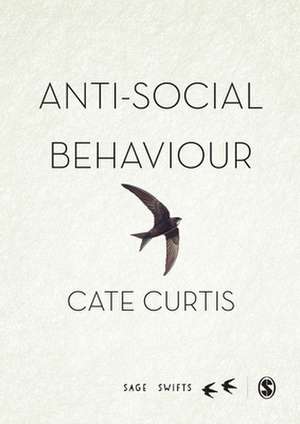
Anti-Social Behaviour: A multi-national perspective of the everyday to the extreme: SAGE Swifts
Autor Cate Curtisen Limba Engleză Electronic book text – 21 feb 2016
- Cathy Coleborne, University of Newcastle, Australia
“A timely work given the present global shift in the use of social media and violence. Cate Curtis’ book serves as a multinational mini-meta-analytic review of anti-social behaviours”
- Richard Langford, University of Hawaii West Oahu
“Cate Curtis’ coverage in this book is breath-taking. It is centred on challenging taken for granted assumptions concerning the three Rs: ‘risk’, ‘resilience’ and ‘recovery’ whilst questioning what is respectable everyday activities and extreme behaviour in culture and society.”
- Shane Blackman, Canterbury Christ Church University
Cate Curtis seeks to disrupt assumptions about anti-social behaviour by bringing together a host of key concepts and theories applicable to the field. Going beyond individualised discussions, the book explores broader concepts such as the social construction of ‘anti-social behaviour’, ‘risk’ and ‘resilience’, and the social contents and influences under which these are most likely to occur.
An excellent companion for researchers and postgraduate students in of anti-social behaviour across criminology, social psychology, sociology and social work.
Din seria SAGE Swifts
- 8%
 Preț: 449.65 lei
 - 15%
 Preț: 450.27 lei
 -
 Preț: 466.01 lei
 - 5%
 Preț: 506.70 lei
 - 15%
 Preț: 565.27 lei
 - 15%
 Preț: 442.69 lei
 - 15%
 Preț: 548.30 lei
 - 15%
 Preț: 546.77 lei
 - 8%
 Preț: 450.67 lei
 - 11%
 Preț: 399.19 lei
 - 11%
 Preț: 399.13 lei
 - 15%
 Preț: 440.38 lei
 - 8%
 Preț: 450.28 lei
 - 8%
 Preț: 434.35 lei
 - 11%
 Preț: 400.01 lei
 - 8%
 Preț: 496.70 lei
 - 5%
 Preț: 517.90 lei
 - 15%
 Preț: 439.08 lei
 - 18%
 Preț: 753.60 lei
 - 11%
 Preț: 399.19 lei
 - 15%
 Preț: 565.19 lei
 - 15%
 Preț: 423.78 lei
 -
 Preț: 114.20 lei
 -
 Preț: 129.59 lei
 -
 Preț: 121.88 lei
 -
 Preț: 121.88 lei
 -
 Preț: 121.88 lei
 -
 Preț: 129.59 lei
 -
 Preț: 129.59 lei
 -
 Preț: 121.88 lei
Preț: 121.88 lei
Puncte Express: 183
Indisponibil temporar
Doresc să fiu notificat când acest titlu va fi disponibil:
Se trimite...
Specificații
ISBN-13: 9781473933897
ISBN-10: 1473933897
Pagini: 120
Dimensiuni: 148 x 210 mm
Ediția:1
Editura: SAGE Publications
Colecția Sage Publications Ltd
Seria SAGE Swifts
Locul publicării:London, United Kingdom
ISBN-10: 1473933897
Pagini: 120
Dimensiuni: 148 x 210 mm
Ediția:1
Editura: SAGE Publications
Colecția Sage Publications Ltd
Seria SAGE Swifts
Locul publicării:London, United Kingdom
V-ar putea interesa
-
 The Collective Memory ReaderJeffrey K. Olick-20%Preț: 428.53 lei538.71 lei
 -
 -15%Preț: 326.78 lei384.53 lei
 -
 Preț: 132.06 lei
 -
 Society of the Dead – Quita Manaquita and Palo Praise in CubaTodd Ramón OchoaPreț: 229.33 lei
 -
 Social StructuresJohn Levi MartinPreț: 365.49 lei
 -
 The New Production of KnowledgeMichael Gibbons-8%Preț: 480.14 lei521.89 lei
 -
 The SAGE Dictionary of Sports StudiesDominic MalcolmPreț: 441.03 lei
 -
 Ethnicity and RaceStephen Cornell-18%Preț: 954.84 lei1164.45 lei
 -
 Ethnography in EducationDavid MillsPreț: 382.41 lei
 -
 Cultures and CrisesMary Douglas-15%Preț: 448.20 lei527.29 lei
 -
 Social Justice and Social Policy in ScotlandGerry MooneyPreț: 403.90 lei
 -
 Social ResearchBruce Curtis-18%Preț: 698.27 lei851.55 lei
Recenzii
In
seven
chapters,Antisocial
Behaviourneatly
and
succinctly
takes
readers
through
ways
to
understand
and
interpret
the
label
of
‘antisocial’
behaviour
in
a
wider
context,
showing
how
it
is
socially,
historically
and
culturally
produced
as
well
as
understood
in
professional
health
and
policing
or
correctional
contexts.
In
her
innovative
SWIFT
intervention,
Curtis
also
grapples
with
new
forms
of
antisocial
behaviour
as
imagined
in
online
spaces,
and
examines
the
new
ways
in
which
communities
and
governments
have
sought
to
police,
‘correct’,
or
limit
this
type
of
behaviour.
The
text
offers
a
crisp
insightful
synthesis
of
core
issues
in
social
psychology.
A timely work given the present global shift in the use of social media and violence. Cate Curtis’ book serves as a multinational mini-meta-analytic review of anti-social behaviours. Each chapter builds developmentally by topic to the concluding chapter that outlines various intervention alternatives.This is a book that will fit well in both undergraduate and graduate courses in psychology, family studies, education (social justice), social welfare, nursing, criminal justice, political science, behavioural economics, sociology, and anthropology.
Curtis takes the reader through the perceptions and concepts of what we have come to think of as anti-social behaviour, drawing on the work of Emile Durkheim, Sigmund Freud and Robert Merton amongst others. She examines the risk and protective factors related to aberrant behaviour, focusing primarily on the social roots but also considering biological factors. She also considers the role of new technologies and and social media concluding that the public and media perception of ASB often fail to match the evidence and the current levels of concern might be reasonably seen as a moral panic.
This book will be an extremely useful resource across many disciplines, not least criminal justice, social welfare, behavioural economics, psychology, sociology and anthropology as it provides a very good introduction to and explanation of what anti-social behaviour (ASB) is and, indeed, what it is not.
Cate Curtis’ coverage in this book on Anti-social behaviour is breath-taking. It is centred on challenging taken for granted assumptions concerning the three Rs: ‘risk’, ‘resilience’ and ‘recovery’ whilst questioning what is respectable everyday activities and extreme behaviour in culture and society. Her investigation into social behaviour is fast paced and detailed assessing diverse and oppositional arguments as she moves towards a complex assessment of multiple factors, which shape the meaning of anti-social behaviour. Written in an accessible style with scholarly depth, the book will be touchstone for students and researchers in sociology, criminology, media and cultural studies, politics and social policy.
Cate Curtis examines anti-social behaviour, starting with the 1998 UK legislation (and the conduct it was designed to suppress), but she expands the scope of ‘‘anti-social behaviour’’ to include other western jurisdictions and other, more serious, forms of offending. She adopts an international, comparative approach and combines seminal and contemporary scholarship from the traditions of social psychology, social work, sociology, and criminology. Remarkably, she does all of this in a mere 87 pages of text organised into seven succinct chapters. In the sixth century BCE, Aesop observed that ‘good things come in small packages’. He might be right.
A timely work given the present global shift in the use of social media and violence. Cate Curtis’ book serves as a multinational mini-meta-analytic review of anti-social behaviours. Each chapter builds developmentally by topic to the concluding chapter that outlines various intervention alternatives.This is a book that will fit well in both undergraduate and graduate courses in psychology, family studies, education (social justice), social welfare, nursing, criminal justice, political science, behavioural economics, sociology, and anthropology.
Curtis takes the reader through the perceptions and concepts of what we have come to think of as anti-social behaviour, drawing on the work of Emile Durkheim, Sigmund Freud and Robert Merton amongst others. She examines the risk and protective factors related to aberrant behaviour, focusing primarily on the social roots but also considering biological factors. She also considers the role of new technologies and and social media concluding that the public and media perception of ASB often fail to match the evidence and the current levels of concern might be reasonably seen as a moral panic.
This book will be an extremely useful resource across many disciplines, not least criminal justice, social welfare, behavioural economics, psychology, sociology and anthropology as it provides a very good introduction to and explanation of what anti-social behaviour (ASB) is and, indeed, what it is not.
Cate Curtis’ coverage in this book on Anti-social behaviour is breath-taking. It is centred on challenging taken for granted assumptions concerning the three Rs: ‘risk’, ‘resilience’ and ‘recovery’ whilst questioning what is respectable everyday activities and extreme behaviour in culture and society. Her investigation into social behaviour is fast paced and detailed assessing diverse and oppositional arguments as she moves towards a complex assessment of multiple factors, which shape the meaning of anti-social behaviour. Written in an accessible style with scholarly depth, the book will be touchstone for students and researchers in sociology, criminology, media and cultural studies, politics and social policy.
Cate Curtis examines anti-social behaviour, starting with the 1998 UK legislation (and the conduct it was designed to suppress), but she expands the scope of ‘‘anti-social behaviour’’ to include other western jurisdictions and other, more serious, forms of offending. She adopts an international, comparative approach and combines seminal and contemporary scholarship from the traditions of social psychology, social work, sociology, and criminology. Remarkably, she does all of this in a mere 87 pages of text organised into seven succinct chapters. In the sixth century BCE, Aesop observed that ‘good things come in small packages’. He might be right.
Cuprins
Introduction
Perceptions and Concepts: Constructing Anti-Social Behaviour
The Politics of Anti-Social Behaviour: Policies and Values
Ordinary Anti-Social Behaviour: Everyday Hassles
Anti-Social Behaviour as a Social Activity: Group Processes
New Technology, New Media: Transmitting New Behaviour?
Prevention, Intervention and Punishment: Risk, Resilience and Recovery
Perceptions and Concepts: Constructing Anti-Social Behaviour
The Politics of Anti-Social Behaviour: Policies and Values
Ordinary Anti-Social Behaviour: Everyday Hassles
Anti-Social Behaviour as a Social Activity: Group Processes
New Technology, New Media: Transmitting New Behaviour?
Prevention, Intervention and Punishment: Risk, Resilience and Recovery