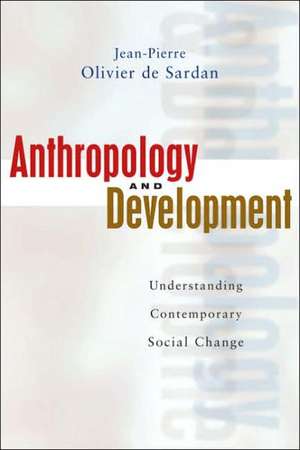
Anthropology and Development: Understanding Contemporary Social Change
Autor Jean-Pierre Oliver De-Sardanen Limba Engleză Paperback – 20 ian 2005
The Introduction provides a thought-provoking examination of the principal new approaches that have emerged in the discipline during the 1990s. Part I then makes clear the complexity of social change and development, and the ways in which socio-anthropology can measure up to the challenge of this complexity. Part II looks more closely at some of the leading variables involved in the development process, including relations of production; the logics of social action; the nature of knowledge; forms of mediation; and 'political' strategies.
| Toate formatele și edițiile | Preț | Express |
|---|---|---|
| Paperback (1) | 204.72 lei 6-8 săpt. | |
| Bloomsbury Publishing – 20 ian 2005 | 204.72 lei 6-8 săpt. | |
| Hardback (1) | 526.05 lei 6-8 săpt. | |
| Bloomsbury Publishing – 20 ian 2005 | 526.05 lei 6-8 săpt. |
Preț: 204.72 lei
Preț vechi: 249.20 lei
-18%
Puncte Express: 307
Preț estimativ în valută:
36.19€ • 43.15$ • 31.39£
36.19€ • 43.15$ • 31.39£
Carte tipărită la comandă
Livrare economică 16-30 martie
Specificații
ISBN-13: 9781842774175
ISBN-10: 1842774174
Pagini: 256
Dimensiuni: 138 x 216 x 15 mm
Greutate: 0.4 kg
Editura: Bloomsbury Publishing
Colecția Zed Books
Locul publicării:London, United Kingdom
ISBN-10: 1842774174
Pagini: 256
Dimensiuni: 138 x 216 x 15 mm
Greutate: 0.4 kg
Editura: Bloomsbury Publishing
Colecția Zed Books
Locul publicării:London, United Kingdom
V-ar putea interesa
-
 The Anthropology of LawFernanda Pirie-23%Preț: 329.14 lei425.39 lei
 -
 Preț: 170.44 lei
 -
 Preț: 442.32 lei
 -
 The Prehistory of HomeJerry MoorePreț: 236.89 lei
 -
 Preț: 460.25 lei
 -
 The Human Age: The World Shaped by UsDiane Ackerman-27%Preț: 54.98 lei75.71 lei
 -
 Preț: 166.69 lei
 -
 SaharasiaJames DemeoPreț: 266.47 lei
 -
 -18%Preț: 123.21 lei149.73 lei
 -
 -12%Preț: 321.28 lei365.50 lei
Cuprins
Introduction: The three approaches in the anthropology of development
1. The discourse of development
2. Socio-anthropology of Development: some preliminary statements
3. Anthropology, Sociology, Africa and Development: a brief historical overview
4. A renewal of anthropology ?
5. Stereotypes, ideologies and conceptions
6. Is an anthropology of innovation possible ?
7. Developmentist populism and social science populism: ideology, action, knowledge
8. Relations of production and modes of economic action
9. Development projects and social logic
10. Popular knowledge and scientific and technical knowledge
11. Mediations and brokerage
12. Arenas and strategic games
Conclusion : The dialogue between social scientists and developers
Bibliography
Index
1. The discourse of development
2. Socio-anthropology of Development: some preliminary statements
3. Anthropology, Sociology, Africa and Development: a brief historical overview
4. A renewal of anthropology ?
5. Stereotypes, ideologies and conceptions
6. Is an anthropology of innovation possible ?
7. Developmentist populism and social science populism: ideology, action, knowledge
8. Relations of production and modes of economic action
9. Development projects and social logic
10. Popular knowledge and scientific and technical knowledge
11. Mediations and brokerage
12. Arenas and strategic games
Conclusion : The dialogue between social scientists and developers
Bibliography
Index
Recenzii
Condenses several decades of research into an accessible and well-referenced textbook that provides provoking insights into the anthropology of development.
This is a lucid, thoroughly researched and brilliantly argued book.
A subtle, wide-ranging argument for a productive tension between the development industry and its critics on behalf of its ultimate subjects.
Olivier de Sardan throws a long-needed intellectual bridge over the big canyon separating European and American development anthropologies.
Olivier de Sardan tackles two sets of vested interests head-on but, more than that, he offers a resolution both might find appealing and neither can afford to ignore.
This is a lucid, thoroughly researched and brilliantly argued book.
A subtle, wide-ranging argument for a productive tension between the development industry and its critics on behalf of its ultimate subjects.
Olivier de Sardan throws a long-needed intellectual bridge over the big canyon separating European and American development anthropologies.
Olivier de Sardan tackles two sets of vested interests head-on but, more than that, he offers a resolution both might find appealing and neither can afford to ignore.