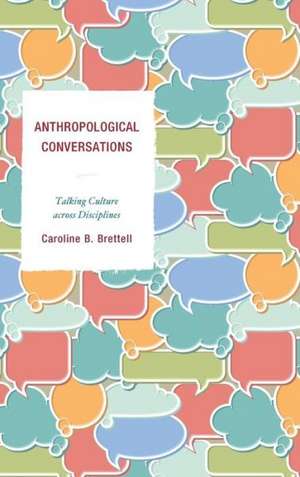
Anthropological Conversations: Talking Culture across Disciplines
Autor Caroline B. Brettellen Limba Engleză Hardback – 23 oct 2014
Preț: 353.89 lei
Preț vechi: 507.69 lei
-30%
Puncte Express: 531
Carte tipărită la comandă
Livrare economică 28 noiembrie-12 decembrie
Livrare prin curier în România Termenul estimat este afișat lângă disponibilitate.
Transport gratuit de la 400.00 lei Plată online sau ramburs, în funcție de opțiunile comenzii.
Retur gratuit în 14 zile Comandă securizată și suport în română.
Specificații
ISBN-13: 9780759123823
ISBN-10: 0759123829
Pagini: 232
Ilustrații: black & white illustrations
Dimensiuni: 150 x 230 x 20 mm
Greutate: 0.45 kg
Editura: Bloomsbury Publishing
Colecția Rowman & Littlefield
Locul publicării:New York, United States
ISBN-10: 0759123829
Pagini: 232
Ilustrații: black & white illustrations
Dimensiuni: 150 x 230 x 20 mm
Greutate: 0.45 kg
Editura: Bloomsbury Publishing
Colecția Rowman & Littlefield
Locul publicării:New York, United States
V-ar putea interesa
-
 The Standard Code of Parliamentary ProcedureAlice SturgisPreț: 126.03 lei
 -
 -49%Preț: 58.01 lei112.80 lei
 -
 -18%Preț: 2799.16 lei3413.62 lei
 -
 Study Indust Fluctuations LseDennis Holme Robertson-18%Preț: 1118.04 lei1363.46 lei
 -
 Gender in Cross-Cultural PerspectiveCaroline B. Brettell-9%Preț: 1317.90 lei1448.25 lei
 -
 -9%Preț: 1131.10 lei1242.97 lei
 -
 Workflow Handbook 1997Peter Lawrence-18%Preț: 1027.95 lei1253.60 lei
 -
 Anthropology and Migration: Essays on Transnationalism, Ethnicity, and IdentityCaroline B. Brettell-20%Preț: 312.43 lei390.12 lei
 -
 When They Read What We Write: The Politics of EthnographyCaroline B. Brettell-26%Preț: 243.82 lei330.38 lei
 -
 -15%Preț: 455.27 lei535.61 lei
 -
 Preț: 118.08 lei
 -
 Model Engineer's HandbookTubal CainPreț: 98.65 lei
Descriere
Cultural anthropologists can be an intellectually adventurous crowd: open-even eager-to building bridges across disciplines in the name of understanding human behavior and the human experience more broadly. In this first-of-its-kind book, Caroline Brettell explores the cross-disciplinary conversations that have engaged cultural anthropologists both past and present.
Brettell highlights a handful of conversations between the discipline of anthropology on the one hand and history, geography, literature, biology, psychology and demography on the other. She also pinpoints how these exchanges address three enduring issues of anthropological concern: the temporal and the spatial dimensions of human experience; the scientific and the humanistic dimensions of the anthropological enterprise; and the individual and the group/population as units of analysis in research. Anthropological Conversations offers detailed accounts of particular ethnographic methodologies and findings (and the theoretical trends informing them) as a means of grasping the big-picture issues. Brettell clearly shows that, by engaging with other fields, cultural anthropologists have been able to think more deeply about what they mean by culture; through this book, she invites readers to continue the conversation.
Brettell highlights a handful of conversations between the discipline of anthropology on the one hand and history, geography, literature, biology, psychology and demography on the other. She also pinpoints how these exchanges address three enduring issues of anthropological concern: the temporal and the spatial dimensions of human experience; the scientific and the humanistic dimensions of the anthropological enterprise; and the individual and the group/population as units of analysis in research. Anthropological Conversations offers detailed accounts of particular ethnographic methodologies and findings (and the theoretical trends informing them) as a means of grasping the big-picture issues. Brettell clearly shows that, by engaging with other fields, cultural anthropologists have been able to think more deeply about what they mean by culture; through this book, she invites readers to continue the conversation.
Cuprins
Introduction: Anthropological Conversations across Disciplines
1-The Presence of the Past in Culture: Anthropology and History
Fieldwork in the Archives: Tackling the Methodology of History
The Presence of the Past: Anthropological History
The Presence of the Past: The Anthropology of History
Conclusion: The Presence of the Past: An Engaged Historical Anthropology
2-Space, Place, and Culture: Anthropology and Geography
Anthropology and Geography: Early Conversations
The Anthropology of Space and Place
Gendered Space and Feminist Geography
The New Anthropology of Landscape and the Environment
Conclusion: From the Etics of Region to the Emics of Space and Place
3-Writing Culture: Anthropology and Literature
Ethnography as Genre: Experimenting with Forms of Writing
The Literary Observer: Novelists with an Anthropological Eye
Conclusion: The Craft of Writing Anthropology
4-The Science in Culture: Anthropology and Biology
Biology and Culture in the Twentieth Century: From Boas to Sociobiology to Bioculturalism
New Directions in the Integration of Biology and Culture
Conclusion
5-The Individual and Culture: Anthropology and Psychology
Anthropology, Psychoanalysis, and Neo-Freudianism: Seeds of Interaction, Seeds of Cross-Disciplinarity
Stress, Trauma, and Meaning-Centered Psychology Anthropology
Conclusion: A Cross-Cultural Psychology
6-Culture and Population: Anthropology and Demography
Bridging the Divide: Methods, Concepts, and Epistemology
The Problems Explored by Anthropological Demographers
Conclusion: Toward Convergence and Cross-Disciplinarity?
Notes
References
Index
About the Author
1-The Presence of the Past in Culture: Anthropology and History
Fieldwork in the Archives: Tackling the Methodology of History
The Presence of the Past: Anthropological History
The Presence of the Past: The Anthropology of History
Conclusion: The Presence of the Past: An Engaged Historical Anthropology
2-Space, Place, and Culture: Anthropology and Geography
Anthropology and Geography: Early Conversations
The Anthropology of Space and Place
Gendered Space and Feminist Geography
The New Anthropology of Landscape and the Environment
Conclusion: From the Etics of Region to the Emics of Space and Place
3-Writing Culture: Anthropology and Literature
Ethnography as Genre: Experimenting with Forms of Writing
The Literary Observer: Novelists with an Anthropological Eye
Conclusion: The Craft of Writing Anthropology
4-The Science in Culture: Anthropology and Biology
Biology and Culture in the Twentieth Century: From Boas to Sociobiology to Bioculturalism
New Directions in the Integration of Biology and Culture
Conclusion
5-The Individual and Culture: Anthropology and Psychology
Anthropology, Psychoanalysis, and Neo-Freudianism: Seeds of Interaction, Seeds of Cross-Disciplinarity
Stress, Trauma, and Meaning-Centered Psychology Anthropology
Conclusion: A Cross-Cultural Psychology
6-Culture and Population: Anthropology and Demography
Bridging the Divide: Methods, Concepts, and Epistemology
The Problems Explored by Anthropological Demographers
Conclusion: Toward Convergence and Cross-Disciplinarity?
Notes
References
Index
About the Author
Recenzii
Brettell has made an extremely valuable contribution to the literatures on thinking anthropologically and across disciplines. Six chapters devoted to 'conversations' between anthropology and history, geography, literature, biology, psychology, and demographics give readers a survey of the various topics and approaches that have crossed those lines and key scholars involved in such projects. The writing is clear and accessible, suitable for all audiences, and the content includes both historical and contemporary examples. . . .The book will be useful for anthropological readers in a variety of contexts (e.g., methods, disciplinary history, general philosophy of the field) and also very useful for non-anthropologists to get a sense of and appreciation for ways that anthropological approaches and works might be relevant to their own fields and for encouraging further conversations across disciplinary lines. Summing Up: Highly recommended. For all general and academic audiences.
Ambitious and incredibly broad. I know of no other book which addresses so many of anthropology's cross-disciplinary engagements while tackling many of the "big questions" that have concerned anthropologists over the last century. Brettell's approach is immensely valuable and distinctive for its coverage of the ways that anthropology has engaged with numerous disciplines and the ways that these engagements have evolved and taken shape in both historical and current contexts. She does an exceptional job of bringing in recent and cutting-edge research (as well as classical studies) that tells the reader what is happening in anthropology today.
A thoughtful, insightful, wonderful review of the interdisciplinary possibilities anthropologists share with neighboring disciplines. We should all take its core message to heart: In addressing broad intellectual questions, anthropologists work best when they work with others. Full of provocative ideas to ponder late into the night.
No discipline is an island, and Caroline Brettell's superb overview of anthropology's past and present shows how much of its vitality has always depended on exploring its borderlands. For all who want breadth and depth in their understanding of the debates which have moved anthropology forward, it is a smart strategy to devote some time to looking sideways. I know of no better guide to the territory than this book.
Accessible, compelling, and enjoyable. Anthropological Conversations interrogates the interdisciplinary boundaries of contemporary anthropology through insightful essays on writing, space and place, history, landscape and the environment. Brettell challenges readers to explore the intersections of disciplines and the way that intellectual encounters have enriched the field. The book also highlights the importance of considering influence in multidirectional ways.
Ambitious and incredibly broad. I know of no other book which addresses so many of anthropology's cross-disciplinary engagements while tackling many of the "big questions" that have concerned anthropologists over the last century. Brettell's approach is immensely valuable and distinctive for its coverage of the ways that anthropology has engaged with numerous disciplines and the ways that these engagements have evolved and taken shape in both historical and current contexts. She does an exceptional job of bringing in recent and cutting-edge research (as well as classical studies) that tells the reader what is happening in anthropology today.
A thoughtful, insightful, wonderful review of the interdisciplinary possibilities anthropologists share with neighboring disciplines. We should all take its core message to heart: In addressing broad intellectual questions, anthropologists work best when they work with others. Full of provocative ideas to ponder late into the night.
No discipline is an island, and Caroline Brettell's superb overview of anthropology's past and present shows how much of its vitality has always depended on exploring its borderlands. For all who want breadth and depth in their understanding of the debates which have moved anthropology forward, it is a smart strategy to devote some time to looking sideways. I know of no better guide to the territory than this book.
Accessible, compelling, and enjoyable. Anthropological Conversations interrogates the interdisciplinary boundaries of contemporary anthropology through insightful essays on writing, space and place, history, landscape and the environment. Brettell challenges readers to explore the intersections of disciplines and the way that intellectual encounters have enriched the field. The book also highlights the importance of considering influence in multidirectional ways.