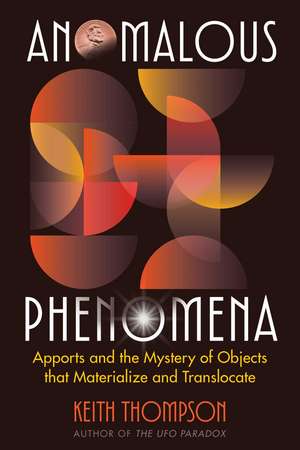
Anomalous Phenomena: Apports and the Mystery of Objects That Materialize and Translocate
Autor Keith Thompsonen Limba Engleză Paperback – 5 noi 2026
• Defines apports—objects that appear, vanish, or relocate under mysterious conditions—and documents the Scole Experiment’s remarkable physical materializations
• Examines ancestral dreams revealing hidden truths, ghosts seeking resolution, conscious UFOs, spontaneous healings, and phantom companions guiding explorers in danger
• Shows how these events point toward untapped human potentials and a larger model of reality where intention and meaning exert real effects
Apports—objects that materialize, dematerialize, or translocate without known physical cause—are among the most startling anomalous phenomena on record. Yet they are only one part of a much wider story.
Drawing on archival reports, eyewitness testimony, and on-the-ground investigation, Anomalous Phenomena presents a panoramic chronicle of extraordinary events: mysteriously transported objects, telepathic communications, apparitions of the departed, remarkable healings, and UFOs that behave less like machines than intelligent presences.
Across cultures and centuries, the same motifs recur—phantom figures guiding the lost, ancestors arriving in dreams, unearthly lights that seem to rearrange reality’s fabric. Far from fringe curiosities, such episodes demand recognition as part of the human record. Threaded throughout this book are Thompson’s own glimpses of the uncanny.
Inviting readers to reconsider the mind–matter divide, Thompson’s Anomalous Phenomena opens onto a larger, empirically open model of reality—one that brings science, spirit, and lived experience onto shared ground—where the extraordinary often lives just a breath from the ordinary.
Preț: 111.22 lei
Nou
Puncte Express: 167
Carte disponibilă
Livrare economică 06-20 noiembrie
Livrare prin curier în România Termenul estimat este afișat lângă disponibilitate.
Transport gratuit de la 400.00 lei Plată online sau ramburs, în funcție de opțiunile comenzii.
Retur gratuit în 14 zile Comandă securizată și suport în română.
Specificații
ISBN-13: 9781591435594
ISBN-10: 1591435595
Pagini: 208
Ilustrații: Includes 16-page color insert
Dimensiuni: 152 x 229 x 15 mm
Greutate: 0.27 kg
Editura: Inner Traditions/Bear & Company
Colecția Bear & Company
ISBN-10: 1591435595
Pagini: 208
Ilustrații: Includes 16-page color insert
Dimensiuni: 152 x 229 x 15 mm
Greutate: 0.27 kg
Editura: Inner Traditions/Bear & Company
Colecția Bear & Company
Notă biografică
Keith Thompson is an author and independent journalist who writes about politics, belief, and the persistent fact of mystery. He is a talk radio host, former TV talk show host, and former U.S. Senate staff member. His articles have appeared in the New York Times, Esquire, and San Francisco Chronicle. The author of The UFO Paradox and Angels and Aliens, he lives in northwest Florida.
Extras
1
The Apports of Scole
Glimpsing a Physics of Intentionality
It’s hard to communicate how magically thrilling it
is to feel a levitated table swim, to hear a bell ring and
a drum banged with no human agent involved. . . .
[T]hese physical phenomena really do occur. They have
been reliably demonstrated time and time again, by
qualified, skeptical observers in situations where hoaxing
or faulty observations can be ruled out. Objects are moved
and sounds made by some force we don’t understand—a
force that sometimes seems to act with intelligence.
Leslie Kean, Surviving Death
Imagine an early autumn afternoon, a fading September day in a small village on the Norfolk-Suffolk border in England’s flat country. Rain-soaked ground sinks underfoot, heavy as unclaimed grief. The landscape is quiet, almost shrugging—nothing to see here, yet it pulls your eye back. Hedgerows, wild and thick, cling to the road, blackberries dark and sweet, dropping unpicked. A soft wind keens across the fields, carrying the faint salt of distant seas. A sign, half-covered in ivy, tilts left: Scole, 2 mi. Beyond it, the sky hangs gray, washed out like a shirt left too long on a wind-whipped clothesline.
Picture a farmhouse on a gravel lane, waiting since the Magna Carta. Its roof, once red, has faded to rusty brown. The air carries a damp Norfolk chill; it smacks of wet wool and secrets. Smoke curls from the chimney, smelling of coal and old wood. The windows catch the light, reflecting it dimly, like tired eyes. The front door, paint chipped, creaks open on stiff hinges. Inside, floorboards shift underfoot, and a pot of tea sits cold on the counter. Downstairs, the cellar’s stone walls hold a cool, earthy dampness, tinged with a faint metallic bite, like old batteries. A plain table stands in the center, built to prevent tricks, holding a quartz rock the size of a fist, cloudy as trapped smoke, and a small recorder ready to capture every sound.
The people who gathered in the cellar of that old house came with questions about what happens when the pulse stops and the last breath slips out—where it all goes, if it goes anywhere. Starting in 1993, they launched what became the Scole Experiment, a five-year effort documented in Grant and Jane Solomon’s book, The Scole Experiment: Scientific Evidence for Life After Death. The title was bold, like a challenge to the world. In a quiet English village, these ordinary folks turned their basement into a testing ground for the afterlife, drawing in believers, puzzling honest skeptics, and frustrating debunkers. Their work left behind a mix of evidence, doubt, and quiet wonder.
They wanted the facts of it, something they could know firsthand. The question nags at everyone—does the light just go out, or does it shift elsewhere? Nobody says it out loud, not at the grocery store or the gas pump, afraid the neighbors might overhear and start whispering about what’s going on in that farmhouse down the lane.
In the dim cellar they called the “Scole Hole,” a group of regular people—no scientists among them, just curious souls hungry for answers—sat ready. The air hung heavy with anticipation, like before a storm breaks. This was no casual gathering or parlor game; it was a careful push to connect with whatever lay beyond, using simple tools: a few devices bought at the store or rigged up at home.
It started with four people: Robin and Sandra Foy, and Alan and Diana Bennett. Robin handled logistics, mapping out each session with care. Sandra, sharp-eyed, tracked every detail. Alan and Diana, seasoned mediums, brought voices from somewhere else—whispers or bold words that came when the room went dark. They weren’t after fame or money, just answers to questions nobody asks twice: what happens when life stops, and what, if anything, remains.
The cellar was plain: a varnished particle-board table at the center, a quartz crystal catching the faint light. Tired of vague seances, they wanted proof—something spirits could say or leave behind, recorded for study. So they locked the door, set up two small cassette recorders, and followed the spirit team’s rules: no light, natural or artificial, not even infrared, which they said would disrupt the work. Luminous wristbands glowed on their hands, and adhesive tabs marked every movable object, ensuring nothing slipped past notice.
Others joined later. A voice called Manu, deep and calm, spoke through the mediums, claiming to lead a crew from the other side. Emily Bradshaw, a Victorian lady long gone, chimed in with sharp humor. Patrick and Joseph added their own tones, like a band you couldn’t see. Jennifer Jones, an American visitor, watched closely and wrote it all down. Skeptics from the UK’s Society for Psychical Research (SPR) arrived, notebooks ready, checking locks and asking questions. When the lights went out, the dark settled fast. A chair creaked. Then it started.
Apports and Other Impossibles
On April 4, 1994, a penny dated 1891 hit the table with a clink, cold and copper. A silver Churchill crown followed, heavy, landing hard. Then a newspaper dropped—Daily Express, April 1, 1944, with headlines of Allied troops in Italy. It looked fresh, untouched by time. Robin Foy turned it over, noting its clean edges. The Solomons wrote: “The Daily Express bore the texture and weight of wartime newsprint, yet showed no signs of the brittleness or discoloration”1 The SPR, skeptical but thorough, sent a sample to the Paper Industry Research Association. Their verdict: genuine wartime newsprint.
Things kept coming. A brooch, a dog tag, a quartz piece landed on the table, solid, from nowhere. The group called them “apports,” gifts from spirits, never stolen. Lights flickered across the cellar, tiny orbs darting from floor to ceiling. Voices spoke—Manu’s deep rumble, Emily Bradshaw’s sharp wit—through Alan or Diana, their eyes closed. The SPR watched closely, notebooks open, ruling out tricks. On October 6, 1996, Manu asked for a camera. Loaded with fresh film from sealed boxes, it rose off the table, snapping eleven times in twenty seconds, then settled back. The images showed glowing streaks, like the lights they’d seen.2
By January 17, 1997, the spirit team pushed further. They asked for unopened film, no camera. The group placed it on the table, waited in the dark. When developed, the film held images: artwork, faces of the dead, a handwritten poem signed by Wordsworth, a new take on his “Ruth.” One image showed a man in a bubble, staring out. The SPR checked the seals, found no tampering. Robin, Sandra, Alan, and Diana stared at the prints, stunned. With no budget or expertise, they couldn’t imagine faking such things. The sheer strangeness—the coins, the paper, the film—made them believe something real was breaking through.
Human Presences and Lasting Proofs
By late 1994, the Scole group sensed the apports—coins, brooches, newspapers—were only the start. Something more was coming. In the dark of the cellar, hands and arms took shape, warm and solid, reaching out with permission to touch Robin, Sandra, or a guest. Once, Robin felt the embrace of his late parents and sister, their voices soft but clear, speaking as if they’d never left. He sat still, barely breathing, as the moment held him.
The phenomena grew bolder. A penny, dated 1891, struck the table with a clink. A Churchill crown followed, heavy and silver, glinting under a flashlight. Robin lifted it, marveling at its clean edges. “It’s a Churchill crown . . . and it’s in mint condition!”3A rusted dog tag rattled down, its chain coiled. The air would hum or chill before each drop, as if signaling thought turned solid. The SPR checked the locks, found no tricks. In subsequent sessions across Europe and the United States, the same effects appeared—lights flickering, voices speaking, hands reaching. In Los Angeles, participants later spoke of those nights as life-changing, their awe undimmed years on.
In 1998, after five years and hundreds of sessions, the spirit team said the energy had shifted. The cellar went quiet. The Solomons’ book cataloged the coins, lights, and embraces, calling them proof. Critics scoffed, pointing to loose controls. But those who sat in the dark—Robin watching the table, Sandra noting each sound, Alan and Diana breathing slow as voices came—knew what they’d felt. The quartz on the table caught the faint light. Outside, rain tapped the roof, steady, like it knew.
The Apports of Scole
Glimpsing a Physics of Intentionality
It’s hard to communicate how magically thrilling it
is to feel a levitated table swim, to hear a bell ring and
a drum banged with no human agent involved. . . .
[T]hese physical phenomena really do occur. They have
been reliably demonstrated time and time again, by
qualified, skeptical observers in situations where hoaxing
or faulty observations can be ruled out. Objects are moved
and sounds made by some force we don’t understand—a
force that sometimes seems to act with intelligence.
Leslie Kean, Surviving Death
Imagine an early autumn afternoon, a fading September day in a small village on the Norfolk-Suffolk border in England’s flat country. Rain-soaked ground sinks underfoot, heavy as unclaimed grief. The landscape is quiet, almost shrugging—nothing to see here, yet it pulls your eye back. Hedgerows, wild and thick, cling to the road, blackberries dark and sweet, dropping unpicked. A soft wind keens across the fields, carrying the faint salt of distant seas. A sign, half-covered in ivy, tilts left: Scole, 2 mi. Beyond it, the sky hangs gray, washed out like a shirt left too long on a wind-whipped clothesline.
Picture a farmhouse on a gravel lane, waiting since the Magna Carta. Its roof, once red, has faded to rusty brown. The air carries a damp Norfolk chill; it smacks of wet wool and secrets. Smoke curls from the chimney, smelling of coal and old wood. The windows catch the light, reflecting it dimly, like tired eyes. The front door, paint chipped, creaks open on stiff hinges. Inside, floorboards shift underfoot, and a pot of tea sits cold on the counter. Downstairs, the cellar’s stone walls hold a cool, earthy dampness, tinged with a faint metallic bite, like old batteries. A plain table stands in the center, built to prevent tricks, holding a quartz rock the size of a fist, cloudy as trapped smoke, and a small recorder ready to capture every sound.
The people who gathered in the cellar of that old house came with questions about what happens when the pulse stops and the last breath slips out—where it all goes, if it goes anywhere. Starting in 1993, they launched what became the Scole Experiment, a five-year effort documented in Grant and Jane Solomon’s book, The Scole Experiment: Scientific Evidence for Life After Death. The title was bold, like a challenge to the world. In a quiet English village, these ordinary folks turned their basement into a testing ground for the afterlife, drawing in believers, puzzling honest skeptics, and frustrating debunkers. Their work left behind a mix of evidence, doubt, and quiet wonder.
They wanted the facts of it, something they could know firsthand. The question nags at everyone—does the light just go out, or does it shift elsewhere? Nobody says it out loud, not at the grocery store or the gas pump, afraid the neighbors might overhear and start whispering about what’s going on in that farmhouse down the lane.
In the dim cellar they called the “Scole Hole,” a group of regular people—no scientists among them, just curious souls hungry for answers—sat ready. The air hung heavy with anticipation, like before a storm breaks. This was no casual gathering or parlor game; it was a careful push to connect with whatever lay beyond, using simple tools: a few devices bought at the store or rigged up at home.
It started with four people: Robin and Sandra Foy, and Alan and Diana Bennett. Robin handled logistics, mapping out each session with care. Sandra, sharp-eyed, tracked every detail. Alan and Diana, seasoned mediums, brought voices from somewhere else—whispers or bold words that came when the room went dark. They weren’t after fame or money, just answers to questions nobody asks twice: what happens when life stops, and what, if anything, remains.
The cellar was plain: a varnished particle-board table at the center, a quartz crystal catching the faint light. Tired of vague seances, they wanted proof—something spirits could say or leave behind, recorded for study. So they locked the door, set up two small cassette recorders, and followed the spirit team’s rules: no light, natural or artificial, not even infrared, which they said would disrupt the work. Luminous wristbands glowed on their hands, and adhesive tabs marked every movable object, ensuring nothing slipped past notice.
Others joined later. A voice called Manu, deep and calm, spoke through the mediums, claiming to lead a crew from the other side. Emily Bradshaw, a Victorian lady long gone, chimed in with sharp humor. Patrick and Joseph added their own tones, like a band you couldn’t see. Jennifer Jones, an American visitor, watched closely and wrote it all down. Skeptics from the UK’s Society for Psychical Research (SPR) arrived, notebooks ready, checking locks and asking questions. When the lights went out, the dark settled fast. A chair creaked. Then it started.
Apports and Other Impossibles
On April 4, 1994, a penny dated 1891 hit the table with a clink, cold and copper. A silver Churchill crown followed, heavy, landing hard. Then a newspaper dropped—Daily Express, April 1, 1944, with headlines of Allied troops in Italy. It looked fresh, untouched by time. Robin Foy turned it over, noting its clean edges. The Solomons wrote: “The Daily Express bore the texture and weight of wartime newsprint, yet showed no signs of the brittleness or discoloration”1 The SPR, skeptical but thorough, sent a sample to the Paper Industry Research Association. Their verdict: genuine wartime newsprint.
Things kept coming. A brooch, a dog tag, a quartz piece landed on the table, solid, from nowhere. The group called them “apports,” gifts from spirits, never stolen. Lights flickered across the cellar, tiny orbs darting from floor to ceiling. Voices spoke—Manu’s deep rumble, Emily Bradshaw’s sharp wit—through Alan or Diana, their eyes closed. The SPR watched closely, notebooks open, ruling out tricks. On October 6, 1996, Manu asked for a camera. Loaded with fresh film from sealed boxes, it rose off the table, snapping eleven times in twenty seconds, then settled back. The images showed glowing streaks, like the lights they’d seen.2
By January 17, 1997, the spirit team pushed further. They asked for unopened film, no camera. The group placed it on the table, waited in the dark. When developed, the film held images: artwork, faces of the dead, a handwritten poem signed by Wordsworth, a new take on his “Ruth.” One image showed a man in a bubble, staring out. The SPR checked the seals, found no tampering. Robin, Sandra, Alan, and Diana stared at the prints, stunned. With no budget or expertise, they couldn’t imagine faking such things. The sheer strangeness—the coins, the paper, the film—made them believe something real was breaking through.
Human Presences and Lasting Proofs
By late 1994, the Scole group sensed the apports—coins, brooches, newspapers—were only the start. Something more was coming. In the dark of the cellar, hands and arms took shape, warm and solid, reaching out with permission to touch Robin, Sandra, or a guest. Once, Robin felt the embrace of his late parents and sister, their voices soft but clear, speaking as if they’d never left. He sat still, barely breathing, as the moment held him.
The phenomena grew bolder. A penny, dated 1891, struck the table with a clink. A Churchill crown followed, heavy and silver, glinting under a flashlight. Robin lifted it, marveling at its clean edges. “It’s a Churchill crown . . . and it’s in mint condition!”3A rusted dog tag rattled down, its chain coiled. The air would hum or chill before each drop, as if signaling thought turned solid. The SPR checked the locks, found no tricks. In subsequent sessions across Europe and the United States, the same effects appeared—lights flickering, voices speaking, hands reaching. In Los Angeles, participants later spoke of those nights as life-changing, their awe undimmed years on.
In 1998, after five years and hundreds of sessions, the spirit team said the energy had shifted. The cellar went quiet. The Solomons’ book cataloged the coins, lights, and embraces, calling them proof. Critics scoffed, pointing to loose controls. But those who sat in the dark—Robin watching the table, Sandra noting each sound, Alan and Diana breathing slow as voices came—knew what they’d felt. The quartz on the table caught the faint light. Outside, rain tapped the roof, steady, like it knew.
Cuprins
Acknowledgments
PROLOGUE What More Are We?
1 The Apports of Scole
Glimpsing a Physics of Intentionality
2 “Buy the Little Red House”
A Gone Ancestor Calls Out from Beyond
3 Guardians at the Threshold
Rangers of the Impossible on the
Navajo Nation
4 The Persistence of Presence
Memory, Motive, and the Lingering Self
5 The Knowing Body
How Belief, Symbol, and Identity Shape Flesh
6 The Veil and the Echo
Encounters with Phantom Figures and
Extraphysical Presence
7 DMT’s Gated Cosmos
Shamanic Wisdom Meets Scientific Rigor
8 Revisioning UFOs
A Sliding Scale of Sentience Threading
the Physical and the Fleeting
EPILOGUE Coming Ashore to a Larger Earth
The Canvas Still Wet with Paint
Notes
Bibliography
Index
PROLOGUE What More Are We?
1 The Apports of Scole
Glimpsing a Physics of Intentionality
2 “Buy the Little Red House”
A Gone Ancestor Calls Out from Beyond
3 Guardians at the Threshold
Rangers of the Impossible on the
Navajo Nation
4 The Persistence of Presence
Memory, Motive, and the Lingering Self
5 The Knowing Body
How Belief, Symbol, and Identity Shape Flesh
6 The Veil and the Echo
Encounters with Phantom Figures and
Extraphysical Presence
7 DMT’s Gated Cosmos
Shamanic Wisdom Meets Scientific Rigor
8 Revisioning UFOs
A Sliding Scale of Sentience Threading
the Physical and the Fleeting
EPILOGUE Coming Ashore to a Larger Earth
The Canvas Still Wet with Paint
Notes
Bibliography
Index
Recenzii
“Keith Thompson is a born storyteller with an investigator’s restraint. Anomalous Phenomena opens into a wide-ranging, humane inquiry at the edge of reality—where consciousness, experience, and the physical world may be converging. Thompson’s meticulously documented work shows how to expand our curiosity without abandoning our standards.”
“Keith Thompson turns a journalist’s eye on phenomena that refuse to yield to easy explanation. The testimony he has gathered is compelling, the questions raised are genuine, and the cost of dismissing them may be higher than we know. Anomalous Phenomena is a necessary book for anyone who suspects that our understanding of reality may be far narrower than what is actually there.”
“Keith Thompson starts with one of the most disreputable anomalies of all—objects that appear and move without known cause. At times they begin to feel almost like the ‘scapegoat’ of the anomalous—easily sidelined, but somehow carrying the deeper logic of the impossible. The most ungainly phenomena become the most revealing. Mind and matter no longer look so different. Thompson is our guide. He does not land; he provokes, like the apports out of nowhere. That is his glory.”
“Anomalous Phenomena is a must-read for anyone exploring the borderlands of official science—or who has encountered ‘things that shouldn’t happen, but which happen anyway.’ The book is impeccably researched and beautifully written in a style at once poetic and precise. It weaves a rich fabric of firsthand accounts, diligent sleuthing, philosophical sophistication, keen reasoning, and hard evidence for realities typically omitted from our modern Western worldview. Thompson has issued a fierce and wise call for an honest reckoning with our assumptions about reality.”
“Thompson does not stand at a safe distance; he enters accounts of the extraordinary with curiosity, care, and a genuine willingness to consider that reality may be far less boxed-in than our habitual categories suggest. The book treats apports, apparitions, UFOs, and related anomalies not as curiosities to be filed away, but as openings into larger questions about consciousness, matter, and the nature of being itself.”
“Where most might stumble in asserting contradictory truths, Thompson excels. Anomalous Phenomena gathers voices from every walk of life whose testimony reveals a reality so vast, contradiction vanishes.”
“Stretching the mind beyond conventional limits, Thompson offers compelling evidence for extraordinary anomalous phenomena. With intellectual rigor and poetic sensitivity, he explores a universe in which consciousness and matter may be far more deeply intertwined than our prevailing models allow. Particularly fascinating is his analysis of DMT entity encounters, situated within a broader inquiry into invisible interconnections, intentionality, and the deeper architecture of reality. This book is a journey into mysteries so enthralling it is difficult to put down.”
“Anomalous Phenomena unfolds with the precision and intrigue of a masterfully crafted narrative. Thompson weaves disparate anomalies into a cohesive field of meaning—drawing the reader into a parallel journey of discovery alongside those whose experiences challenge the boundaries of reality.”
“Keith Thompson brings readers into a series of deeply human encounters that unfold with the tension and forward pull of a compelling novel. The result is both intellectually engaging and emotionally resonant—a work of uncommon beauty and wonder.”
“Keith Thompson turns a journalist’s eye on phenomena that refuse to yield to easy explanation. The testimony he has gathered is compelling, the questions raised are genuine, and the cost of dismissing them may be higher than we know. Anomalous Phenomena is a necessary book for anyone who suspects that our understanding of reality may be far narrower than what is actually there.”
“Keith Thompson starts with one of the most disreputable anomalies of all—objects that appear and move without known cause. At times they begin to feel almost like the ‘scapegoat’ of the anomalous—easily sidelined, but somehow carrying the deeper logic of the impossible. The most ungainly phenomena become the most revealing. Mind and matter no longer look so different. Thompson is our guide. He does not land; he provokes, like the apports out of nowhere. That is his glory.”
“Anomalous Phenomena is a must-read for anyone exploring the borderlands of official science—or who has encountered ‘things that shouldn’t happen, but which happen anyway.’ The book is impeccably researched and beautifully written in a style at once poetic and precise. It weaves a rich fabric of firsthand accounts, diligent sleuthing, philosophical sophistication, keen reasoning, and hard evidence for realities typically omitted from our modern Western worldview. Thompson has issued a fierce and wise call for an honest reckoning with our assumptions about reality.”
“Thompson does not stand at a safe distance; he enters accounts of the extraordinary with curiosity, care, and a genuine willingness to consider that reality may be far less boxed-in than our habitual categories suggest. The book treats apports, apparitions, UFOs, and related anomalies not as curiosities to be filed away, but as openings into larger questions about consciousness, matter, and the nature of being itself.”
“Where most might stumble in asserting contradictory truths, Thompson excels. Anomalous Phenomena gathers voices from every walk of life whose testimony reveals a reality so vast, contradiction vanishes.”
“Stretching the mind beyond conventional limits, Thompson offers compelling evidence for extraordinary anomalous phenomena. With intellectual rigor and poetic sensitivity, he explores a universe in which consciousness and matter may be far more deeply intertwined than our prevailing models allow. Particularly fascinating is his analysis of DMT entity encounters, situated within a broader inquiry into invisible interconnections, intentionality, and the deeper architecture of reality. This book is a journey into mysteries so enthralling it is difficult to put down.”
“Anomalous Phenomena unfolds with the precision and intrigue of a masterfully crafted narrative. Thompson weaves disparate anomalies into a cohesive field of meaning—drawing the reader into a parallel journey of discovery alongside those whose experiences challenge the boundaries of reality.”
“Keith Thompson brings readers into a series of deeply human encounters that unfold with the tension and forward pull of a compelling novel. The result is both intellectually engaging and emotionally resonant—a work of uncommon beauty and wonder.”
Descriere
Exploring the frontier where mind and matter converge