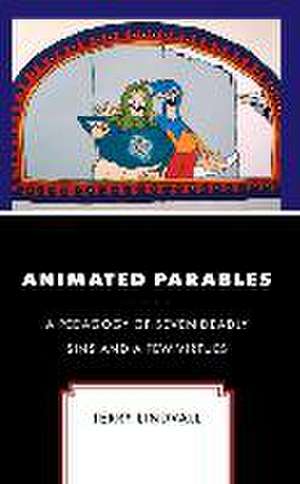
Animated Parables: A Pedagogy of Seven Deadly Sins and a Few Virtues: Theology, Religion, and Pop Culture
Autor Terry Lindvallen Limba Engleză Hardback – 28 dec 2022
Din seria Theology, Religion, and Pop Culture
- 32%
 Preț: 564.98 lei
 - nou
 Preț: 563.78 lei
 - 33%
 Preț: 525.20 lei
 - 26%
 Preț: 259.91 lei
 - 32%
 Preț: 552.55 lei
 - 35%
 Preț: 597.27 lei
 - 33%
 Preț: 583.59 lei
 - 33%
 Preț: 551.58 lei
 - 33%
 Preț: 518.19 lei
 - 32%
 Preț: 563.59 lei
 - 32%
 Preț: 584.00 lei
 - 28%
 Preț: 222.16 lei
 - 32%
 Preț: 530.67 lei
 - 34%
 Preț: 630.96 lei
 - 33%
 Preț: 570.17 lei
 - 34%
 Preț: 599.31 lei
 - 32%
 Preț: 570.53 lei
 - 37%
 Preț: 501.91 lei
 - 33%
 Preț: 551.31 lei
 - 33%
 Preț: 615.24 lei
 - 28%
 Preț: 221.53 lei
 - 34%
 Preț: 492.43 lei
 - 27%
 Preț: 254.91 lei
 - 36%
 Preț: 578.33 lei
 - 32%
 Preț: 565.74 lei
 - 33%
 Preț: 582.53 lei
 - 33%
 Preț: 467.62 lei
 - 28%
 Preț: 220.25 lei
 - 32%
 Preț: 491.49 lei
 - 32%
 Preț: 491.24 lei
 - 32%
 Preț: 565.15 lei
 - 33%
 Preț: 517.53 lei
 - 32%
 Preț: 570.68 lei
 - 27%
 Preț: 258.15 lei
 - 32%
 Preț: 570.58 lei
 - 33%
 Preț: 592.54 lei
 - 32%
 Preț: 610.84 lei
 - 35%
 Preț: 597.01 lei
 - 30%
 Preț: 535.90 lei
 - 32%
 Preț: 552.10 lei
 - 32%
 Preț: 563.96 lei
 - 36%
 Preț: 524.11 lei
 - 36%
 Preț: 525.17 lei
Preț: 578.15 lei
Preț vechi: 864.72 lei
-33%
Puncte Express: 867
Carte tipărită la comandă
Livrare economică 02-16 decembrie
Livrare prin curier în România Termenul estimat este afișat lângă disponibilitate.
Transport gratuit pentru acest produs Plată online sau ramburs, în funcție de opțiunile comenzii.
Retur gratuit în 14 zile Comandă securizată și suport în română.
Specificații
ISBN-13: 9781978715035
ISBN-10: 197871503X
Pagini: 284
Dimensiuni: 160 x 232 x 24 mm
Greutate: 0.59 kg
Editura: Bloomsbury Publishing
Colecția Fortress Academic
Seria Theology, Religion, and Pop Culture
Locul publicării:New York, United States
ISBN-10: 197871503X
Pagini: 284
Dimensiuni: 160 x 232 x 24 mm
Greutate: 0.59 kg
Editura: Bloomsbury Publishing
Colecția Fortress Academic
Seria Theology, Religion, and Pop Culture
Locul publicării:New York, United States
Cuprins
Introduction: A Brief Pedagogy of Parables
Part I: Aesthetic Roots
Chapter One: Parables and Fables
Chapter Two: Emergence of the Visual Parable
Part II: Dead Branches
Chapter Three: Sin, Judgment, and Blindness
Chapter Four: Pride (Superbia of the Peacock)
Chapter Five: Envy (Invidia or the Wolf)
Chapter Six: Wrath (Ira or the Lion)
Chapter Seven: Sloth (Acedia or the Ass)
Chapter Eight: Avarice (Avaricia or the Camel)
Chapter Nine: Gluttony (Gula or the Swine)
Chapter Ten: Lust (Luxuria or the Goat)
Part III: Spiritual Fruit
Chapter Eleven: Virtues and Redemption
Part I: Aesthetic Roots
Chapter One: Parables and Fables
Chapter Two: Emergence of the Visual Parable
Part II: Dead Branches
Chapter Three: Sin, Judgment, and Blindness
Chapter Four: Pride (Superbia of the Peacock)
Chapter Five: Envy (Invidia or the Wolf)
Chapter Six: Wrath (Ira or the Lion)
Chapter Seven: Sloth (Acedia or the Ass)
Chapter Eight: Avarice (Avaricia or the Camel)
Chapter Nine: Gluttony (Gula or the Swine)
Chapter Ten: Lust (Luxuria or the Goat)
Part III: Spiritual Fruit
Chapter Eleven: Virtues and Redemption
Recenzii
Lindvall took a topic usually of little interest to most popular culture researchers-i.e., religion/theology-"relevantized" it with much supporting theory drawn from many fields, polished it with interesting anecdotal snippets and entertaining synopses of animation shorts, and wove all of this into a book offering diverse cultural, historical, and international contexts. Lindvall's aim was to show how the seven deadly sins-pride, envy, anger, sloth, avarice, gluttony, and lust-have been interpreted by theologians, literary authors, philosophers, artists, animators, painters, filmmakers, religious figures (e.g., the apostles, Buddha, Christ, etc.). Each deadly sin is given a chapter, impeccably researched and amusingly presented, with bits of theory, poetry, song lyrics, illustrations, story plots, informational notes, and plentiful references. Cleverly organized, rich in information, and written with an infectious sense of humor, Animated Parables is a wonderful resource. Never were the seven deadly sins presented with such precision, wit, and verve. Bravo, Lindvall! Essential. Upper-division undergraduates through faculty.
What do Kierkegaard, The Three Little Pigs, Betty Boop, The Big Snit and Dante, all have in common? More than you might think, suggests Terry Lindvall in his book, Animated Parables. Lindvall, a leading historian of culture/film and religion, has crafted a compelling and witty argument focusing on the parabolic value of short, animated films and cartoons. These small visual stories teach their viewers- disorienting preconceptions, arousing curiosity, and provoking fresh meanings and actions. I laughed and learned as story after story about vice and virtue were recounted.
Terry Lindvall's research is impeccable--and a delight to read. Who wouldn't want to spend an afternoon chuckling about animation and the Seven Deadly Sins? Not just a book for specialists, its examples are placed in a broad cultural and historical context. The links that Dr. Lindvall forges provide valuable connections for the field of animation studies as a whole. Put this one on your reading list!
[I] ultimately found the book to be stimulating and delightful. Animated Parables introduced me to a number of excellent animated films I had never heard of (let alone seen), many of which I will be now including in the classroom when teaching Christian theology. Moreover, Lindvall's breadth of knowledge cannot be overstated-his humble self-deprecating humor on display throughout the book does not diminish what is obviously a rich understanding and appreciation of global animated cinema. I enjoyed the book thoroughly.
What do Kierkegaard, The Three Little Pigs, Betty Boop, The Big Snit and Dante, all have in common? More than you might think, suggests Terry Lindvall in his book, Animated Parables. Lindvall, a leading historian of culture/film and religion, has crafted a compelling and witty argument focusing on the parabolic value of short, animated films and cartoons. These small visual stories teach their viewers- disorienting preconceptions, arousing curiosity, and provoking fresh meanings and actions. I laughed and learned as story after story about vice and virtue were recounted.
Terry Lindvall's research is impeccable--and a delight to read. Who wouldn't want to spend an afternoon chuckling about animation and the Seven Deadly Sins? Not just a book for specialists, its examples are placed in a broad cultural and historical context. The links that Dr. Lindvall forges provide valuable connections for the field of animation studies as a whole. Put this one on your reading list!
[I] ultimately found the book to be stimulating and delightful. Animated Parables introduced me to a number of excellent animated films I had never heard of (let alone seen), many of which I will be now including in the classroom when teaching Christian theology. Moreover, Lindvall's breadth of knowledge cannot be overstated-his humble self-deprecating humor on display throughout the book does not diminish what is obviously a rich understanding and appreciation of global animated cinema. I enjoyed the book thoroughly.